SchemeInfo • Independent Pakistan programme guide • Reviewed 12 November 2026
A loan in Pakistan can mean bank finance, microcredit, a subsidised business facility or a housing product. Start with your borrowing purpose and repayment capacity, then compare the correct legal provider, full price and documentation rather than the biggest advertised ceiling.
Explore this guide — table of contents
- Key facts at a glance
- Eligibility requirements
- Required documents
- How the financing works
- Understanding provider types and repayment choices
- Costs, documents and decisions
- Choosing the borrowing route
- Application and risk checks
- Reader decision worksheet
- Worked borrowing example
- Worked examples
- How to proceed
- Related guides
- Frequently asked questions
- Official sources and disclaimer
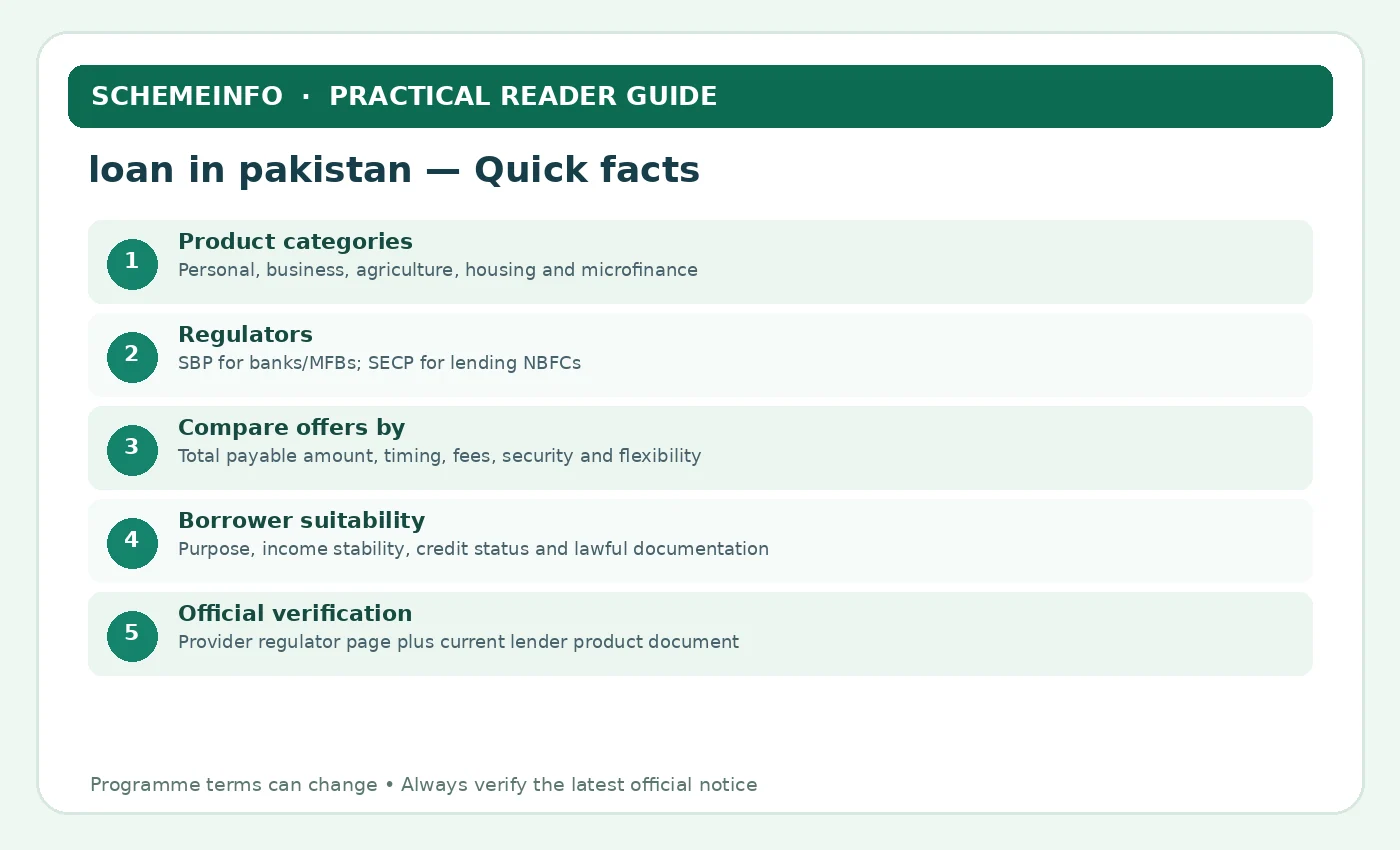
loan in pakistan: key facts at a glance
These are the central published facts for this programme, not a guarantee of admission, approval or an open registration window. The references at the bottom distinguish current official pages from historical phases.
| Product categories | Personal, business, agriculture, housing and microfinance |
|---|---|
| Regulators | SBP for banks/MFBs; SECP for lending NBFCs |
| Compare offers by | Total payable amount, timing, fees, security and flexibility |
| Borrower suitability | Purpose, income stability, credit status and lawful documentation |
| Official verification | Provider regulator page plus current lender product document |
loan in pakistan: lender eligibility and borrower suitability
Begin with the responsible institution’s written eligibility rules for loan in pakistan. These checks are not a promise of approval; eligibility is decided through the named programme’s actual verification process.
- Borrower has a legitimate finance purpose and applies for a product meant for that purpose.
- Borrower meets the selected provider’s age, residency, income and credit-assessment rules.
- Borrower can show enough stable after-expense cash flow for contractual repayments.
- Borrower discloses existing debts and credit obligations when requested by the lender.
- For secured credit, borrower can provide acceptable ownership/security records and complete verification.
- For subsidised schemes, borrower meets location, sector or vulnerability criteria unique to that programme.
Documents for loan in pakistan: records and proof
Keep essential records legible and separate from optional supporting papers. For loan in pakistan, confirm which forms the responsible office requires before sharing identity or family information.
- Valid CNIC, mobile number and address details required for customer identification.
- Income proof appropriate to employment type: salary slips, bank statements, receipts or business records.
- Business registration, quotations or project plans when applying for enterprise financing.
- Property or asset papers when the selected product uses collateral.
- Existing loan declarations and other credit documents requested by the regulated institution.
- Signed application, terms and repayment schedule saved for the borrower’s own records.
How loan in pakistan works: eligibility, price and choices
Use these programme-specific details to check the official route and to avoid interpreting a rule more broadly than it was written.
Identify the borrowing purpose first
A personal expense, a farm input purchase and a first-home construction project should not all be financed with the same short-term product. Start by writing the exact purpose and which outcome the money will achieve. Purpose affects documentation, loan term and lender suitability. A farmer who needs seasonal working capital may be better served by a crop facility than by a consumer app expecting repayment in days. For loan in pakistan, an official bank or SECP reference is more valuable than sponsored ranking language.
Banks, microfinance and NBFCs differ
Commercial banks commonly underwrite salaried, business or secured financing. Microfinance providers may specialise in smaller clients or livelihood activities. Non-bank digital lenders offer separate app-based products under SECP oversight when licensed. Public programmes may be grants, interest-free loans or subsidised credit through partner lenders. Compare legal provider type before comparing rates. A person considering loan in pakistan should calculate monthly surplus using conservative figures.
Income matters more than the advertised ceiling
A maximum advertised amount is not an entitlement. Lenders assess actual earnings, regular expenses, existing liabilities and credit record. Self-employed income may fluctuate more than a monthly salary, so keep a simple cash-flow record across different seasons. The honest calculation is what remains after essential living costs, not what an applicant hopes will be left in a very good month. Under loan in pakistan, the smallest advertised number is not automatically the cheapest loan.
Total repayment is the real price
Loan advertisements may highlight monthly instalments while burying processing charges, markup resets or mandatory insurance. Add every payment across the term and compare that total with money actually received or the asset financed. Longer terms reduce an instalment but can increase cumulative costs. For Islamic financing, review the actual contract structure and payment schedule rather than assuming the term “Islamic” always means free financing. In the context of loan in pakistan, this difference can change both the applicant’s next action and expectations. Someone searching for loan in pakistan might be under time pressure, which makes fake release charges particularly dangerous.
Understanding provider types and repayment choices
Personal finance versus productive finance
Borrowing to replace an essential household appliance has a different return from buying a machine that generates revenue. Productive credit can support sales but also brings inventory, maintenance and customer risks. Consumer credit should be supported by existing income because the purchase itself rarely creates cash. Separate these two categories in a household budget before applying. A credible guide to loan in pakistan needs to acknowledge limits as clearly as the possible benefits. In assessing loan in pakistan, the borrower should assume that a difficult month can happen.
What a strong application looks like
Keep identity and contact details consistent across CNIC, bank account and forms. For salary income, organise employer letters and statements; for self-employment, show sales records, invoices and customer payments. For secured finance, resolve ownership disputes before appraisal. A coherent file is easier to review and reduces the temptation to exaggerate finances under pressure. People researching loan in pakistan should keep the original document date beside any figures they encounter. For loan in pakistan, gather only the documents requested by a verified institution and keep copies of the versions submitted.
How to compare competing offers
Request written offers for the same principal, term and repayment pattern. Compare processing costs, total payable, collateral, early settlement rules, insurance and consequences of missed payments. A slightly lower advertised rate does not guarantee a cheaper product. Use a small comparison table and avoid signing until every line has a clear meaning. Any decision involving loan in pakistan is stronger when the applicant can show accurate records and a manageable budget. An enquiry about loan in pakistan can end with a refusal or a smaller offer; that is not a reason to accept opaque charges.
The safe sequence from search to disbursement
First select the right financing type, then verify the lender, prepare documents, calculate affordability and submit through the published channel. Next comes verification and possibly credit approval. Only after seeing a genuine agreement should a borrower accept final terms. Keep the disbursement confirmation and repayment calendar. No responsible provider can guarantee every applicant approval based on a CNIC alone. The practical value of loan in pakistan depends on the approved conditions, not the size of a headline. Where the search is loan in pakistan, the correct product could be an asset loan, seasonal farm finance or a smaller livelihood facility rather than consumer cash.

Costs, documents and decisions
Special programmes have special conditions
Government schemes are sometimes restricted to students, particular districts, women-owned businesses, agriculture activities or first-time homeowners. Registration can be time-limited and funding can be exhausted. Do not combine provincial schemes with similarly named federal products. A family comparing loan in pakistan should look at personal eligibility before relying on publicised amounts. Before continuing with loan in pakistan, confirm both the website and the operator, and avoid installing remote-control software at a stranger’s request.
If an application is rejected
A decline may arise from credit history, unverifiable income, mismatched documents, insufficient collateral or a closed allocation. Ask the institution for any explanation it can lawfully provide and correct genuine errors. Avoid giving repeated applications to several dubious lenders in response. Often the best next move is reducing the requested amount or strengthening evidence of stable income. If the details of loan in pakistan are disputed, ask the responsible office for its current written explanation. When tracking loan in pakistan, rely on a formal status reference.
How complaints and scams should be handled
Keep a copy of the contract, payment receipts and your complaint reference. Contact the regulated firm’s complaint mechanism first. SBP describes further routes for bank complaints, while non-bank lending problems may fall under SECP. Fraudulent ads frequently claim instant approval and demand fees to private accounts. Verify the lender before sharing CNIC photographs or financial data. A person using loan in pakistan should avoid funding one instalment with another high-cost loan.
loan in pakistan: choosing the right borrowing route
Beyond the headline amount, these details help a borrower compare the offer, prepare reliable evidence and avoid avoidable costs. Financial terms and availability always depend on the actual lender or programme.
Match the reason for borrowing to the right product
A useful comparison starts with what the money will buy. Personal hardship, agricultural inputs and a long-life asset require different cash-flow patterns and evidence.
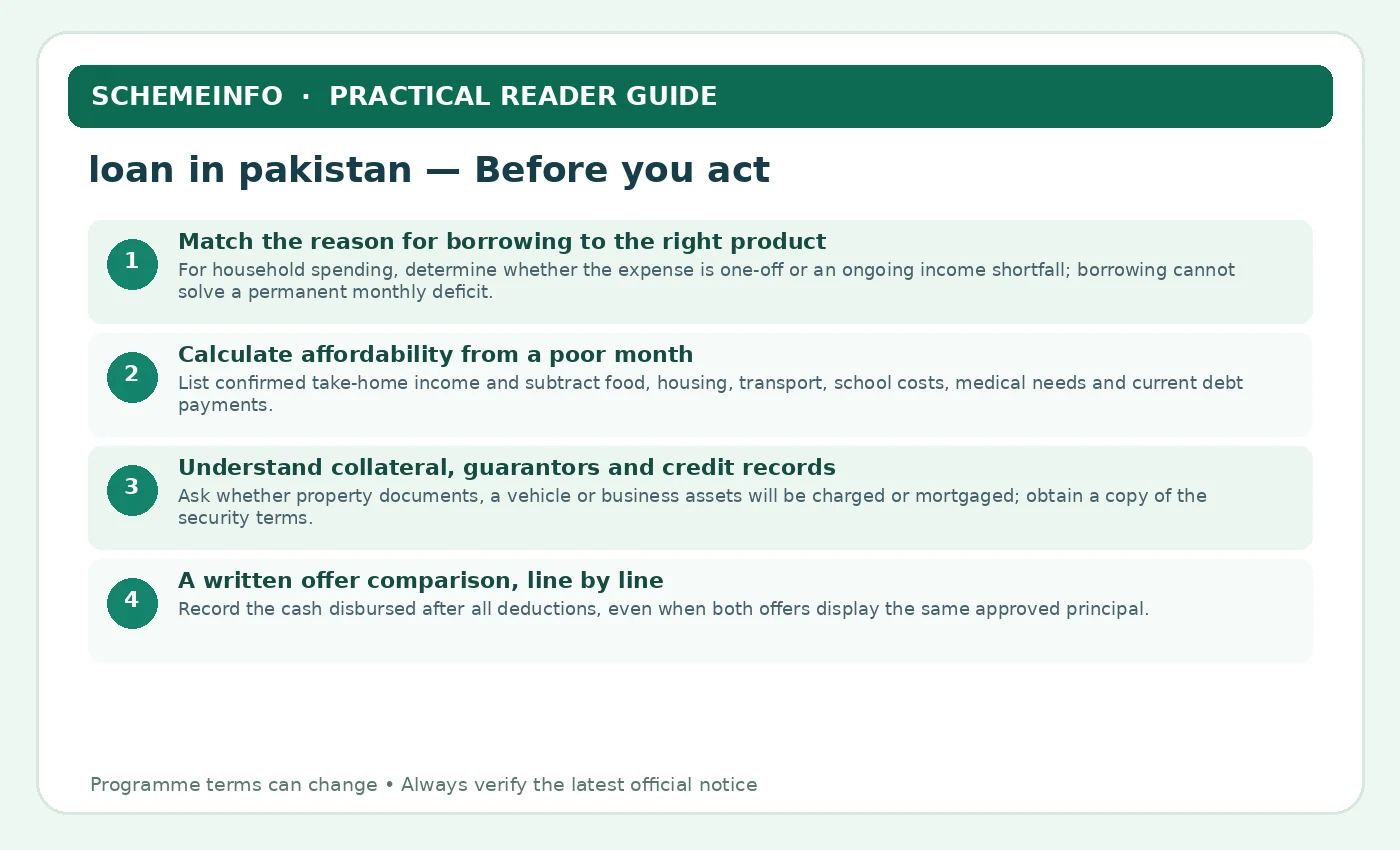
- For household spending, determine whether the expense is one-off or an ongoing income shortfall; borrowing cannot solve a permanent monthly deficit.
- For inventory, compare working-capital products with repayment dates that follow customer collections rather than arbitrary calendar weeks.
- For a tractor or machine, calculate useful life, maintenance and resale value before choosing a long repayment schedule.
- For housing, distinguish purchasing a house, constructing on owned land and obtaining a subsidised house allocation.
- For education or medical bills, check institutional payment plans and legitimate assistance before taking a costly unsecured product.
The product label matters because the lender may restrict what funds can finance and what receipts must be shown.
Calculate affordability from a poor month
Eligibility screening alone cannot prove that borrowing is safe. Build your own budget using income you can reasonably expect rather than a maximum earning month.
- List confirmed take-home income and subtract food, housing, transport, school costs, medical needs and current debt payments.
- Keep a small cushion for irregular expenses; do not commit every remaining rupee to a new instalment.
- If self-employed, calculate net income after stock purchases, operating costs and seasonal shutdowns.
- Compare repayment burden with a month when income falls by 20% to 30%; if essential bills become unaffordable, request less.
- Ask how missed or early payments change the obligation and whether a written restructuring process exists.
Borrowing less than the bank offers can be a sensible decision. Your own cash-flow margin is the important ceiling.
loan in pakistan: practical risk and application checks
Beyond the headline amount, these details help a borrower compare the offer, prepare reliable evidence and avoid avoidable costs. Financial terms and availability always depend on the actual lender or programme.
Understand collateral, guarantors and credit records
A low advertised rate may depend on a pledge or guarantee with real consequences. Read security obligations separately from the monthly instalment.
- Ask whether property documents, a vehicle or business assets will be charged or mortgaged; obtain a copy of the security terms.
- Find out when the lender may enforce a guarantee and whether the guarantor is liable for the whole balance.
- Check which legal, valuation, insurance and registration charges are payable beyond stated profit or markup.
- Correct inaccurate credit-history information using the lender’s documented complaints route, rather than paying an agent to “clear” a record.
- Make sure spouses or co-owners understand any property rights affected by the contract before signing documents.
Lenders may assess security, but borrowers should assess the downside of losing it.
A written offer comparison, line by line
A proper comparison table should include not only price but also timing, risks and practical flexibility. Request the same information from each credible provider.
- Record the cash disbursed after all deductions, even when both offers display the same approved principal.
- Check whether the price is fixed, variable, declining-balance, flat or based on an Islamic financing contract.
- Compare total repayment in rupees over the whole term; a lower instalment can still cost more when the term is longer.
- Note processing, documentation, late-payment, early-settlement and compulsory insurance charges separately.
- Check complaints contacts and ask for a repayment schedule and a complete copy of the offer before accepting.
If the provider refuses to give the written financial details, do not fill the gap with assumptions.
Borrower decision worksheet: loan in pakistan
For loan in pakistan, work through these questions before providing personal records or accepting a financing offer. This is an independent decision tool, not a lender application form. Write the evidence or published rule that answers each question.
- Decision 1: Which named lender, department or licensed company would make the actual decision?
- Decision 2: Is this the currently authorised application route, and what date is the guidance from?
- Decision 3: What amount would reach my account after processing and other authorised deductions?
- Decision 4: What exact dates and amounts would I repay, including any compulsory fees?
- Decision 5: How much remains after rent, food, utilities, transport and all existing repayments?
- Decision 6: What happens to collateral, guarantors or credit records if I miss a payment?
- Decision 7: Can I prove the spending purpose and funds use with appropriate business or personal records?
- Decision 8: Where is the responsible organisation’s official complaints and correction channel?
Four checks specific to this financing question
For education or medical bills, check institutional payment plans and legitimate assistance before taking a costly unsecured product.
Ask how missed or early payments change the obligation and whether a written restructuring process exists.
Make sure spouses or co-owners understand any property rights affected by the contract before signing documents.
Check complaints contacts and ask for a repayment schedule and a complete copy of the offer before accepting.
The purpose of a worksheet is to prevent one misleading number from deciding the entire choice. Compare the original source, the actual offer and the household budget. If any one of these is missing, the sensible next action is further verification rather than signing.
Worked budget: why the maximum offer is not the safe loan amount
A household may be eligible on paper but have too little free cash for the proposed instalment. In this example a worker has predictable pay, current financial obligations and unavoidable costs. Figures are illustrative; a lender may use a different underwriting method.
| Monthly take-home income | Rs 115,000 |
|---|---|
| Essential household costs | Rs 75,000 |
| Existing debt instalments | Rs 12,000 |
| Money left before new borrowing | Rs 28,000 |
| Money left after a proposed Rs 25,000 instalment | Rs 3,000 |
What the comparison means before you act
- Only Rs 3,000 would remain for medicine, travel disruption or a household emergency, making the proposed payment fragile even if a bank accepts the application.
- If the instalment were Rs 12,000 instead, the illustrative buffer would be Rs 16,000, though that still needs a personal emergency reserve.
- For seasonal or variable income, replace the pay figure with the weaker end of your ordinary monthly range.
- Compare available bank, regulated microfinance or government routes only after deciding what the loan will fund.
- Ask for the true final instalment and net proceeds: costs deducted before disbursement can change the effective affordability picture.
- Do not label a high credit limit “affordable” simply because the provider advertised a generous maximum ceiling.
The aim is to turn a search for finance into a decision about sustainable repayments rather than a competition for the highest approved amount.
Illustrative worksheet: Figures are educational examples, not a real lender quotation or confirmed approval. Always use the responsible institution’s current written terms.
Two realistic loan in pakistan situations
These scenarios are illustrations, not real applicants, case-law findings or promised outcomes. Their purpose is to show what a careful next decision looks like when one key detail is uncertain.
Same principal, very different total payment
Two providers advertise Rs 300,000. One has different charges and security terms. The borrower should compare dated repayment schedules and net disbursements, not conclude the products are identical.
A business applies for a personal product
A seller needs inventory financing but considers a short-term personal loan. They should ask about business credit products whose drawdown and repayment fit stock turnover instead of choosing the fastest form.
How to proceed with loan in pakistan
Loan applications differ by lender and programme. Follow the authorised current procedure, and separate application submission from credit approval and money being deposited.
- Name the exact product: Identify the licensed bank, NBFC or department responsible for loan in pakistan. Confirm its official portal or branch before providing information.
- Check whether it suits the purpose: Match the product’s geographic, age, income, security, tax and business-purpose rules to your situation, without assuming every lender has the same criteria.
- Calculate the real budget: Write down the expense that needs funding, money you can contribute, net cash required and the instalment that remains affordable in a weak month.
- Prepare truthful records: Make required identity, income, employment or business records consistent; do not pay an agent to alter credit or eligibility data.
- Apply through the proper channel: Use the verified online system or branch, save the acknowledgement and never share an OTP or PIN with a supposed loan officer.
- Read the offer before agreeing: Check the written amount, fees, net proceeds, repayment schedule, security, consent, default and complaints terms before signing or accepting digitally.
- Keep records after funding: Save the agreement, disbursement receipt, instalment record and lender contacts. If there is a problem, use the institution’s documented complaint process.
Official loan in pakistan sources and independence
The links below are owned by the programme administrators or responsible public bodies. Their current instructions outrank summaries and old dates. SchemeInfo is an independent information publisher: it is not a government agency, bank, lending institution or government loan administrator.
Editorial review: 12 November 2026. Scheme rules and payments may change after this date. Verify before applying or sharing sensitive personal information.
Frequently asked questions about loan in pakistan
Each answer is based on the specific policy or programme history discussed above. A later official announcement, hospital letter, or signed loan agreement may supersede an older online summary.
Can anyone obtain a loan immediately?
No. Legitimate providers verify eligibility, affordability and relevant documentation.
What is usually the first document?
A valid CNIC is commonly needed, followed by provider-specific income proof.
Are all government schemes interest-free?
No. Some are grants, some interest-free loans and others subsidised finance.
How do I compare loan rates?
Calculate total repayable including fees, timing and deductions.
Can self-employed applicants qualify?
Possibly, with business records and suitable lender assessment.
Does Islamic finance mean no cost?
Not necessarily; review the contractual profit or rental structure.
Is collateral always necessary?
No. Requirements depend on product type and approved underwriting.
Who handles bank service complaints?
Start at the bank’s complaint unit, following SBP guidance for escalation.
Can I trust a guaranteed-approval ad?
Treat unverified guarantees as a scam warning.
What if my income changes often?
Use conservative averages and avoid repayments that require unusually good months.