SchemeInfo • Independent Pakistan programme guide • Reviewed 12 November 2026
A loan application should start with an eligible purpose, a real provider and accurate supporting records—not a generic downloadable form. This guide takes you from financial need and document preparation to safe submission, offer comparison, complaints and record-keeping.
Explore this guide — table of contents
- Key facts at a glance
- Eligibility requirements
- Required documents
- How this scheme works
- Application form, records and contract review
- Costs, documents and decisions
- Troubleshooting, safer alternatives and next steps
- Detailed decision guide, part 1
- Detailed decision guide, part 2
- Reader decision worksheet
- Worked decision example
- Mistakes to avoid
- Worked examples
- How to proceed
- Related guides
- Frequently asked questions
- Official sources and disclaimer

Loan Application: key facts at a glance
These are the central published facts for the Loan Application, not a guarantee of admission, approval or an open registration window. The references at the bottom distinguish current official pages from historical phases.
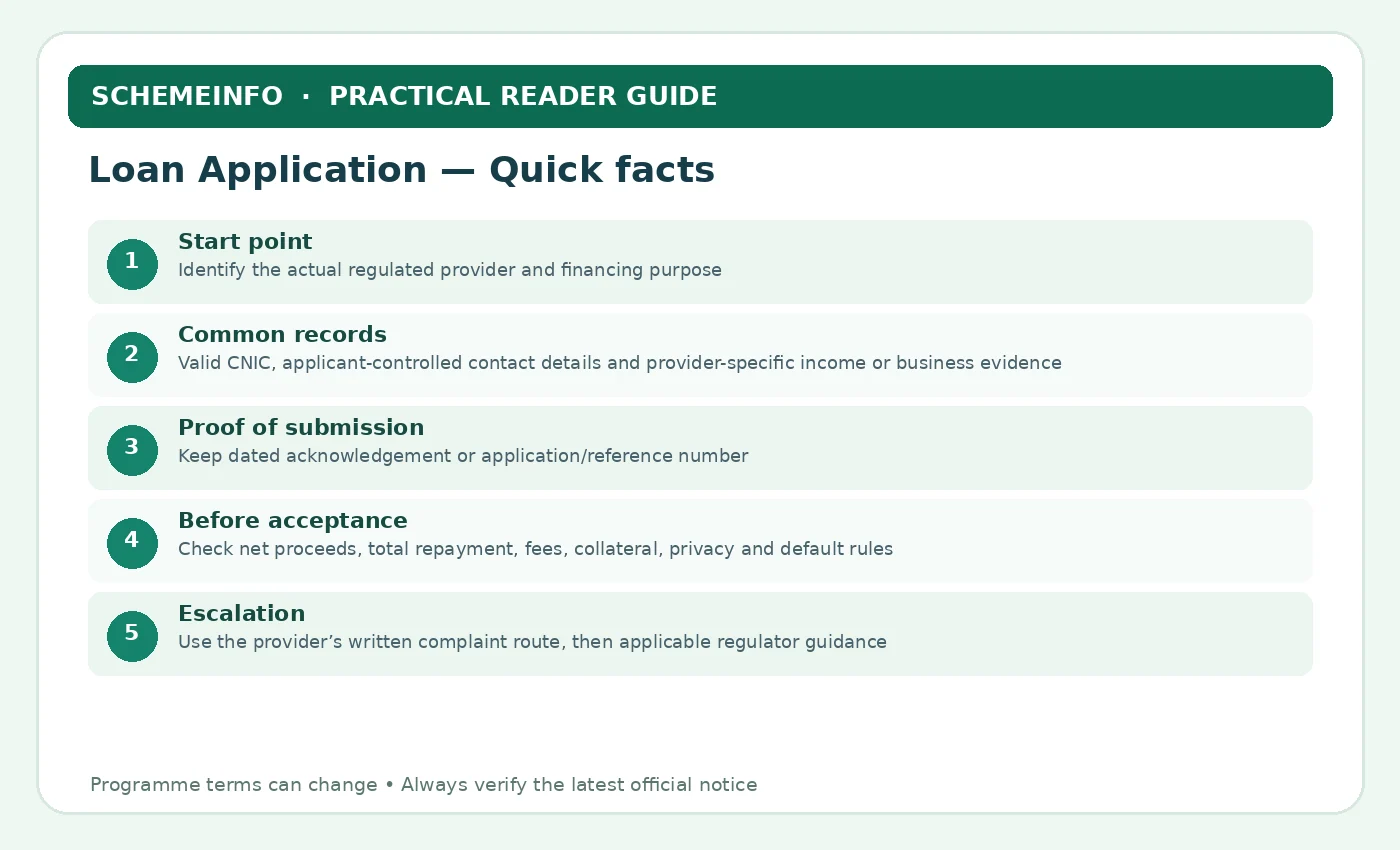
| Start point | Identify the actual regulated provider and financing purpose |
|---|---|
| Common records | Valid CNIC, applicant-controlled contact details and provider-specific income or business evidence |
| Proof of submission | Keep dated acknowledgement or application/reference number |
| Before acceptance | Check net proceeds, total repayment, fees, collateral, privacy and default rules |
| Escalation | Use the provider’s written complaint route, then applicable regulator guidance |
Eligibility for a responsible loan application
Begin with the responsible institution’s written eligibility rules for Loan Application. These checks are not a promise of approval; eligibility is decided through the named programme’s actual verification process.
- Applicant’s CNIC, legal age and residence satisfy the particular scheme or regulated lender’s rules.
- The financing purpose is one the chosen product permits.
- Income or business cash flow is sufficiently verifiable to pass the provider’s assessment.
- The applicant declares existing financing truthfully and meets credit-history conditions if applicable.
- Required tax, business, property or guarantor conditions for the product are satisfied.
- An official application route is available and the applicant can safely receive account messages.
Application documents to gather
Keep essential records legible and separate from optional supporting papers. For Loan Application, confirm which forms the responsible office requires before sharing identity or family information.
- CNIC and genuine applicant-controlled phone/email for authentication.
- Salary record, business earnings or bank statements if the specific lender requests evidence.
- Expense quotations, business plans or property records matched to the loan purpose.
- NTN/tax records, employer letter or domicile where published as eligibility requirements.
- Guarantor, collateral, land title or insurance documents only for applicable secured products.
- Saved official application acknowledgement, contract, fee disclosure and repayment schedule.
How Loan Application works: rules, evidence and decisions
The following sections unpack the Loan Application rules, common misunderstandings and evidence needed for a responsible decision. Check the original official source whenever a condition affects your eligibility.
Step 1: define the purpose and exact amount
A bank and government programme assess different uses of finance. Borrowing for stock, a house, crop inputs or an urgent personal expense should not be combined into a vague application. A seller buying equipment should record the equipment price, installation and expected additional income rather than simply requesting the largest available amount.
Step 2: identify a real regulated provider
A professional-looking website does not establish that the business is licensed. Pakistan’s SBP regulates banks, while SECP provides information on approved NBFC digital lending apps. Locate the actual legal entity through official channels and compare it with the URL or app you intend to use. An app may use a familiar generic title while being operated by a different unverified company.
Step 3: confirm eligibility before registration
Programmes can restrict applicants by age, business type, province, employment, tax registration or asset ownership. If the rule does not fit, registration wastes time and risks exposing documents. The PM Youth federal age band cannot be copied into a Punjab SME form with a different threshold.
Step 4: choose the exact application route
Some finance providers require online applications, others accept branch submissions, and some have separate mobile systems. No single loan portal processes all Pakistan lenders. Akhuwat’s official branch route should not be replaced with an online agent promising an immediate loan.
Application form, records and contract review
Step 5: prepare identity and contact details
Names, CNIC number, date of birth and residence should match official records. An applicant should control the phone used for OTP messages and account recovery. A small typo in CNIC or mobile number can block further authentication or delay document review.
Step 6: assemble supporting financial documents
Lenders may seek payslips, income evidence, tax records, bank statements, cash-flow plans or existing debt declarations. The requirement depends on risk and product purpose. Supply genuine, complete scans and retain the originals; never create fictitious sales records to reach an advertised tier. A new business can explain projected sales transparently instead of presenting invented historical accounts.
Step 7: check the total cost of the offer
Before accepting financing, compare nominal interest/markup with processing fees, annual charges, insurance, penalties and repayment frequency. A zero-markup programme can still have documented fees. A small recurring card fee can change the economics of a low-value business loan even when borrower markup is subsidised.
Step 8: submit and keep the acknowledgement
A confirmation message typically records receipt or registration, not guaranteed sanction or transfer. Some applications proceed through identity, business and bank checks. Save the date, reference number and confirmation on a secure device and note the next official instruction. Do not pay a third party claiming they can convert “submitted” into “approved” without normal review.

Costs, documents and decisions
Step 9: track application and respond to queries
A request for extra evidence is different from rejection, and each provider has its own tracking route. Official communications should include enough context to identify the Loan Application or lender. A banking customer should not use a Punjab agricultural subsidy status page to locate a personal bank application.
Step 10: review the contract before signing
Approval is only the start of contractual responsibility. Borrowers should read early-settlement, security, late-payment, default and complaint provisions before accepting funds. Compare every field against what the provider advertised and ask for clarification before signing a binding instrument. A contract requiring a guarantor should not be signed until the guarantor understands the real potential liability.
What if the application is rejected
The reason could be eligibility, credit, missing documents, weak affordability or product closure. A new application is not always the right response. A record error should be disputed with evidence rather than hidden in a second account.
Borrowing for a sole proprietor versus a company
Individual traders and registered companies may need different tax, ownership, liability and authorisation records. The structure affects who signs and who owes money. Select the correct legal applicant category and verify business documents before applying. A proprietor should not upload another company’s NTN merely because it belongs to a family member.
Troubleshooting, safer alternatives and next steps
Guarantors, property and security
Some loans are unsecured, others require personal guarantees or registered collateral. These are material legal commitments beyond the monthly instalment. A guarantor’s signature can expose them to liability even if the borrower insists it is “only formality.”
Privacy protection throughout the process
A legitimate lender may require CNIC or financial records, but it should not demand unrelated passwords, private contacts or remote access as an unofficial approval step. Use secure original portals and stop if asked to transfer advance fees to an individual wallet or share OTPs. Taking a loan to cover an emergency should not require sacrificing control of a phone or personal account.
How to create an application audit file
Keep copies of original terms, submitted forms, identity records, payment schedule, reference number and all authorised communications. This helps if there is a dispute or document correction. A complete file makes it easier to distinguish a document error from a missed instalment or a bank service problem.
Making the final borrowing decision
The most suitable product is one whose permitted use, total cost and repayment fit the applicant—not necessarily one with the biggest headline amount or easiest online form. A business that can cover half the purchase from savings may be healthier with a smaller loan than with the maximum approval.
Choosing the legitimate lender and form
Use the named programme’s actual rules and documents to evaluate these decisions. Each item below addresses a different obstacle that applicants commonly face.
Specify one measurable use of funds
“I need a loan” does not tell a bank what risk or purpose it must assess. A business inventory purchase, house renovation, crop input payment and urgent medical expenditure have different lender options, documentation and repayment patterns. A strong application starts with what will be purchased, why it is necessary and how that expense leads to a realistic payment plan.
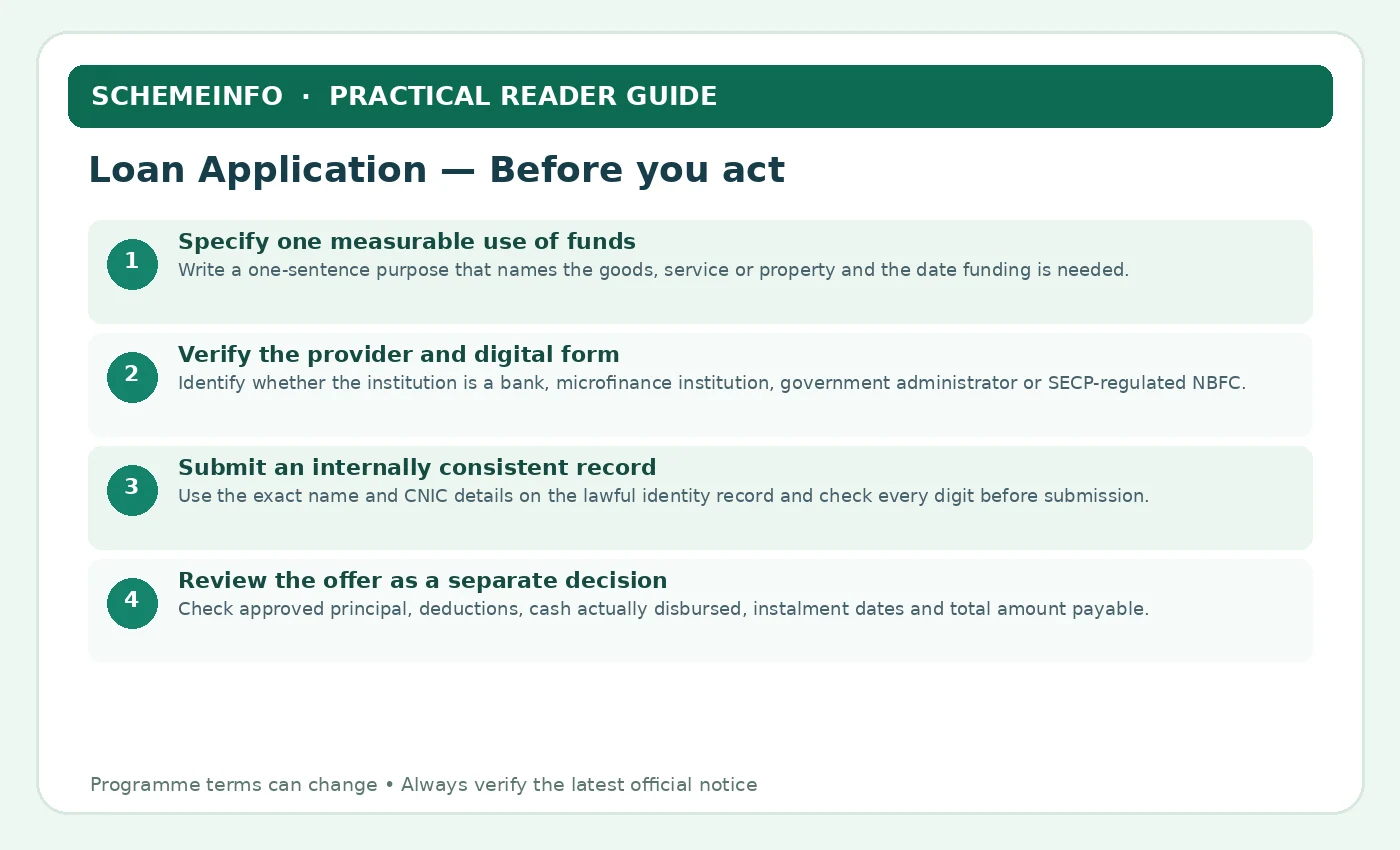
- Write a one-sentence purpose that names the goods, service or property and the date funding is needed.
- Prepare a line-item cost estimate supported by supplier quotations or existing bills where appropriate.
- Deduct money already available so the requested amount does not exceed the genuine funding gap.
- Choose the product category that permits the purpose; do not label personal consumption as business capital to fit a promotional loan.
A smaller, well-evidenced request can be easier to assess than a maximum-limit application with no clear spending explanation.
Verify the provider and digital form
A genuine loan application begins with the legal lender and a current official channel. Public schemes often use a named government portal and participating bank, while private digital lending companies operate under different authorisations. Search ads and copied landing pages can mimic a legitimate form. The safe route is to locate the responsible operator first and reach the form from its official site.
- Identify whether the institution is a bank, microfinance institution, government administrator or SECP-regulated NBFC.
- For a digital NBFC loan app, check the current SECP approved-app list and compare the exact app and company name.
- For a government scheme, open the stated government/agency portal rather than trusting an intermediary’s shortened link.
- Never share OTPs, banking passwords, unneeded contact-list permissions or original credentials with a paid form-filling agent.
A real application portal may be busy or temporarily closed. That does not justify sending the same CNIC documents to a substitute website.
Submission accuracy and contract assessment
Use the named programme’s actual rules and documents to evaluate these decisions. Each item below addresses a different obstacle that applicants commonly face.
Submit an internally consistent record
Loan processors often have to reconcile identity, income, address, business or property information. Inconsistent dates, expired contact details and unclear statements can delay verification. The goal is not to manufacture a perfect record but to make every entry accurate, supported and readable. Some products require tax records, guarantor details or collateral; others do not.
- Use the exact name and CNIC details on the lawful identity record and check every digit before submission.
- Provide current phone and email contacts that you control and can continue to access after applying.
- Match salary slips, business sales figures or bank statements with the declared source of repayment.
- Upload readable documents in the accepted format and retain the original confirmation of successful submission.
If a form is rejected for a genuine error, use the official correction or appeal route and preserve the new acknowledgement. Do not overwrite truthful data merely to satisfy a software field.
Review the offer as a separate decision
Approval is not the end of the process. The contract may differ from an advertisement in amount, fees, timing and security requirements. A borrower should be able to explain the repayment in rupees before signing or tapping an in-app acceptance button. Keep a copy of the full agreed terms and an independent calculation of what the household or business can afford.
- Check approved principal, deductions, cash actually disbursed, instalment dates and total amount payable.
- Read any guarantor, mortgage, insurance, legal-fee, data-consent and late-payment clauses in the final document.
- Compare repayments against a conservative cash-flow budget; include existing obligations and essential living costs.
- Know the written complaint route and preserve the agreement, payments and communications from day one.
There is no need to accept immediately when terms are unclear. Request an explanation from the regulated institution and compare another legitimate offer if necessary.
Reader verification worksheet: Loan Application
For Loan Application, work through these questions before providing personal records or accepting a financing offer. This is an independent reader decision tool, not a government or lender application form. Write the evidence or published rule that answers each question.
- Decision 1: What exactly will this loan buy, and which dated evidence supports the cost?
- Decision 2: Which regulated institution or legitimate public programme offers the appropriate purpose?
- Decision 3: Does my age, geography, employment, tax and other eligibility really fit?
- Decision 4: Are my CNIC, contact, income, account and business records internally consistent?
- Decision 5: Do the upload requirements match the official form without unnecessary personal data?
- Decision 6: Have I saved the acknowledgement and checked that the form was actually submitted?
- Decision 7: What amount would reach me after authorised fees and what total must be repaid?
- Decision 8: Do I understand security, consent, default and formal complaint terms before accepting?
Four checks specific to this financing question
Choose the product category that permits the purpose; do not label personal consumption as business capital to fit a promotional loan.
Never share OTPs, banking passwords, unneeded contact-list permissions or original credentials with a paid form-filling agent.
Upload readable documents in the accepted format and retain the original confirmation of successful submission.
Know the written complaint route and preserve the agreement, payments and communications from day one.
A short written checklist makes it easier to distinguish an official fact, an unverified claim and a remaining question. Keep the record private and update it when the responsible organisation releases new information.
Loan application maths: amount requested versus cash received
Suppose a real supplier quote is Rs 420,000 and the applicant can contribute Rs 90,000. The remaining gap is Rs 330,000. A requested amount should be based on that gap, while the Loan Application’s exact net disbursement and total cost need their own separate calculation.
| Quoted legitimate cost | Rs 420,000 |
|---|---|
| Verified available savings | Rs 90,000 |
| Calculated funding gap | Rs 330,000 |
| Illustrative application amount | Rs 330,000, if the named product permits it |
| Final check before acceptance | Do net proceeds cover the purchase after valid fees, and is the repayment affordable? |
What the comparison means before you act
- Retain the supplier quote rather than inventing a purpose to match the maximum loan limit.
- Disclose existing debts and genuine income accurately.
- Keep the original portal acknowledgement and respond only to authorised document requests.
- Review the signed contract separately: submitting a form does not require accepting every offer.
The most useful application proves the need, the legal eligibility and the ability to repay rather than focusing on the largest advertised ceiling.
Illustrative worksheet: Figures are educational examples, not a real lender quotation or confirmed approval. Always use the responsible institution’s current written terms.
Seven checks before pressing Submit or Accept
The following checklist is tailored to this exact topic. Use it as a final check before registering, signing, sharing identity records or acting on a purported result.
- The intended purpose, amount and deadline are specific and backed by authentic supplier, property or personal-cost evidence.
- The lender or scheme has been verified on the current official regulator or government route.
- Identity information and contact details are accurate and belong to the genuine applicant.
- Income, business statements and existing debts agree with the application, rather than hiding inconvenient commitments.
- Attachments are complete, readable and submitted only on the authorised portal or bank channel.
- The receipt or reference number is saved immediately after submission for later status checks.
- The final contract is checked independently for fees, total repayment, collateral, consent and complaint rights before acceptance.
{esc(closing)}
Two realistic Loan Application situations
These scenarios are illustrations, not real applicants, case-law findings or promised outcomes. Their purpose is to show what a careful next decision looks like when one key detail is uncertain.
Small shop documents stock financing
A retailer wants Rs 280,000 for inventory. She gathers supplier quotations, three months of genuine sales records and a repayment budget, then selects a scheme that permits the purpose. She does not increase the requested amount merely because an advertisement mentions a higher ceiling.
Applicant receives a different final offer
A borrower applied for Rs 500,000 but receives a smaller approved amount with additional charges. Rather than treating approval as compulsory acceptance, he checks net proceeds and the instalment schedule, then decides whether the smaller amount still solves the stated need.
How to proceed with Loan Application
Follow the official procedure for this specific topic. A submitted form or preliminary status is never proof of final selection or disbursement.
- State the exact purpose: Prepare a costed business, house or personal need without unnecessary borrowing.
- Locate the legal provider: Verify the bank, public portal or SECP-approved digital lender and its eligible product.
- Check initial criteria: Confirm purpose, residence, age, income, tax and collateral requirements before registering.
- Prepare consistent records: Gather CNIC, applicant-controlled contact information and the actual requested evidence.
- Submit and retain confirmation: Complete the official form accurately, then save the dated reference number.
- Respond to legitimate questions: Correct missing attachments in the authenticated account without sharing passwords or OTPs.
- Review the final offer: Independently check net funds, instalments, all fees, security and complaint terms before acceptance.
Official Loan Application sources and independence
The links below lead to the responsible government or regulator information services, including public rules that can supersede older summaries. Their current instructions outrank summaries and old dates. SchemeInfo is an independent information publisher: it is not a government agency, bank, lending institution or government loan administrator.
Editorial review: 12 November 2026. Scheme rules and payments may change after this date. Verify before applying or sharing sensitive personal information.
Frequently asked questions about Loan Application
These practical answers apply to application preparation; the named lender’s current form and final contract control a real case.
Does one loan application work for all lenders in Pakistan?
No. Each government programme, bank and licensed provider has its own route.
Can a submitted application still be rejected?
Yes. Registration and initial submission are separate from underwriting and sanction.
Must everyone provide a tax return?
Not universally. Tax records are required by particular products and borrower categories.
Can I apply on behalf of another person?
Only if the official service permits a lawfully authorised representative; never use someone else’s credentials without permission.
What should I read before signing?
The full amount, fees, repayment, security, late-payment and complaint clauses.
For loan application, what matters about step 2: identify a real regulated provider?
A professional-looking website does not establish that the business is licensed. Locate the actual legal entity through official channels and compare it with the URL or app you intend to use..
For loan application, what matters about step 4: choose the exact application route?
Some finance providers require online applications, others accept branch submissions, and some have separate mobile systems. Follow the original provider website to the current form and keep the exact URL for later tracking..
For loan application, what matters about step 6: assemble supporting financial documents?
Lenders may seek payslips, income evidence, tax records, bank statements, cash-flow plans or existing debt declarations. Supply genuine, complete scans and retain the originals; never create fictitious sales records to reach an advertised tier..
For loan application, what matters about step 10: review the contract before signing?
Approval is only the start of contractual responsibility. Compare every field against what the provider advertised and ask for clarification before signing a binding instrument..
For loan application, what matters about privacy protection throughout the process?
A legitimate lender may require CNIC or financial records, but it should not demand unrelated passwords, private contacts or remote access as an unofficial approval step.. Use secure original portals and stop if asked to transfer advance fees to an individual wallet or share OTPs..