SchemeInfo • Independently edited guide • Reviewed 12 November 2026
PEEF master’s support is usually handled through a participating university, not a public direct application sent to the PEEF office. Understand the published 60%/2.5 CGPA threshold, income rules, eligible degrees and institutional selection process before assembling your file.
Explore this guide — table of contents
- Eligibility: who this programme is actually for
- Required documents: organised and verifiable
- Verified facts at a glance
- Understand the university-led application route
- Check graduation results and degree history
- Read the income condition and exemptions carefully
- Calculate the real study budget
- Maintain eligibility after selection
- Programme details that often change the decision
- Student budget and eligibility worksheet
- Real-life situations and the better decision
- How to apply for PEEF Masters Level Scholarship: six verified steps
- Related guides
- Frequently asked questions
- Official sources and editorial independence

Eligibility: who this programme is actually for
Before applying for PEEF Masters Level Scholarship, review the following conditions against the latest notice. These points are not an approval guarantee. Punjab domicile under the published university eligibility criteria. At least 60% graduation marks or a CGPA of 2.5, with the qualifying examination sessions specified by the relevant institutional notice. Admission as a full-time student in an eligible Master, MS or MPhil programme at a PEEF partner university or degree-awarding institution. Declared parental monthly income at or below Rs. 60,000 under the cited 2025–26 notices, with published exceptions for some BPS 1–4 families and civilian martyr cases. Not receiving another education scholarship in the same academic year, and meeting university merit and need assessment. Students who already hold a specified postgraduate degree may be ineligible under relevant notices; check programme-specific exclusions.
A quick self-screen before applying
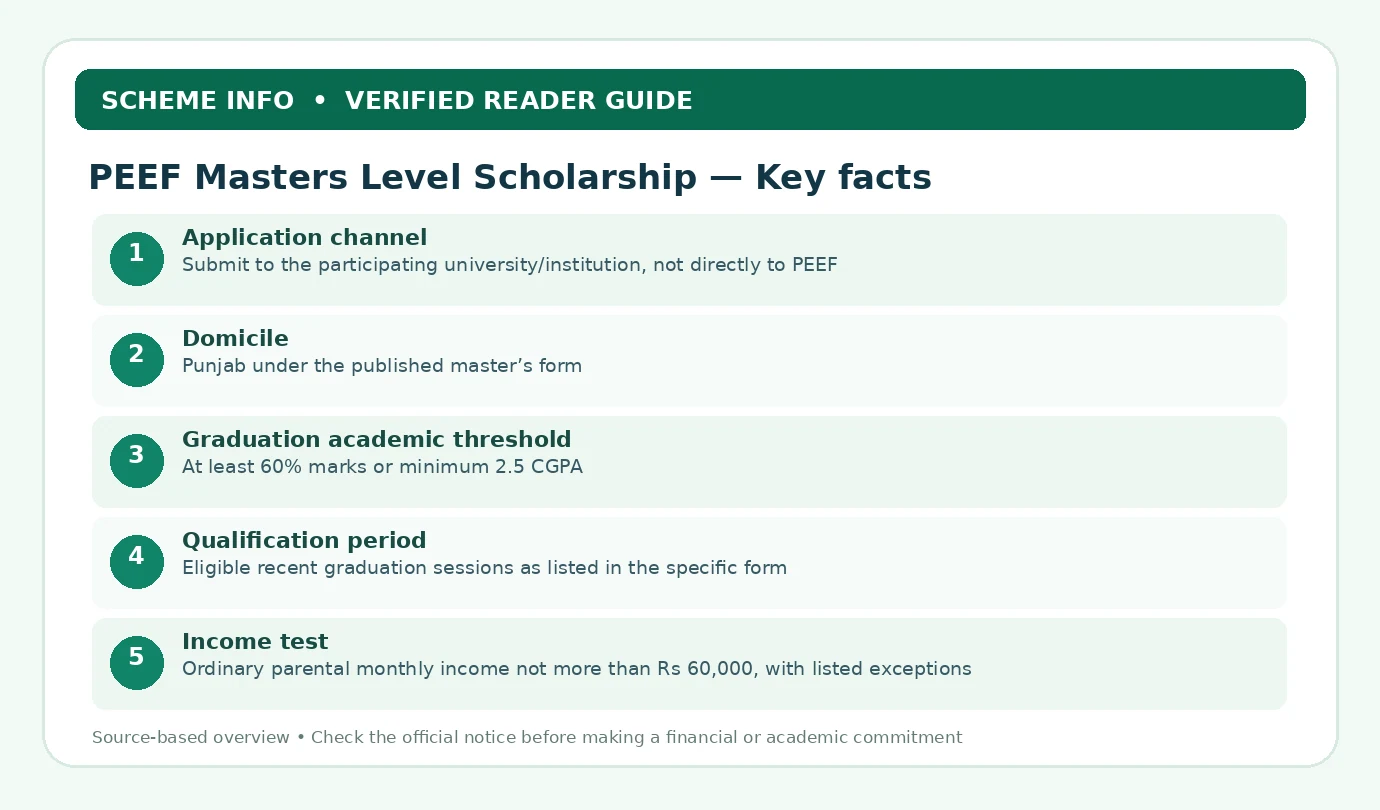
- Submit to the participating university/institution, not directly to PEEF
- Punjab under the published master’s form
- At least 60% marks or minimum 2.5 CGPA
- Eligible recent graduation sessions as listed in the specific form
- Ordinary parental monthly income not more than Rs 60,000, with listed exceptions
Where a location, degree, machine type or financial share is stated as a published condition, match it to your own document or quotation. An appealing programme title is not sufficient evidence of eligibility.
Required documents: organised and verifiable
The following records are required or relevant depending on the published instructions. Conditional items are identified as such, and applicants should use official channels for personal records. PEEF Master-level application form supplied or accepted by the partner institution. Punjab domicile and valid CNIC, plus academic transcripts or graduation result records. Proof of current full-time admission/enrolment and student registration details. Parents’ income affidavit or other financial evidence in the required institutional format. Any institutional interview form, supporting certificates or exemption evidence applicable to the student.
Five checks before uploading anything
- CNIC or student ID exactly matching the application
- Dated and complete records supporting the published eligibility conditions
- Official evidence for any special category, land holding or finance claim
- The latest advertisement or application guidance saved for reference
- A secure copy of submission acknowledgement and correspondence
A list from an old intake is a useful starting checklist only. Follow the mandatory format and attestation rules issued for the actual round, and protect personal certificates from unofficial agents.
Verified facts at a glance
The published programme tells you which route may be relevant; it does not prove that a specific applicant is selected. Here are the conditions worth checking first.
| Application channel | Submit to the participating university/institution, not directly to PEEF |
|---|---|
| Domicile | Punjab under the published master’s form |
| Graduation academic threshold | At least 60% marks or minimum 2.5 CGPA |
| Qualification period | Eligible recent graduation sessions as listed in the specific form |
| Income test | Ordinary parental monthly income not more than Rs 60,000, with listed exceptions |
| Other awards | Cannot simultaneously receive another educational scholarship in the same academic year |
Details reviewed 12 November 2026. Official advertisements and award letters control any later changes.

Understand the university-led application route
The most important procedural difference is where the application belongs. A student should contact their university’s scholarship focal person, not post an unsolicited package to PEEF.
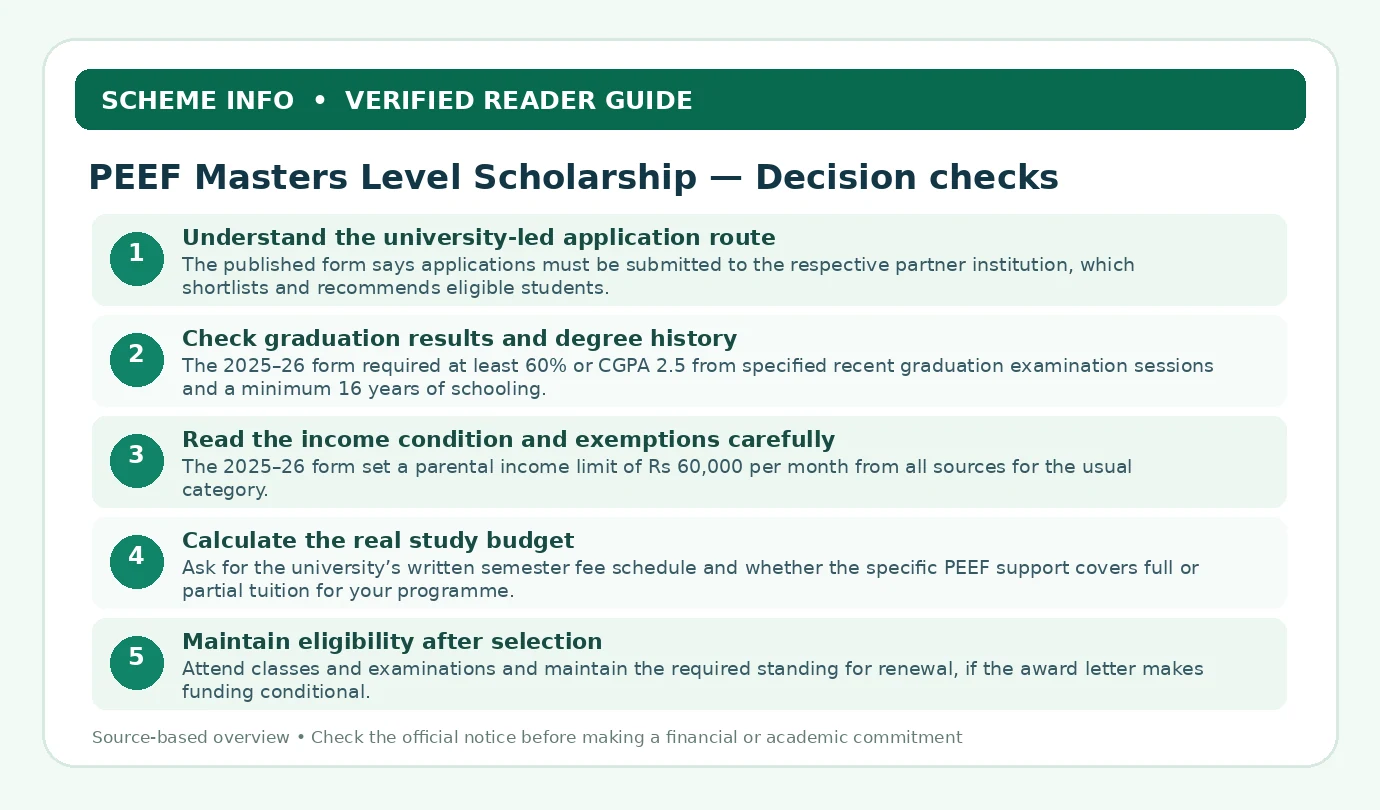
- The published form says applications must be submitted to the respective partner institution, which shortlists and recommends eligible students.
- Confirm the university appears in the partnership arrangements for the relevant year and that your specific degree is a qualifying full-time programme.
- Ask the financial-aid or scholarship office for the institution’s internal deadline, which may differ from the general scholarship announcement.
- Submit the original signed form and evidence according to that office’s instructions and retain a stamped or electronic acknowledgement.
- Do not assume that sending an email directly to PEEF creates an application when the route is institution-led.
What this means for a real applicant
A strong application starts with the decision the family or operator actually faces. Record the facts that apply to your own land, qualifications, machine or programme category and mark any missing evidence. A helpful scheme guide should enable you to decide whether to proceed, change the plan or investigate a different option.
Check graduation results and degree history
Published master’s eligibility combines marks or CGPA with a recent graduation record and admission in the current academic session.
- The 2025–26 form required at least 60% or CGPA 2.5 from specified recent graduation examination sessions and a minimum 16 years of schooling.
- Confirm the qualifying examination year on the current form; graduation from an older session can affect eligibility even with excellent grades.
- Full-time enrolment at a partner institution matters. Evening or spring sessions may be eligible where the programme specifically allows them.
- Students who already possess MA, MSc, MS or MPhil-type qualifications are excluded under the published form’s rule.
- Keep official graduation transcript and degree, university admission proof and any required equivalence certificate in one checked file.
How to turn these points into evidence
Where a number is published, keep the source and its date beside the calculation. Use actual fees, quotations, marks and family records—not a rounded social-media figure. The correct decision may be to revise the proposed amount, wait for a verified intake or ask the implementing office for written clarification.
Read the income condition and exemptions carefully
Financial need assessment uses parental income, not only a verbal statement that the household is struggling. The current form governs acceptable evidence.
- The 2025–26 form set a parental income limit of Rs 60,000 per month from all sources for the usual category.
- Children of BPS 1–4 government employees were exempt where salary was the only source of income under the form.
- Children of civilians martyred in terrorist attacks were listed among those with a separate income-condition exception.
- Be prepared to explain any income from rent, farming, employment or self-employment if the university asks for verification.
- Never alter salary figures or request a false affidavit to reach an apparent threshold; universities may cancel awards for inaccurate information.
The hidden cost or condition
Compare the best-case headline with the less attractive possibilities: an applicant share above the cap, a delayed payment, a year of low demand, or a scholarship expense beyond the award. That comparison is what makes planning more reliable than relying on an eligibility headline alone.
Calculate the real study budget
Even a successful scholarship may not cover every fee or cost, so students should plan tuition, transport and unavoidable household spending separately.
- Ask for the university’s written semester fee schedule and whether the specific PEEF support covers full or partial tuition for your programme.
- List commuting or hostel costs, study materials, lab fees, printing, travel home and unexpected examination charges.
- Prepare for timing differences: fees may fall due before selection is complete or a scholarship is credited to the university.
- Keep payment receipts and scholarship-office emails; they are useful when reconciling a fee balance after an award.
- Compare the affordability of the programme even if PEEF support is delayed, reduced or not awarded.
How to check a claim before committing
Treat the active government advertisement, a university focal person or the responsible department as the decision-maker. An intermediary may help explain a process, but cannot change the formal conditions. Keep a dated screenshot or PDF of the notice when a portal opens.
Maintain eligibility after selection
University-led awards depend on accurate records, academic progress and compliance with the offer’s terms, not only on being selected once.
- Attend classes and examinations and maintain the required standing for renewal, if the award letter makes funding conditional.
- Inform the scholarship office promptly if programme, university, attendance or financial circumstances change.
- Do not hold another educational scholarship concurrently where the published PEEF criteria prohibit it.
- Keep copies of your admission letter, award, university recommendation and each fee payment in an organised folder.
- Ask the focal person to explain any appeal, wait-list or renewal process in writing rather than relying on unofficial assurances.
A practical next decision
Finish with a decision you can defend: the relevant scheme, the matching condition, the exact evidence, the cost or expected benefit, and the one unanswered question. This keeps the research focused rather than collecting forms before establishing a realistic path.
Programme details that often change the decision
These details address questions that often appear only after the headline scheme conditions are understood. Read the relevant point alongside the current official notice, particularly where a programme phase or regional rule matters.
Why this is an institutional scholarship
PEEF Master-level assistance is administered through partner universities rather than a general direct-to-PEEF online payment request. The university screens candidates for merit and need. For example, two people can face the same difficulty while only one belongs to the specified category. Checking that difference first is respectful of the reader’s time. The student financial aid office, not a third-party broker, is the first practical point of contact. For PEEF Masters Level Scholarship, school enrolment and academic evidence need to refer to the correct class, examination session and institution.
Domicile and educational record
Published institutional criteria require Punjab domicile and graduation-level marks or CGPA at the stated threshold. Specific qualifying sessions vary by call. For people researching PEEF Masters Level Scholarship, this particular distinction is worth checking before an application. A common source of confusion is that articles written for different years use similar headings. The right way to resolve a conflict is to identify the issuing authority and the exact intake year shown on the form, not to select whichever description promises the larger benefit. Take your complete transcript rather than relying on a self-calculated average; academic offices use official conversion rules. Timing changes the practical decision.
Understanding the 60% and 2.5 CGPA thresholds
The Women University Multan notice for its intake says at least 60% marks or 2.5 CGPA in graduation. Those are threshold requirements, not a promise of automatic selection. A certificate obtained from the wrong office or a form submitted outside the institutional route can be rejected even when the underlying personal circumstances are genuine. A brief confirmation before submission is worthwhile. A student near the boundary should seek the university’s method for interpreting cumulative results and degree equivalence.
Admission into an eligible programme
The scholarship requires a current full-time place in an eligible partner institution and programme. Old admission letters or offers without actual enrolment may not suffice. Information about PEEF Masters Level Scholarship is most useful when it separates documented facts from likely but unconfirmed assumptions. Families may understandably focus on the headline amount or prestige of the programme. But the less visible details—verification, identity matching, household circumstances and available allocation—often determine whether an application proceeds. Ask whether the programme, campus, academic session and timing appear on the university’s approved PEEF allocation list. For a family comparing options, the important distinction is between being allowed to apply and actually receiving support.
Parental income limit and exceptions
The cited 2025–26 institutional notice uses parental income of Rs. 60,000 per month from all sources. Certain children of BPS 1–4 government employees and civilian martyrs may have exceptions. Questions about PEEF Masters Level Scholarship often arise because several different stages are described as “application”. A short, clear enquiry is better than a long speculative request. State the applicant category, the specific form or programme notice and the one condition needing clarification. Keep the official response with the application record. An exception must match the published policy and be evidenced; it is not a general waiver for anyone with a difficult household budget.
Other scholarships and prior degrees
PEEF excludes those already using another education scholarship in the same year under the institution’s notice, and some already-qualified postgraduate students may also be excluded. Sensitive records should not travel through random group chats. Once shared publicly, a CNIC scan, health letter or school record may be copied by strangers. Use the published channel and remove unnecessary personal details from any enquiry. Declare existing assistance honestly because duplicate awards can create repayment and disciplinary problems later. There is also a privacy issue: application records often contain CNIC numbers, addresses, income data or health information. Only submit these through an official secure channel and avoid uploading them to public social media comments.
Where the application is submitted
The Punjab University PEEF instructions say the form goes to the respective institution and applications sent directly to PEEF are not entertained. For people researching PEEF Masters Level Scholarship, this particular distinction is worth checking before an application. There is a difference between calculating the value of a possible benefit and making a financial commitment. The responsible approach is to wait for a decision, then check any payment timing and restrictions before spending against it. Identify the financial aid office deadline, which can be earlier than a general web notice because staff need processing time. Budgeting should be based on an approved and documented offer rather than an advertised maximum. For PEEF Masters Level Scholarship, school enrolment and academic evidence need to refer to the correct class, examination session and institution.
Documents and income affidavits
The 2025–26 listing includes an application form, eligibility criteria, income affidavit and interview sheet. Different universities may request supporting proofs. The correctable problems are often small: a mismatched date, an outdated phone number or the absence of a stamp. Fixing them early is more reliable than filing a second application with inconsistent information. Prepare copies without altering figures, signatures or seals; discrepancies can stop a valid application before merit assessment. If a record is incorrect, update it through the institution that issued it. An unverified workaround may solve the appearance of the problem temporarily but cause a serious inconsistency at the final scrutiny stage.
Merit, need and shortlisting
Meeting basic conditions is not a guarantee of funding. Partner universities apply allocation, eligibility, merit and need assessments using their own committee procedures. Information about PEEF Masters Level Scholarship is most useful when it separates documented facts from likely but unconfirmed assumptions. Keeping a photograph of a receipt for your own records can help, but it should not be posted publicly. A date, receipt number and office name are usually more useful for follow-up than sending the whole document to a stranger. A stronger application clearly explains financial need using evidence rather than a dramatic narrative unsupported by household figures. Applicants benefit from a simple paper trail: note when the form was received, which official took it, what was missing and when to follow up.
What costs can be supported
University scholarship awards may offset approved education expenses as defined by the award letter. Never assume all housing, transport and living expenses are covered. Questions about PEEF Masters Level Scholarship often arise because several different stages are described as “application”. Words such as “eligible”, “registered” and “selected” describe different stages. The programme may apply to a broad group, yet individual verification and administrative approval remain separate events. Make a separate budget for tuition, research, laboratory fees and living expenses while waiting for the actual award terms. The public wording should not be read as a blanket promise for every person who shares one characteristic.
Renewal and academic standing
Recipients need to ask their institution about continuing conditions, semester grades, changes in degree status and withdrawal reporting. A family income figure or institutional fee estimate needs a clear basis. If a relevant office asks for an affidavit or certificate, use its recognized format and make sure it agrees with the underlying records. A scholarship may not transfer automatically if the student changes universities or switches programmes. An honest explanation of financial need is usually more effective than exaggerated claims. With PEEF Masters Level Scholarship, a scholarship may be conditional on academic progress or continuing attendance.
Timing across academic sessions
Different university offices publish separate deadlines and quota notices. A previously open spring call does not mean the entire PEEF scheme accepts fresh applicants in November. For people researching PEEF Masters Level Scholarship, this particular distinction is worth checking before an application. An official notice can supersede an older web summary. Reading the current form, announcement and associated instructions together is the best way to avoid false certainty about a date or category. Compare the university site, PEEF site and scholarship-office notice board whenever a new intake is announced. This is also a reason to compare the most recent circular with older summaries.
Common rejection reasons
Missing a domicile copy, misunderstanding previous-degree exclusions, incorrect parent income or late submission can make an application fail before ranking. A declined form can have different meanings: missing evidence, non-eligibility, a closed round or exhausted funds. Each situation calls for a different response; no one should promise a shortcut that defeats the policy. Before signing, have the university office confirm that every compulsory field and attachment is complete. An applicant who is turned away should ask for the exact missing requirement or formal reason. For PEEF Masters Level Scholarship, school enrolment and academic evidence need to refer to the correct class, examination session and institution.
How to ask for a review
If a result appears inconsistent, use the institution’s published scholarship appeal or help procedure. Avoid flooding offices with duplicate untracked applications. Information about PEEF Masters Level Scholarship is most useful when it separates documented facts from likely but unconfirmed assumptions. Third-party assurances are easy to make and hard to verify. A reliable programme does not ask families to conceal facts or transfer money to an individual just to have an application viewed. Keep an organised record of submission date, correspondence, acknowledgement and any additional documents requested. It helps to distinguish authorized administrative advice from an unofficial agency’s marketing.
Student budget and eligibility worksheet
Education support should be measured against the full academic year: tuition, admission deposits, accommodation, books, local travel and living expenses. A stipend or scholarship may be paid on a different timetable from the costs.
Before you rely on the result
- I have the correct dated official notice, not only a blog or forwarded message.
- I understand which eligibility rule or project area applies to my own situation.
- My cost, award, or benefit calculation includes the non-covered items.
- I know who will verify the application and which document supports each claim.
- I have a practical alternative if I am not selected, if finance is refused or if funding is delayed.
Replace all hypothetical figures with your own dated records and the institution’s formal decision. A conservative plan is more useful than an optimistic estimate that has no margin for delays or setbacks.
Real-life situations and the better decision
These are realistic examples intended to clarify decisions—not real applicants, official promises or predictions of selection. Use the questions each situation raises to check your own evidence.
A student with 2.6 CGPA from an older graduation year
The academic score may qualify, but the year of graduation must still meet the current intake’s permitted range. The next step is to identify the formal requirement involved and obtain the specific supporting record, rather than making a payment on the strength of a verbal promise.
A scholarship applicant already holding an MS degree
The published master’s form excludes students who already possess listed master’s-level qualifications. An applicant should compare the actual cost and timing with a less risky alternative, then use the official office or bank to confirm what remains uncertain.
A student at a partner university
The proper next step is the university scholarship office and its internal deadline, not posting the form directly to PEEF. The applicant should keep the relevant advertisement or award letter and avoid interpreting a planned project, a maximum grant or an old deadline as a guaranteed benefit.
How to apply for PEEF Masters Level Scholarship: six verified steps
There is no single universal application form for every programme. The steps below explain the right order of preparation while leaving each authority’s current instructions in control.
- Confirm the latest intake: Check the named authority’s current advertisement and date. An older phase, archived form or project allocation does not establish an open application window.
- Screen eligibility first: Compare your true academic record, household status, landholding or approved machine requirement with the exact published criteria.
- Collect and check records: Prepare legible identity, education, land, category or financial documents as appropriate. Confirm names and numbers match before submission.
- Calculate the real commitment: For machinery, obtain a dated quote and own-share estimate; for study, calculate all fees and living expenses; for community works, establish feasibility and rights.
- Submit through the authorised route: Use the official portal, university scholarship office or designated agriculture office. Do not pay a person who promises selection.
- Save references and read the outcome: Keep the acknowledgment, follow official updates, verify any selection and review the actual award, contract or acceptance conditions.
Official sources and editorial independence
Read the current notice alongside this independently edited guide. SchemeInfo is an information website—not the department, university, government, lender or scholarship provider. No application or selection can be guaranteed here.
Editorial verification completed 12 November 2026; later changes should be checked directly with the listed authorities.
Frequently asked questions
These answers reflect the published sources as checked in November 2026. A fresh government advertisement, university notice or award letter can change the procedure for the next intake.
Where do I submit the PEEF master’s application?
To the respective partner university or degree-awarding institution.
Does PEEF accept forms directly?
The published 2025–26 form says it does not.
What is the academic threshold?
At least 60% marks or a 2.5 CGPA under the published form.
Is Punjab domicile required?
Yes, under the visible master’s criteria.
What was the ordinary monthly income ceiling?
Rs 60,000 under the published 2025–26 form, with exceptions.
Can I receive a second scholarship?
Concurrent educational scholarships are prohibited by the published criteria.
Are evening-session students eligible?
Potentially, where the partner institution and form allow the relevant full-time session.
Can someone who already has an MS apply?
The published form excludes candidates already possessing such qualifications.
Is 2026–27 intake open everywhere?
Confirm with each partner institution; an older form does not establish a new open window.
Who decides the institutional shortlist?
The participating university’s scholarship award process under PEEF rules.