
SchemeInfo • Independently edited guide • Reviewed 12 November 2026
For a student from Gilgit-Baltistan, the critical questions are domicile, HSSC results, HEC aptitude-test merit and university admission. This guide explains what the programme covered, the verified selection formula and why old phase results should not be confused with a new application opening.
Explore this guide — table of contents
- Eligibility: who this programme is actually for
- Required documents: organised and verifiable
- Verified facts at a glance
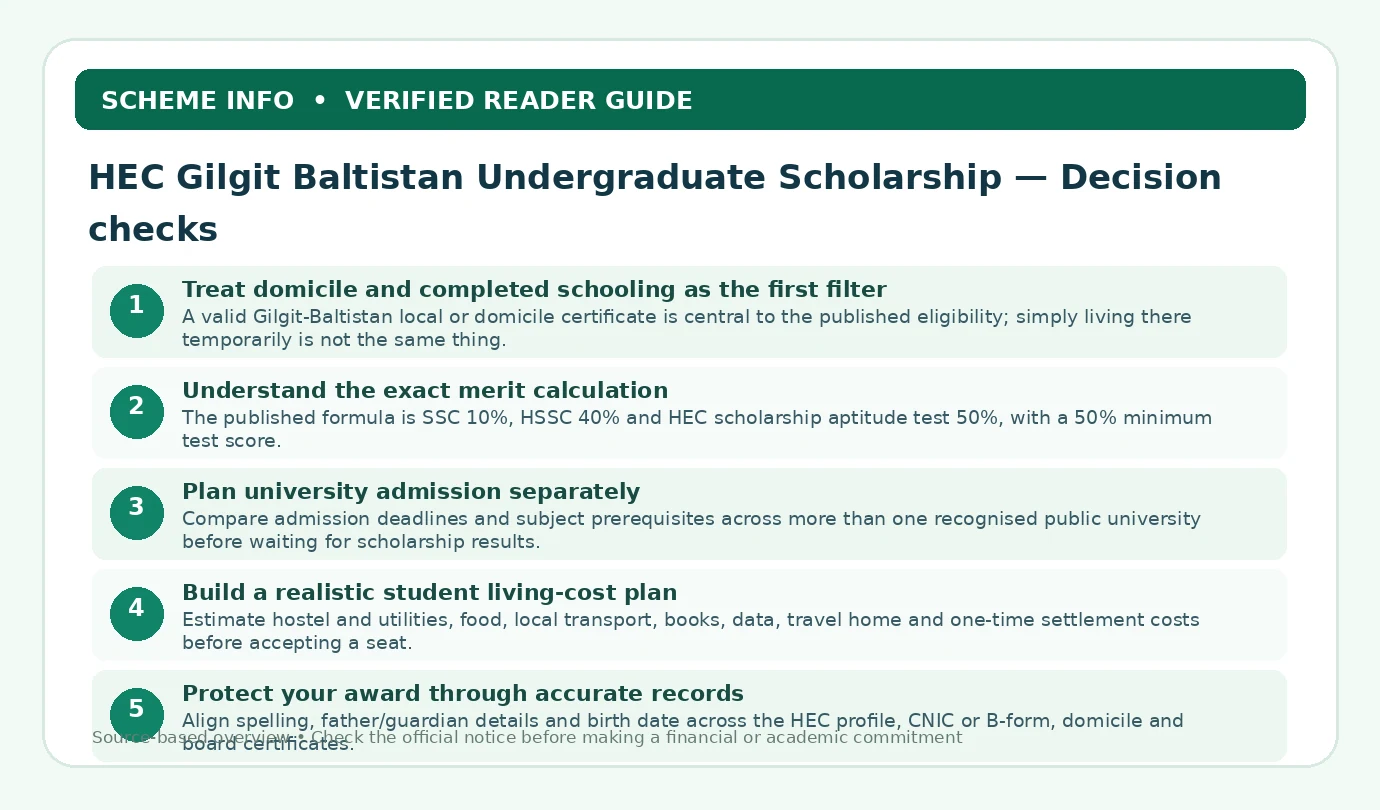
- Treat domicile and completed schooling as the first filter
- Understand the exact merit calculation
- Plan university admission separately
- Build a realistic student living-cost plan
- Protect your award through accurate records
- Programme details that often change the decision
- Student budget and eligibility worksheet
- Six mistakes that can undermine this application
- Real-life situations and the better decision
- How to apply for HEC Gilgit Baltistan Undergraduate Scholarship: six verified steps
- Related guides
- Frequently asked questions
- Official sources and editorial independence

Eligibility: who this programme is actually for
For HEC Gilgit Baltistan Undergraduate Scholarship, check these programme-specific conditions before preparing an application. Applicants need a valid Gilgit-Baltistan domicile or local certificate. They must have completed HSSC or an accepted equivalent. Recipients of another HEC or government scholarship are not eligible. Students already in a BS programme may qualify within the allowed one academic session. Eligible study must be at a recognised public-sector institution in Pakistan.
A quick self-screen before applying
- Gilgit-Baltistan domicile/local certificate
- Completed HSSC or recognised equivalent
- HEC-recognised public-sector institution in Pakistan under the published programme
- SSC 10%, HSSC 40%, scholarship aptitude test 50%
- At least 50% in the HEC test; result valid one year under published procedure
Where a location, degree, machine type or financial share is stated as a published condition, match it to your own document or quotation. An appealing programme title is not sufficient evidence of eligibility.
Required documents: organised and verifiable
The following documents and supporting evidence are relevant to HEC Gilgit Baltistan Undergraduate Scholarship. Mandatory and conditional items are distinguished below. Gilgit-Baltistan domicile or local certificate. CNIC or B-Form, as applicable to the student. HSSC and other relevant academic certificates or marksheets. University admission or enrolment evidence if already studying. Any HEC test or portal-specific document required in the active call. HEC confirms the eligibility criteria. This document list is a practical preparation checklist; the live HEC application notice controls exact uploads.
Five checks before uploading anything
- CNIC or student ID exactly matching the application
- Dated and complete records supporting the published eligibility conditions
- Official evidence for any special category, land holding or finance claim
- The latest advertisement or application guidance saved for reference
- A secure copy of submission acknowledgement and correspondence
A list from an old intake is a useful starting checklist only. Follow the mandatory format and attestation rules issued for the actual round, and protect personal certificates from unofficial agents.
Verified facts at a glance
The published programme tells you which route may be relevant; it does not prove that a specific applicant is selected. Here are the conditions worth checking first.
| Eligible geography | Gilgit-Baltistan domicile/local certificate |
|---|---|
| Academic requirement | Completed HSSC or recognised equivalent |
| University type | HEC-recognised public-sector institution in Pakistan under the published programme |
| Merit formula | SSC 10%, HSSC 40%, scholarship aptitude test 50% |
| Aptitude threshold | At least 50% in the HEC test; result valid one year under published procedure |
| Phase status | HEC reported completion of Phase I in March 2026 |
Details reviewed 12 November 2026. Official advertisements and award letters control any later changes.

Treat domicile and completed schooling as the first filter
An applicant needs to confirm that their personal records satisfy HEC’s defined regional and educational eligibility before spending on tests or travel.
- A valid Gilgit-Baltistan local or domicile certificate is central to the published eligibility; simply living there temporarily is not the same thing.
- Keep HSSC results or accepted equivalence ready. A predicted grade is not a substitute for a result already issued when the call requires it.
- Check restrictions on receiving another HEC or government award and disclose other financial assistance honestly.
- Already-enrolled BS students may be considered only within the stated maximum previous academic year or session.
- Confirm the chosen university is on the correct HEC-recognised public-sector list rather than relying only on its advertising.
What this means for a real applicant
A strong application starts with the decision the family or operator actually faces. Record the facts that apply to your own land, qualifications, machine or programme category and mark any missing evidence. A helpful scheme guide should enable you to decide whether to proceed, change the plan or investigate a different option.
Understand the exact merit calculation
Scholarship selection is not decided by HSSC percentage alone. HEC’s published procedure gives significant weight to its own aptitude test.
- The published formula is SSC 10%, HSSC 40% and HEC scholarship aptitude test 50%, with a 50% minimum test score.
- Illustration: SSC 80%, HSSC 75%, test 70% gives 8 + 30 + 35 = a 73-point weighted score out of 100.
- A test score below the published threshold is not cured merely by excellent board grades; check the current call’s threshold.
- HEC states that a test result remains valid for one year under the published procedure, but applicants should check any new intake’s rules.
- Keep original board marksheets and the exact test result so calculated merit can be verified.
How to turn these points into evidence
Where a number is published, keep the source and its date beside the calculation. Use actual fees, quotations, marks and family records—not a rounded social-media figure. The correct decision may be to revise the proposed amount, wait for a verified intake or ask the implementing office for written clarification.

Plan university admission separately
A provisional scholarship offer is not the same as a confirmed admission. HEC’s published procedure expects selected students to secure their own places at eligible institutions.
- Compare admission deadlines and subject prerequisites across more than one recognised public university before waiting for scholarship results.
- Ask each institution for a written first-year fee schedule covering tuition, hostel, deposits, laboratory charges and transport.
- Check which costs the HEC award will cover and what amount, if any, the family must pay above project limits.
- Keep admission offers and semester start dates because delays can affect placement and paperwork requirements.
- If already enrolled, obtain an official enrolment letter and verify that the preceding academic-session rule is met.
The hidden cost or condition
Compare the best-case headline with the less attractive possibilities: an applicant share above the cap, a delayed payment, a year of low demand, or a scholarship expense beyond the award. That comparison is what makes planning more reliable than relying on an eligibility headline alone.
Build a realistic student living-cost plan
Moving from Gilgit-Baltistan to another city can create expenses beyond the visible tuition amount. A student budget should consider the whole year.
- Estimate hostel and utilities, food, local transport, books, data, travel home and one-time settlement costs before accepting a seat.
- Distinguish university charges from allowances that may be disbursed later or in instalments, as timing matters when a semester begins.
- Keep a small reserve for examinations, medical needs or unexpected travel during difficult weather periods.
- Check accommodation safety and the actual distance to campus instead of choosing the cheapest advertised room.
- Keep all fee receipts and scholarship correspondence because allowances may require institutional verification.
How to check a claim before committing
Treat the active government advertisement, a university focal person or the responsible department as the decision-maker. An intermediary may help explain a process, but cannot change the formal conditions. Keep a dated screenshot or PDF of the notice when a portal opens.
Protect your award through accurate records
Document screening occurs after initial merit shortlisting; discrepancies in identity, qualification or attendance can delay or jeopardise a scholarship.
- Align spelling, father/guardian details and birth date across the HEC profile, CNIC or B-form, domicile and board certificates.
- Upload legible, complete pages and verify their orientation and expiry dates before submitting.
- Keep your email and telephone available for test instructions, scrutiny notices and formal award letters.
- Read the terms on academic progress, programme changes and withdrawal rather than assuming continued funding is unconditional.
- Do not pay private middlemen who claim to influence HEC test results or selection.
A practical next decision
Finish with a decision you can defend: the relevant scheme, the matching condition, the exact evidence, the cost or expected benefit, and the one unanswered question. This keeps the research focused rather than collecting forms before establishing a realistic path.
Programme details that often change the decision
These details address questions that often appear only after the headline scheme conditions are understood. Read the relevant point alongside the current official notice, particularly where a programme phase or regional rule matters.
Why the GB undergraduate award exists
The Higher Education Commission established an undergraduate programme to expand higher education opportunities for students with Gilgit-Baltistan domicile seeking study in recognised Pakistani public institutions. Imagine a student finishing HSSC in Gilgit and selecting a recognised public university.
Domicile is not optional
HEC’s published eligibility rules require a Gilgit-Baltistan domicile or local certificate. Academic success alone cannot replace the stipulated regional qualification. A reader weighing HEC Gilgit Baltistan Undergraduate Scholarship should record that detail before comparing advertised amounts. Imagine an already-enrolled BS student comparing admission date with the advertisement.
Academic preparation
Applicants need an HSSC or equivalent qualification, while graduates of different boards should check equivalence and any programme-specific subject prerequisites for their chosen degree. This specific condition matters more for HEC Gilgit Baltistan Undergraduate Scholarship than a headline about possible benefits. Imagine a family estimating transport and living costs beyond a scholarship award.
Already enrolled students
The HEC page indicates certain students who entered a BS programme no more than one academic session before the advertisement may qualify. Exact timing depends on the specific selection notice. It is a useful way to distinguish HEC Gilgit Baltistan Undergraduate Scholarship from superficially similar programmes. Imagine a candidate preparing for a scholarship aptitude test and university entrance.
Other awards can affect eligibility
Students already receiving another HEC or government scholarship are not eligible under the published rules. Disclose existing funding rather than assuming two public awards can be combined. The real value of HEC Gilgit Baltistan Undergraduate Scholarship depends on how that rule works on the ground. Imagine a student finishing HSSC in Gilgit and selecting a recognised public university.
Selecting a university
The programme is directed at public-sector universities or institutions of Pakistan. Students must also satisfy admission requirements and budget expenses beyond the project’s approved scholarship cost. This condition is often overlooked in casual descriptions of HEC Gilgit Baltistan Undergraduate Scholarship. Imagine an already-enrolled BS student comparing admission date with the advertisement.
Aptitude test and weights
HEC’s selection guidance references an aptitude test of at least 50% and a merit formula of SSC 10%, HSSC 40% and test score 50%. Confirm the current call before treating these as a new-year timetable. For anyone assessing HEC Gilgit Baltistan Undergraduate Scholarship, it defines an important boundary of eligibility or use. In the context of HEC Gilgit Baltistan Undergraduate Scholarship, A feasible applicant contribution can be difficult to assemble at the deadline. Imagine a family estimating transport and living costs beyond a scholarship award.
Admission is the student’s responsibility
A scholarship shortlist does not necessarily provide automatic admission to a degree. Applicants should compare universities, entrance dates, programme recognition and available seats. Those requirements should inform a decision about HEC Gilgit Baltistan Undergraduate Scholarship before any payment is made. Before committing to HEC Gilgit Baltistan Undergraduate Scholarship, A quotation should be evaluated for fit, warranty, eligibility and the ability to obtain repairs or academic services after approval. Imagine a candidate preparing for a scholarship aptitude test and university entrance.
Preparing documents
Keep domicile, CNIC or B-Form, board marksheets, admission evidence and accurate contact details ready. Any test registration, interview or undertaking will have instructions in the HEC notice. A credible plan for HEC Gilgit Baltistan Undergraduate Scholarship starts with a realistic understanding of this obligation. When planning around HEC Gilgit Baltistan Undergraduate Scholarship, A reasonable scenario includes both a normal outcome and a credible problem: an absent technician, unsuitable weather, additional travel, delayed payments or an academic admission result. Imagine a student finishing HSSC in Gilgit and selecting a recognised public university.
Funding is not an unlimited allowance
Scholarship support is governed by the approved award and institutional charges. A student who chooses a costlier institution or optional accommodation may face expenses beyond funded limits. When assessing current access to HEC Gilgit Baltistan Undergraduate Scholarship, treat announcements and open windows separately. Imagine an already-enrolled BS student comparing admission date with the advertisement.
Historical merit lists versus live applications
The official portal displays 2024–25 merit-list information, and a 2026 report discusses an earlier completed phase. That does not establish a fresh intake today. This is one reason that HEC Gilgit Baltistan Undergraduate Scholarship should not be compared only on its advertised maximum. Imagine a family estimating transport and living costs beyond a scholarship award.
Responsible next steps
Monitor the official HEC scholarship page, prepare your degree choices and evidence, then apply only through the scheme’s published channel during a verified application window. The next step for HEC Gilgit Baltistan Undergraduate Scholarship is to check the actual official process applicable to your case. Imagine a candidate preparing for a scholarship aptitude test and university entrance.
Student budget and eligibility worksheet
Education support should be measured against the full academic year: tuition, admission deposits, accommodation, books, local travel and living expenses. A stipend or scholarship may be paid on a different timetable from the costs.
Before you rely on the result
- I have the correct dated official notice, not only a blog or forwarded message.
- I understand which eligibility rule or project area applies to my own situation.
- My cost, award, or benefit calculation includes the non-covered items.
- I know who will verify the application and which document supports each claim.
- I have a practical alternative if I am not selected, if finance is refused or if funding is delayed.
Replace all hypothetical figures with your own dated records and the institution’s formal decision. A conservative plan is more useful than an optimistic estimate that has no margin for delays or setbacks.
Six mistakes that can undermine this application
These mistakes are particular to the HEC Gilgit Baltistan Undergraduate Scholarship described here. Check them against your actual circumstances before making commitments that may be hard to reverse.
- HEC’s announcement that Phase I reached high utilisation is programme history, not proof of a newly opened GB student application window.
- A valid GB domicile/local certificate and completed HSSC/equivalence are essential documentary checks before scholarship-test preparation.
- The aptitude test contributes half the published merit score and has its own 50% threshold; strong board marks alone do not guarantee shortlisting.
- GB programme guidelines refer to HEC-recognised public-sector universities, not every university that offers an undergraduate degree.
- Students already enrolled in BS courses should check the one-academic-session limitation precisely rather than assuming any current year qualifies.
- University admission and housing deposit deadlines may arrive before scholarship funds; calculate the timing gap before committing to a private hostel.
Taking an extra day to verify a condition can be less costly than discovering after purchase, enrolment or submission that the central requirement was misunderstood.
Real-life situations and the better decision
These are realistic examples intended to clarify decisions—not real applicants, official promises or predictions of selection. Use the questions each situation raises to check your own evidence.
A student with excellent HSSC results
The student must still understand the aptitude-test weighting and meet the published score threshold. The next step is to identify the formal requirement involved and obtain the specific supporting record, rather than making a payment on the strength of a verbal promise.
A student already in first-year BS
The candidate may fall within the limited already-enrolled eligibility, but should confirm the exact session timing and university recognition. An applicant should compare the actual cost and timing with a less risky alternative, then use the official office or bank to confirm what remains uncertain.
A student moving to a distant city
Even with scholarship support, deposits and travel costs can arise before an allowance arrives, so a verified fee plan is essential. The applicant should keep the relevant advertisement or award letter and avoid interpreting a planned project, a maximum grant or an old deadline as a guaranteed benefit.
How to apply for HEC Gilgit Baltistan Undergraduate Scholarship: six verified steps
There is no single universal application form for every programme. The steps below explain the right order of preparation while leaving each authority’s current instructions in control.
- Confirm the latest intake: Check the named authority’s current advertisement and date. An older phase, archived form or project allocation does not establish an open application window.
- Screen eligibility first: Compare your true academic record, household status, landholding or approved machine requirement with the exact published criteria.
- Collect and check records: Prepare legible identity, education, land, category or financial documents as appropriate. Confirm names and numbers match before submission.
- Calculate the real commitment: For machinery, obtain a dated quote and own-share estimate; for study, calculate all fees and living expenses; for community works, establish feasibility and rights.
- Submit through the authorised route: Use the official portal, university scholarship office or designated agriculture office. Do not pay a person who promises selection.
- Save references and read the outcome: Keep the acknowledgment, follow official updates, verify any selection and review the actual award, contract or acceptance conditions.
Official sources and editorial independence
Read the current notice alongside this independently edited guide. SchemeInfo is an information website—not the department, university, government, lender or scholarship provider. No application or selection can be guaranteed here.
Editorial verification completed 12 November 2026; later changes should be checked directly with the listed authorities.
Frequently asked questions
These answers reflect the published sources as checked in November 2026. A fresh government advertisement, university notice or award letter can change the procedure for the next intake.
Who is eligible geographically?
Applicants must hold a Gilgit-Baltistan domicile or local certificate.
Can students from private universities apply?
The published GB programme specifies HEC-recognised public-sector institutions.
What test score is required?
The official selection procedure mentions at least 50% on the aptitude test.
How is merit weighted?
SSC 10%, HSSC 40% and aptitude test 50%.
Is an old test valid forever?
No. HEC lists one-year validity under the published procedure.
Can a first-year BS student apply?
Possibly, within the stated previous one academic session rule.
Can I receive another government scholarship?
The eligibility page excludes concurrent HEC/government awards.
Is a new 2026 intake confirmed open?
Completion of Phase I does not establish a fresh active application window.
Who secures university admission?
Selected students are expected to secure admission at an eligible university themselves.
Where can I check the latest process?
HEC’s GB eligibility, selection and programme notice pages.