Benazir Nashonuma Program: Practical Eligibility, Costs, Verification And Next Steps
Nutrition support is designed around pregnancy, breastfeeding and a child’s earliest development—not just the receipt of a cash instalment. Benazir Nashonuma connects eligible BISP families with participating health and nutrition services and follow-up visits.
The short answer
BISP describes a first-1,000-days programme for eligible pregnant or breastfeeding women and children under two, combining conditional cash transfers, specialised nutritious food, routine monitoring and health advice. Availability depends on functioning Nashonuma centres and local referral processes.
Current Official Position And What It Means
Our review uses the official programme information available on 15 November 2026. A webpage can describe a product without confirming whether applications are being accepted in every district, whether funds are available, or what an individual household will receive. Always distinguish published policy from a personal approval.
| Question | Evidence-based answer |
|---|---|
| What are you evaluating? | Benazir Nashonuma Program |
| Where should details be checked? | Official programme information |
| What must not be assumed? | That an application, assessment, approval and payment are the same stage. |
What The First 1,000 Days Means In Daily Life
The programme uses the period from conception to a child’s second birthday because nutrition, infection prevention and timely health care can influence early growth. Support may include specialised nutritious food, health counselling, growth monitoring and cash linked to programme attendance. The purpose is not to replace ordinary meals or professional care but to strengthen them.
A family should ask which visits are expected during pregnancy and after birth, which documents staff need, how a child’s growth is recorded and how referrals work if a health worker identifies a problem. Keep vaccination cards and antenatal notes together so appointments are not delayed by missing papers.
If the programme provides nutrition products, follow the health worker’s instructions for the intended family member and dosage. Do not sell, share or replace them with unverified supplements. If food intolerance or illness occurs, seek clinical advice.
Key Facts At A Glance
These are the central published facts for the Benazir Nashonuma Program, not a guarantee of admission, approval or an open registration window. The references at the bottom distinguish current official pages from historical phases.
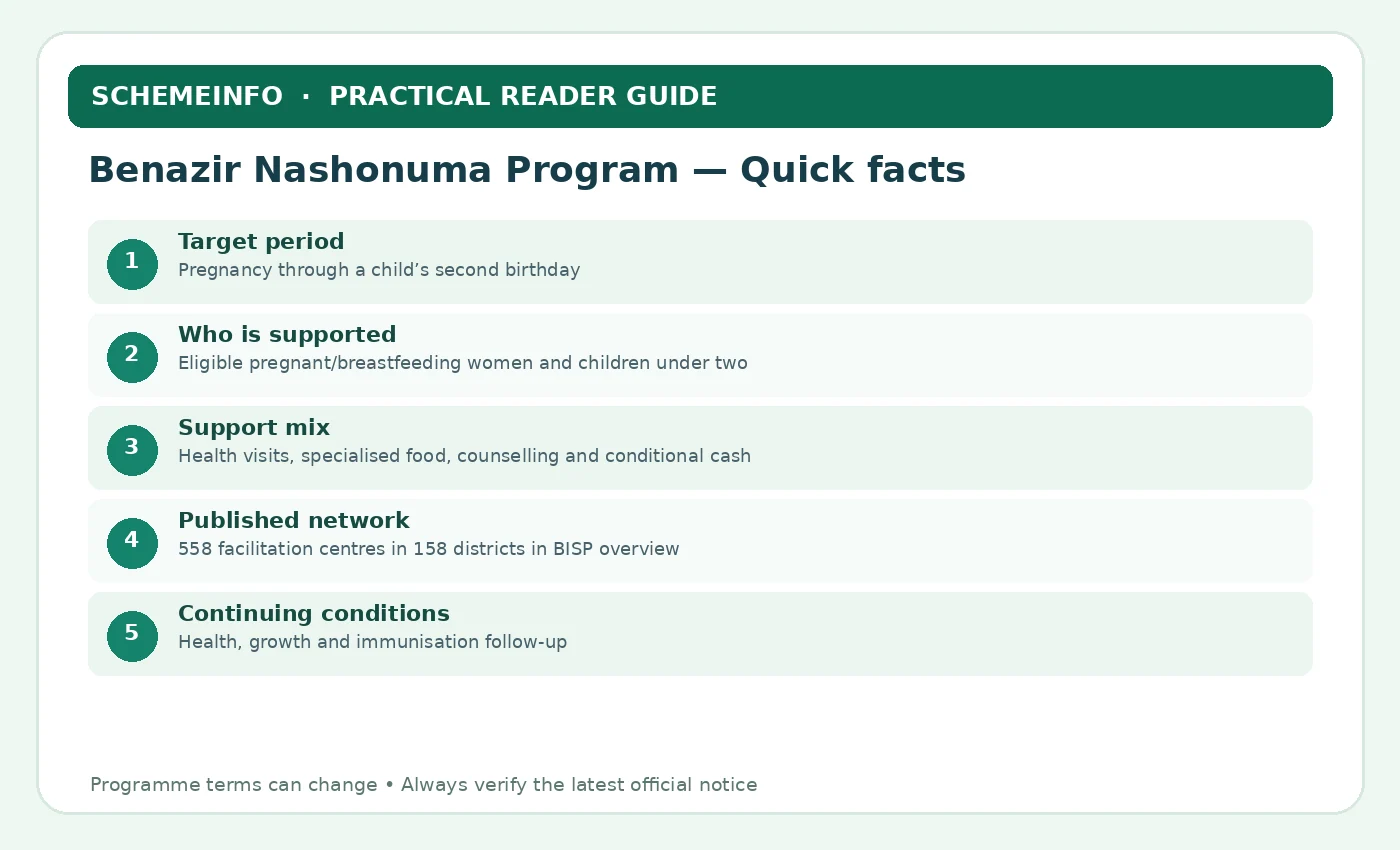
| Target period | Pregnancy through a child’s second birthday |
|---|---|
| Who is supported | Eligible pregnant/breastfeeding women and children under two |
| Support mix | Health visits, specialised food, counselling and conditional cash |
| Published network | 558 facilitation centres in 158 districts in BISP overview |
| Continuing conditions | Health, growth and immunisation follow-up |
Eligibility And Household Suitability
Begin with the institution’s written eligibility rules for Benazir Nashonuma Program. These checks are not a promise of approval; eligibility is decided through the named programme’s actual verification process.
- Pregnant or lactating woman aged 18–59 already enrolled in BISP Kafaalat, according to the published design.
- Children of Kafaalat beneficiaries below two years of age may qualify.
- Beneficiary must live in a district or area where the programme is operating.
- Health screening, routine clinical visits and compliance with programme conditions are required for conditional transfers.
- Child health status, immunization and family records should be verifiable by the participating health service.
Proof Of Identity And Supporting Documents
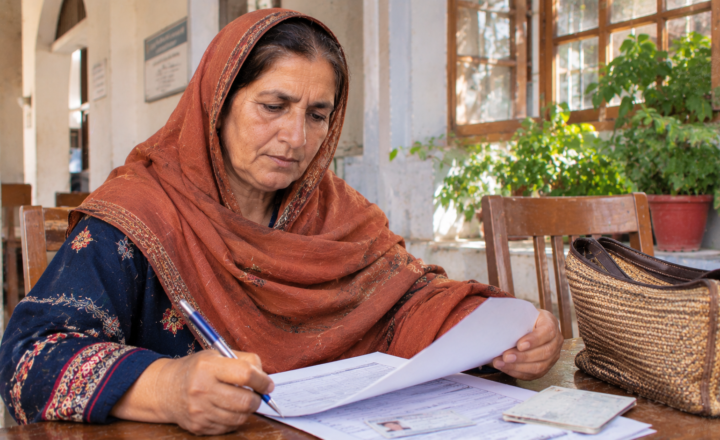
Keep essential records legible and separate from optional supporting papers. For Benazir Nashonuma Program, confirm which forms the responsible office requires before sharing identity or family information.
- Beneficiary’s valid original CNIC and confirmation of active Kafaalat status.
- Pregnancy screening or antenatal registration at a recognized programme-linked health facility.
- NADRA family registration evidence for the child when relevant.
- Child immunization card from the applicable EPI programme.
- Follow-up clinic, growth-monitoring or counselling records requested at the facilitation centre.
How The Programme Works In Practice
Use these programme-specific details to check the official route and to avoid interpreting a rule more broadly than it was written.
The First 1,000 Days Approach
Nashonuma aims to protect nutrition from pregnancy until a child’s second birthday, a period of rapid growth. It combines conditional cash support with health and nutrition services. A payment alone cannot replace antenatal care, vaccinations or reliable nutrition advice from qualified health workers.
How Kafaalat Status Connects
The published design targets pregnant and breastfeeding women already enrolled in Kafaalat, and qualifying children of beneficiary households. Confirm the family’s current status before travelling to a programme facilitation centre.
Pregnancy And Lactation Eligibility
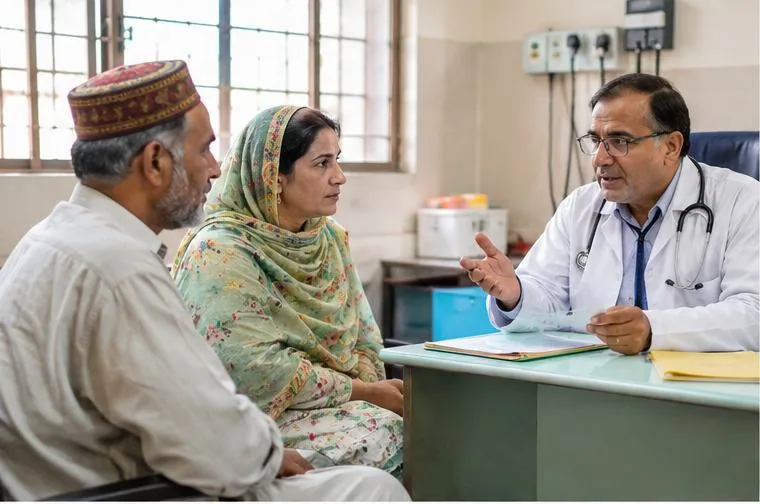
BISP’s design notes pregnant or lactating women aged 18–59, subject to the local service rollout. A health professional verifies pregnancy; a WhatsApp screenshot or self-declaration is not an accepted substitute.
Support For Children Under Two
The Benazir Nashonuma Program separately covers children of eligible households during their early life, with routine monitoring and nutrition services. When the child approaches the second birthday, ask what the graduation or exit procedure means for continued support.
Verification, Selection And Payment
Cash Transfers And Health Conditions
The official design links quarterly stipends to health compliance such as antenatal and postnatal visits, child growth monitoring and immunization. If a visit is missed, contact the participating clinic to ask whether and how the required service can be rescheduled.
Specialized Nutritious Food
BISP lists specialized nutritious food as part of the programme along with communication about dietary diversity. Use the food exactly as the qualified programme team explains; do not sell it or substitute it for an infant’s entire diet.
Published Quarterly Amounts
BISP’s programme-design document lists Rs. 3,500 for a pregnant woman, Rs. 3,500 for a boy child under two and Rs. 4,000 for a girl child under two. These are document-specific figures; ask the facilitation centre for any later revision and actual payment schedule.
What Happens During A Clinic Visit
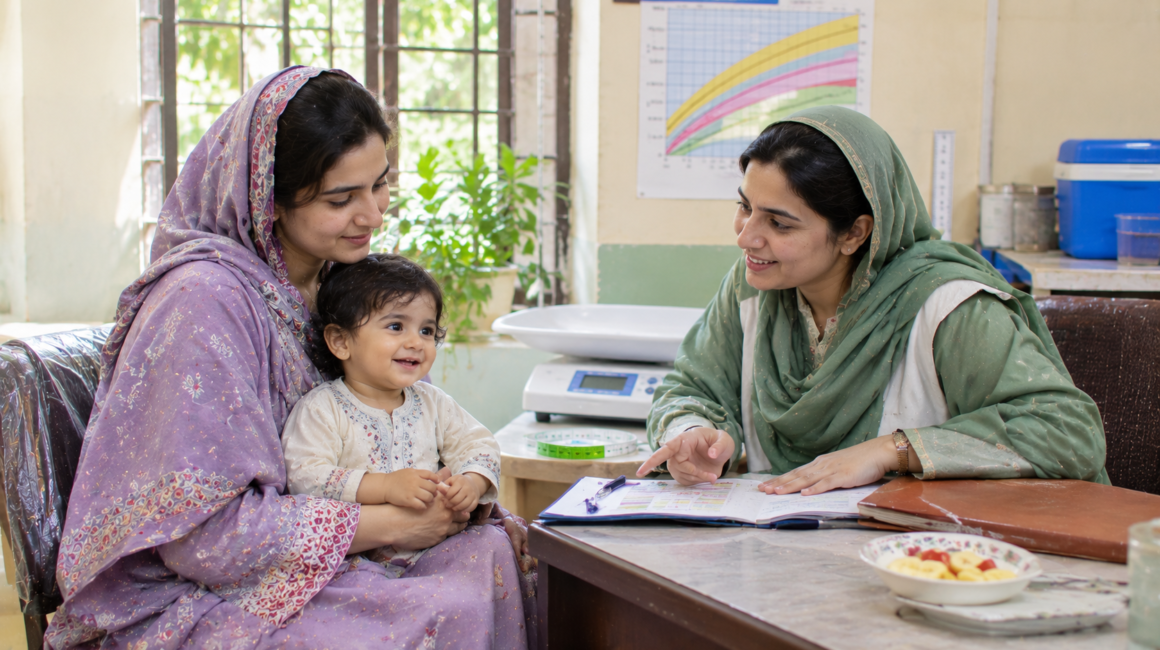
A visit may involve pregnancy assessment, child growth measurements, nutrition counselling or immunization record review. Carry the health card and a written list of questions about feeding difficulties, missed vaccines or maternal symptoms.
Which Situation Fits You? A Practical Comparison
Similar searches often hide very different needs. Use these examples to decide which documents, questions and programme conditions matter to you.
Confirm programme participation and antenatal visit schedule.
Bring growth and immunisation records for eligibility and follow-up.
Ask BISP/health staff for the current referral arrangement.
These scenarios are illustrative rather than eligibility decisions. The relevant authority or lender must confirm each actual case using current rules and documentary evidence.
Make Each Centre Visit Useful Even If Payment Is Delayed
Write down the child’s age, recent illnesses, feeding concerns and questions for the health worker before visiting. Ask about breastfeeding support, appropriate complementary feeding at the correct age, safe drinking water and when to seek immediate help for dehydration or breathing difficulty.
If an appointment is missed because of travel, illness or a centre closure, contact the participating centre to ask how the attendance record can be corrected. A payment delay should not discourage timely antenatal visits or routine child immunisation through the health system.
National programme reach statistics do not prove that every village clinic has a centre. Confirm the participating location and hours locally rather than relying on an old map screenshot.
Paperwork, Costs And Real-World Complications
Why Vaccinations Are Recorded
The Benazir Nashonuma Program ties child support to routine immunization and the official EPI schedule. Accurate records help staff check whether milestones have been met. Do not alter an immunization card to qualify for a payment; seek a legitimate catch-up schedule from a clinician.
Growth Monitoring Without Alarm
A growth measurement is a clinical screening tool, not a judgement on a parent. Health staff interpret changes using age and other medical information. Ask a qualified professional what the result means and when follow-up is needed, rather than relying on a single number from an unofficial app.
Which Districts Have Services
BISP describes a rollout through facilitation centres, but the location of a specific operating centre can change. Verify the nearest active participating health facility with the district BISP or health programme office.
How To Register Without An Agent
Enrollment follows Kafaalat eligibility and programme-linked health screening. No private agent can legitimately approve a beneficiary. Keep identity information private and avoid paying to have a name added to a supposed nutrition list.
What To Do When Something Goes Wrong
Recording Visits And Resolving Delays
Health and payment systems can update at different times. A family should keep visit cards and seek official assistance if a stipend is delayed. Bring the CNIC, relevant health documents and dates of attended appointments to help staff trace the issue.
Nutrition Information Families Can Use
Practical actions include safe food preparation, breastfeeding support when appropriate, age-appropriate complementary feeding and medical follow-up. Personal feeding questions and signs of illness need advice from a qualified clinician, not a financial article.
When Support Ends Or Changes
A child’s eligibility is age-limited, and a mother’s service conditions may change after pregnancy and lactation. Ask the centre about exit dates and other available maternal and child health programmes rather than assuming automatic extension.
Checks To Complete Before Applying
These steps translate the published rules into concrete decisions. Use them as preparation, and allow the official department to determine eligibility, payment or selection.
Use The First 1,000 Days For Care, Not Paperwork Alone
The central purpose of Nashonuma is to reduce early childhood malnutrition through connected maternal care, nutritious food and health follow-up. The cash element supports attendance and nutrition but cannot replace clinical advice.
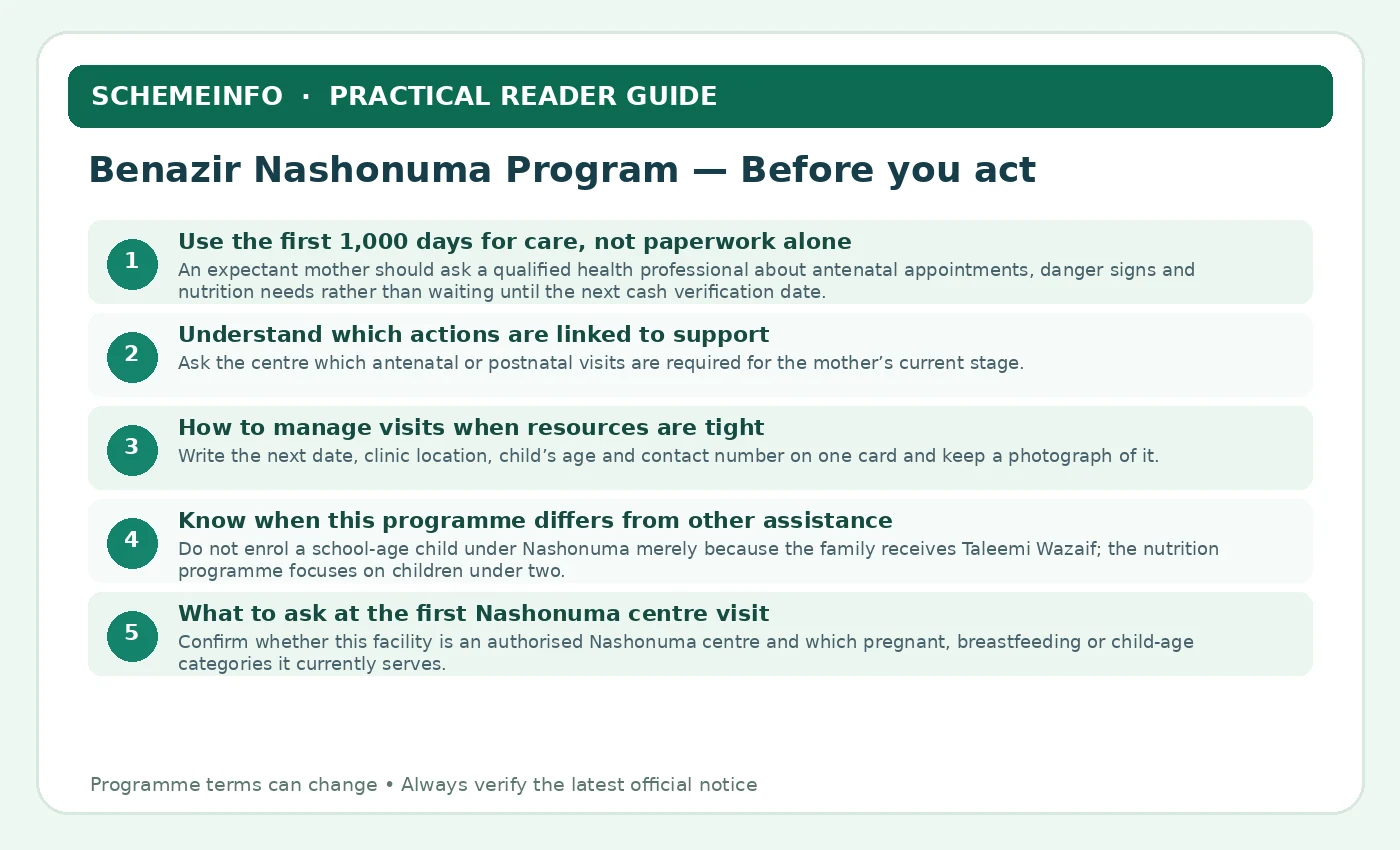
- An expectant mother should ask a qualified health professional about antenatal appointments, danger signs and nutrition needs rather than waiting until the next cash verification date.
- Keep the mother’s CNIC, applicable BISP registration and antenatal card available for the participating centre to check.
- After birth, maintain the child’s birth or immunisation record and follow the centre’s schedule for growth checks and feeding guidance.
- Use specialised nutritious food according to the trained worker’s directions; giving it to an ineligible person may reduce its intended benefit.
- If the household cannot reach the centre regularly, ask whether a closer facility or authorised mobile unit is available.
Urgent maternal or child symptoms require immediate medical care through local health services; a scheme appointment is never a reason to delay emergency treatment.
Understand Which Actions Are Linked To Support
Unlike unconditional Kafaalat payments, Nashonuma links part of its support to health and nutrition interactions. The family should know what a scheduled visit is for and how it is recorded.
- Ask the centre which antenatal or postnatal visits are required for the mother’s current stage.
- Keep the vaccination card current and ask how missed appointments should be handled after illness or travel.
- Record every growth-monitoring visit; weight and length measurements are used to track health trends, not to shame parents.
- Know how the centre confirms that specialised food or cash support was delivered, and retain receipts or visit notes if available.
- If a payment is delayed, distinguish a missing biometric record from a missed health milestone; the remedy differs.
Health professionals should interpret growth and feeding problems. Beneficiaries should not change treatment based on an online stipend guide.
How To Handle Records, Delays And Follow-Up
These steps translate the published rules into concrete decisions. Use them as preparation, and allow the official department to determine eligibility, payment or selection.
How To Manage Visits When Resources Are Tight
A family’s real challenge may be transport, work schedules, childcare and the cost of nutritious foods. A small calendar and budget can reduce avoidable missed appointments.
- Write the next date, clinic location, child’s age and contact number on one card and keep a photograph of it.
- Prepare a modest return-transport budget and identify a safe companion if travel during pregnancy is difficult.
- Ask a health worker for affordable local dietary alternatives based on pregnancy stage, breastfeeding and the child’s age.
- Discuss how to manage visits around paid work or seasonal migration instead of missing several appointments and attempting to fix the record later.
- Keep the child’s immunisation and measurement records together with programme papers, but do not publish them in community groups.
The best use of the Benazir Nashonuma Program is sustained care across visits, even when the cash transfer is delayed.
Know When This Programme Differs From Other Assistance
Kafaalat eligibility and Nashonuma participation are connected but not identical. School-age educational stipends and maternal nutrition assistance solve different needs at different life stages.
- Do not enrol a school-age child under Nashonuma merely because the family receives Taleemi Wazaif; the nutrition programme focuses on children under two.
- Ask whether the woman’s Kafaalat record, pregnancy status and local participating-centre conditions meet the current rules.
- Check the officially published amount for the correct group and visit stage; different child or maternal categories can carry different rates.
- When the child reaches the age limit, ask about normal exit and ongoing public child-health services rather than expecting the same benefit indefinitely.
- Use BISP or the participating centre to report missing service or fraudulent deductions, not a private “registration consultant”.
The goal is healthy pregnancy and child development; financial support is one element in that broader service.
Your Personal Verification Worksheet
Use the questions below as a short decision worksheet for Benazir Nashonuma Program. Each answer should be supported by your own records, a current notice or a written response from the authorised office. This is more useful than a generic checklist copied between unrelated welfare schemes.
- Check 1: Which specific official announcement or policy version applies to my household, student, patient or construction project?
- Check 2: Who makes the final decision, and what document proves that this office has processed my case?
- Check 3: Which eligibility condition could rule me out even if I genuinely need support?
- Check 4: Which expenses are definitely included, which are conditional, and which will remain my responsibility?
- Check 5: What dates, records or verification steps could cause an avoidable delay?
- Check 6: How will I distinguish a provisional result from a final award, approved payment or signed loan?
- Check 7: What safe alternative will I use if the award or instalment does not arrive?
- Check 8: Who can answer a complaint without charging an unofficial fee or demanding a password?
Four Topic-Specific Checks Before Making A Commitment
If the household cannot reach the centre regularly, ask whether a closer facility or authorised mobile unit is available.
If a payment is delayed, distinguish a missing biometric record from a missed health milestone; the remedy differs.
Keep the child’s immunisation and measurement records together with programme papers, but do not publish them in community groups.
Use BISP or the participating centre to report missing service or fraudulent deductions, not a private “registration consultant”.
Confirm the correct BISP or centre contact for a missed appointment, payment issue or change of household address.
Seek prompt medical assessment for dehydration, feeding refusal, fever or other worrying symptoms; a future stipend is not emergency medical care.
Do not assume that a promising website headline has settled all eight questions. A time-sensitive government payment or school result can be genuine while an individual application remains incomplete.
Two Common Decisions To Consider
These scenarios are illustrations, not real applicants, case-law findings or promised outcomes. Their purpose is to show what a careful next decision looks like when one key detail is uncertain.
A Breastfeeding Mother Moves To Another District
She should ask the designated Nashonuma office how to transfer or continue follow-up at an authorised facility rather than assume every clinic can access her existing record.
A Child Is Unwell Before A Scheduled Nutrition Visit
Seek clinical advice immediately; then notify the Benazir Nashonuma Program centre about the appointment and any needed record update.
Finding Support And Completing Visits
For this programme, the proper sequence is shaped by the administering office and the current phase. Follow the published instructions wherever they differ from a general checklist.
- Find the real office: Open one of the official Benazir Nashonuma Program sources below and check the agency name, contact details and any current notice rather than an unofficial social-media form.
- Check the exact rule: Compare the relevant class, household benefit, financial-need threshold, clinical condition or ownership document against the formal criterion for your situation.
- Prepare only the right documents: Match names, CNIC or B-form details, educational or medical records and current contact information. Mark conditional papers rather than treating every checklist item as compulsory.
- Resolve uncertainties before travel: Ask the receiving institution whether the phase is open, which office will verify the file and how an acknowledgement or reference will be issued.
- Submit through an authorised channel: Use the official online application if one is genuinely open, or the named welfare office, school, hospital or local committee where the rules require it.
- Save the result and plan the next action: Keep an acknowledgement, payment advice, academic result or decision letter; confirm any appeal, correction or next-round process through the same authority.
Practical Checklist: Verify, Prepare, Compare And Follow Up
Use this short workflow before relying on a claim in a video, broker message or outdated article. It is useful whether you are submitting an application, comparing finance or tracking an existing benefit.
- Identify the programme precisely. Check the official name, relevant agency and product type.
- Read current eligibility. Match the district, family circumstances, age and documents to the published requirements.
- Verify the official route. Type the authority’s web address yourself or use its published branch details.
- Estimate costs and time. Include fees, travel, waiting periods, instalments or conditional visits as relevant.
- Keep a document record. Save the reference number, receipts and any written answer from staff.
- Protect your identity. Never disclose an OTP or pay to a personal wallet for “guaranteed” approval.
- Check the next stage. Registration is not selection; selection is not necessarily disbursement.
- Follow up through official channels. Escalate a rejected, delayed or incorrect record using the published complaints process.
Official Sources And Editorial Notes
Primary government, regulator or programme-provider references are listed below. The guide is independent and does not accept applications, collect CNIC information or guarantee approval. Some pages display historic scheme parameters; check the date and the most recent notice.
Research review: 15 November 2026. Product terms, public-service operations, eligibility, coverage and fees may change. Worked figures in this article are explanations, not offers or guaranteed payments.
Frequently Asked Questions
Is The Programme Accepting Applications Today?
BISP’s published design covers eligible Kafaalat mothers and children under two in rollout areas; service availability must be checked locally.
Who Can Meet The Main Eligibility Conditions?
Pregnant or lactating woman aged 18–59 already enrolled in BISP Kafaalat, according to the published design. Applicants must also satisfy the remaining conditions and verification steps.
Which Identity Document Should I Prepare?
Beneficiary’s valid original CNIC and confirmation of active Kafaalat status. Bring originals only when the authorized office requests them for inspection.
Is Approval Guaranteed After Submitting A Form?
No. Eligibility, verification, available allocation and current application rules determine the decision. A reference receipt is not an approval letter.
Where Can I Verify The Latest Deadline?
Use the official source page linked below and the office named in the current circular. Do not rely on an unofficial application countdown.
Can I Use An Agent To Speed Up Approval?
Do not pay an unverified agent or share identity numbers and one-time passwords. Ask the responsible authority about its ordinary submission channel.
What If My Information Is Incorrect?
Correct records with the issuing authority before resubmission. Keep proof of any accepted change and avoid submitting contradictory forms.
How Do I Check Whether A Payment Or Award Was Approved?
Use the designated official status mechanism or the responsible institution, with your application reference and valid identification.
Will I Receive The Maximum Advertised Amount?
Not automatically. The published benefit and an individual award are different things; approved terms, service coverage and available funding control the final result.
What Is The Safest Next Step?
For Benazir Nashonuma Program, review the two checklists above, verify BISP Nashonuma official programme design and contact the responsible office if an important rule is unclear.