SchemeInfo • Independent Pakistan programme guide • Reviewed 12 November 2026
The practical starting point for KP Ehsaas Apna Ghar Scheme is to understand who runs it, what applicants actually qualify for, and whether the current route is open. This guide focuses on source-backed facts, careful document preparation, affordable decisions and scam prevention rather than promising an approval.
Explore this guide — table of contents
- Key facts at a glance
- Eligibility requirements
- Required documents
- How the programme works
- Selection, verification and payment explained
- Documents, costs and practical circumstances
- Practical decisions before applying
- Practical decisions after verification
- More topic-specific planning checks
- Reader decision worksheet
- Worked examples
- How to proceed
- Related guides
- Frequently asked questions
- Official sources and disclaimer
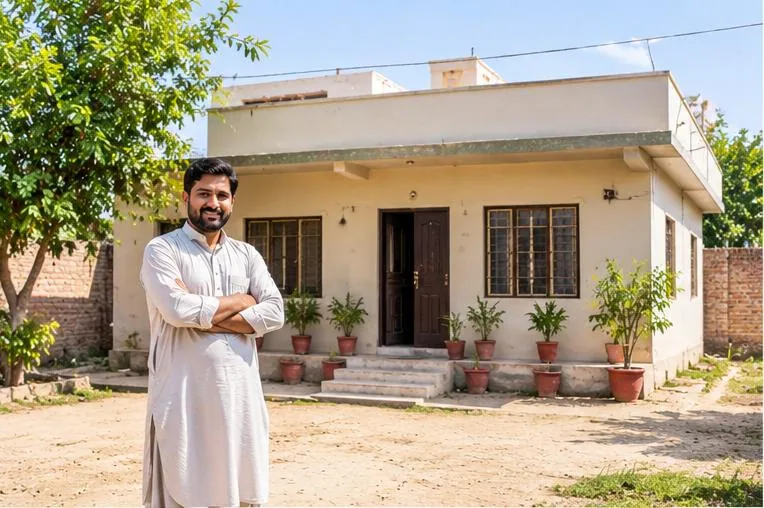
At a glance: programme facts that matter
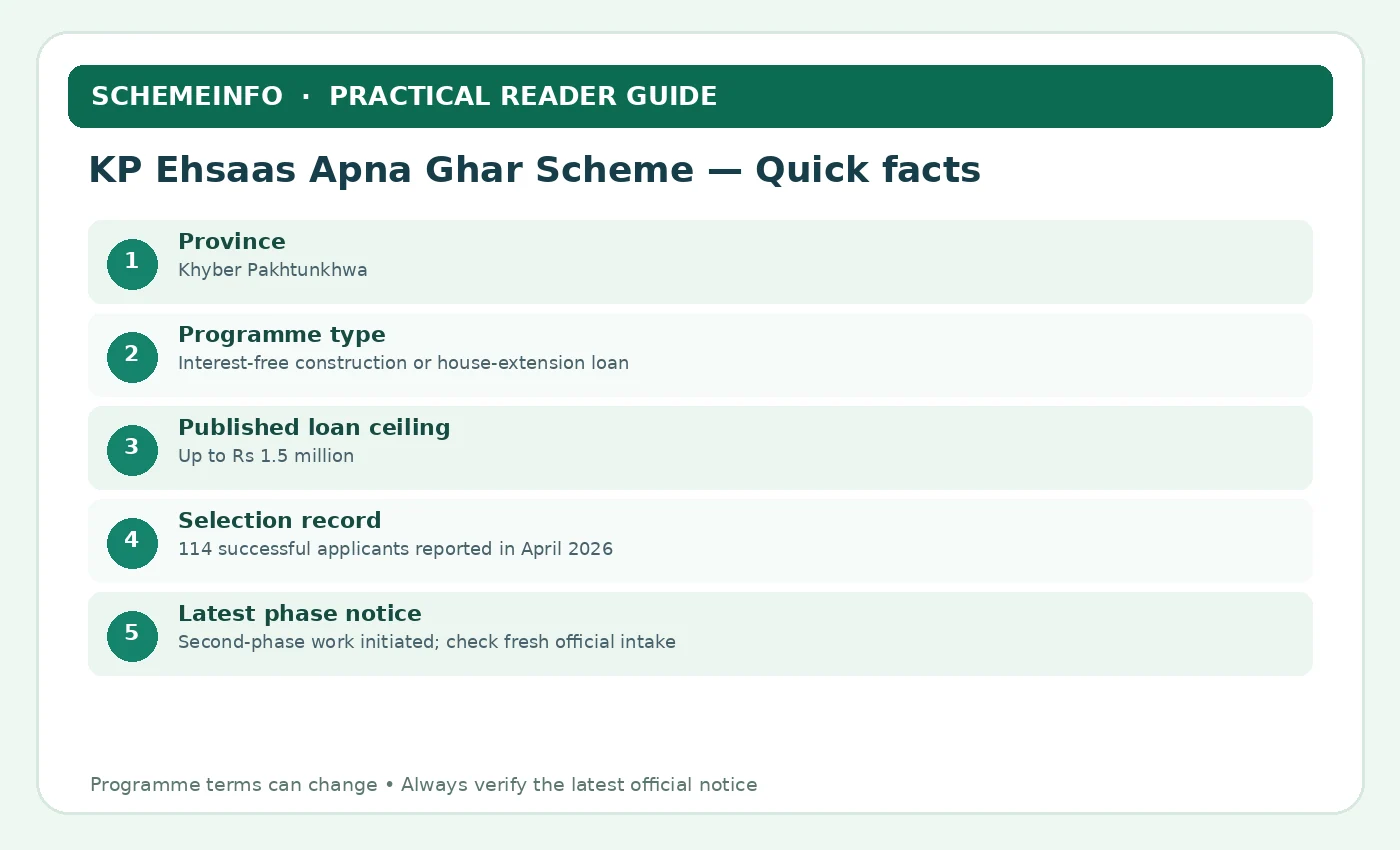
These are the central published facts for the KP Ehsaas Apna Ghar Scheme, not a guarantee of admission, approval or an open registration window. The references at the bottom distinguish current official pages from historical phases.
| Province | Khyber Pakhtunkhwa |
|---|---|
| Programme type | Interest-free construction or house-extension loan |
| Published loan ceiling | Up to Rs 1.5 million |
| Selection record | 114 successful applicants reported in April 2026 |
| Latest phase notice | Second-phase work initiated; check fresh official intake |
Eligibility: who should check the rules?
Begin with the institution’s written eligibility rules for KP Ehsaas Apna Ghar Scheme. These checks are not a promise of approval; eligibility is decided through the named programme’s actual verification process.
- Applicant should be part of a KP household covered by the officially announced phase and local residency rules; verify domicile before applying.
- Household needs to satisfy the poverty/income or low-cost-housing assessment published for the relevant phase.
- For building or expanding, applicant should be able to document lawful rights to the proposed plot or house; confirm the phase’s exact property rule.
- Applicant must be able to meet the partner’s identity, verification and repayment-assessment requirements.
- Selection may depend on eligible applications and computerised balloting; meeting preliminary conditions does not guarantee funding.
- Any special-category quota requires evidence accepted by the implementing authority and may change by programme phase.
Documents to prepare, and who verifies them
Keep essential records legible and separate from optional supporting papers. For KP Ehsaas Apna Ghar Scheme, confirm which forms the responsible office requires before sharing identity or family information.
- Valid CNIC and active contact details for applicant and any required household co-applicant.
- KP residence/domicile evidence if required in the current application notice.
- Proof of ownership or legal possession of the plot/house proposed for construction or expansion.
- Construction estimate, rough floor plan or contractor cost breakdown if requested during appraisal.
- Income and household information for affordability and programme verification.
- Application acknowledgement or balloting reference from the official phase, where issued.
What the published programme actually means
Use these programme-specific details to check the official route and to avoid interpreting a rule more broadly than it was written.
What the provincial programme is designed to do
The provincial initiative is intended to help low-income households build or enlarge safe homes without conventional interest charges. It is not a free plot allotment and should not be confused with ordinary commercial housing finance. Public announcements cite an upper financing amount of Rs 1.5 million, but the amount awarded to any particular household depends on the approved programme terms and construction needs. After obtaining support, review the outcome with the same care used during the application. Keep payment evidence, record any remaining balance and confirm whether follow-up reporting is required. If the facility is repayable, an accurate calendar protects the household.
What the 2026 official record actually shows
KP’s April 2026 information service reported disbursements to 114 beneficiaries and described preparations for a second phase. The provincial roadmap lists a pilot, completed planning milestones and delayed expansion arrangements. Those facts establish real activity, but do not prove a public application form is currently accepting submissions. A trustworthy guide must separate official implementation history from fresh intake availability.
Provincial housing versus federal mortgages
The federal Wazir-e-Azam housing programme is a separate scheme with its own online portal, participating institutions and subsidised markup structure. KP’s Ehsaas Apna Ghar is described as interest-free provincial construction/extension assistance with a smaller financing ceiling. Readers should compare the actual lending agreement, not assume a federal mortgage page is the registration portal for the KP pilot. For KP Ehsaas Apna Ghar Scheme, this is more productive than repeatedly completing unrelated web forms. Finally, remember the distinction between being eligible and being funded. A legitimate programme or lender can receive more qualifying applications than it can support.
Plot ownership and what can be built
A family considering construction should collect the ownership record, identify any shared heirs and determine whether its proposed work is lawful at the location. A cost estimate should distinguish a new room, roof repair, boundary wall and full dwelling, because not every expenditure necessarily meets phase conditions. Ownership and construction-purpose questions must be confirmed with the implementing authority. In the context of KP Ehsaas Apna Ghar Scheme, this difference can change both the applicant’s next action and expectations. When examining KP Ehsaas Apna Ghar Scheme, look for the latest dated primary-source update and identify which stage it confirms.
Selection, verification and payment explained
How computerised balloting affects selection
Provincial records refer to a large pilot application response and successful applicants chosen through balloting. A public lottery is a selection mechanism after preliminary review, not a substitute for meeting eligibility criteria. Households should retain official application receipts, watch for authenticated results and refuse offers to purchase a supposedly winning ballot number. A credible guide to KP Ehsaas Apna Ghar Scheme needs to acknowledge limits as clearly as the possible benefits. Under KP Ehsaas Apna Ghar Scheme, any authorised support should be matched to the permitted purpose rather than spent on unrelated purchases. Consider a household whose income fluctuates from one month to the next.
Understanding the Rs 15 lakh ceiling
“Up to Rs 1.5 million” means a maximum, not a standard cheque. A realistic cost sheet should show labour, materials, transport, municipal work and a contingency. If an approved amount is lower, the family needs a lawful plan to complete safe construction without becoming dependent on expensive unsecured debt. Never commit a contractor based only on a rumour of selection. People researching KP Ehsaas Apna Ghar Scheme should keep the original document date beside any figures they encounter. People seeking KP Ehsaas Apna Ghar Scheme should never hand original identity papers to an unofficial intermediary.
Planning monthly repayment before applying
Interest-free lending still involves repayment of principal and may include procedural duties. Divide the amount actually requested by the possible repayment periods in the official agreement to understand the budget impact; do not assume a repayment term not yet verified for the new phase. Compare that instalment with reliable household surplus after food, school and healthcare, not headline income. Any decision involving KP Ehsaas Apna Ghar Scheme is stronger when the applicant can show accurate records and a manageable budget. For KP Ehsaas Apna Ghar Scheme, keep the application or reference number and ask a precise question: which stage is recorded and what, if anything, is outstanding? Timing deserves attention because a previously announced phase may now be closed, paused or awaiting finance.
Practical steps before a new application opens
Locate the official housing department or authorised partner announcement, check geographic coverage, confirm whether the phase is a pilot or province-wide, and ask how forms are accepted. Assemble identity and plot documentation but avoid uploading originals to an unverified domain. If the portal is closed, save the official notice rather than submitting to cloned websites. The practical value of KP Ehsaas Apna Ghar Scheme depends on the approved conditions, not the size of a headline. If KP Ehsaas Apna Ghar Scheme concerns construction or enterprise equipment, keep receipts and truthful progress records.
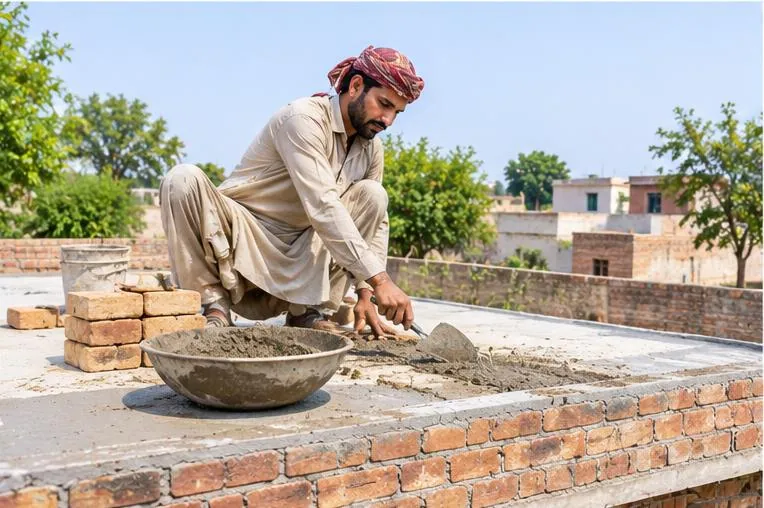
Documents, costs and practical circumstances
Verification visits and construction checks
A housing project may need site verification, cost validation and periodic release checks. Take clear photographs, keep contractor quotations and document the stage of work before accepting funds. If the programme releases amounts in phases, a household should know what proof unlocks the next instalment. Do not present illustrative photos in a guide as evidence of official inspections. A family comparing KP Ehsaas Apna Ghar Scheme should look at personal eligibility before relying on publicised amounts. Stop and compare the demand with the official process for KP Ehsaas Apna Ghar Scheme.
What to do if an old application is pending
Keep the original application number, confirm whether the applicant was provisionally eligible, balloted, approved or funded, and use the implementing agency’s published contact channel. The provincial roadmap records implementation delays, so a missing payment is not proof that an unofficial broker can help. Ask specific questions about the next approved step and record the response. If the details of KP Ehsaas Apna Ghar Scheme are disputed, ask the responsible office for its current written explanation. In discussing KP Ehsaas Apna Ghar Scheme, use the amount’s correct unit and date.
Common errors and safe alternatives
Typical preventable mistakes include mixing programme names, hiding disputed ownership, using an unrealistically low construction budget and forwarding CNIC scans to social media contacts. If KP intake is unavailable, review the separate federal housing programme through its official portal or request ordinary housing-finance terms from a regulated bank. Different routes have different costs and eligibility rules. An article about KP Ehsaas Apna Ghar Scheme should help readers decide not to apply when conditions do not match.
Practical pre-application workbook
Use this decision worksheet before sharing documents or paying money. It helps distinguish confirmed information from assumptions and compare the possible benefits with your own circumstances.
KP Ehsaas Apna Ghar Scheme: practical decisions before you apply
These steps translate the published rules into concrete decisions. Use them as preparation, and allow the official department to determine eligibility, payment or selection.
Decide whether your project fits the provincial scheme
The published provincial product supports constructing or extending a home, not buying an arbitrary private plot. Eligibility, plot rights and geography must be confirmed against the exact phase notice.
- Check whether the applicant must already own or legally possess the land on which work is proposed.
- If ownership is shared with family members, identify heirs, title disputes and whether permission is needed for construction.
- Get a basic drawing or scope for the work: one additional room, roof completion or a full modest structure are different projects.
- Ask whether your district is included in the current phase and whether local residence rules apply.
- Keep the provincial scheme separate from federal subsidised housing mortgages and other provincial loan cards.
The KP Ehsaas Apna Ghar Scheme’s interest-free description does not remove the need to repay principal or comply with monitoring and documentation.
Build a realistic Rs 15 lakh construction budget
An upper financing ceiling is not a fixed grant or a guarantee that all home-building costs will be covered. Construction expenses move with prices, site access and labour availability.
- Get separate quotations for foundations, brickwork, roofing, plumbing, electricity, doors, labour and transport.
- Include professional drawings, permits or land-record expenses where relevant, instead of excluding them to make a budget appear affordable.
- Add a contingency line for material price changes or site conditions; work can stall if the budget has no margin.
- Compare the proposed amount with cash already available and any stage-wise disbursement conditions.
- Do not give contractors a large non-refundable advance solely because the application has entered balloting.
As an illustration, a Rs 1.2 million principal divided evenly across 60 months would require Rs 20,000 per month before any other permitted charges. That period is only hypothetical; use the signed contract for actual instalments.
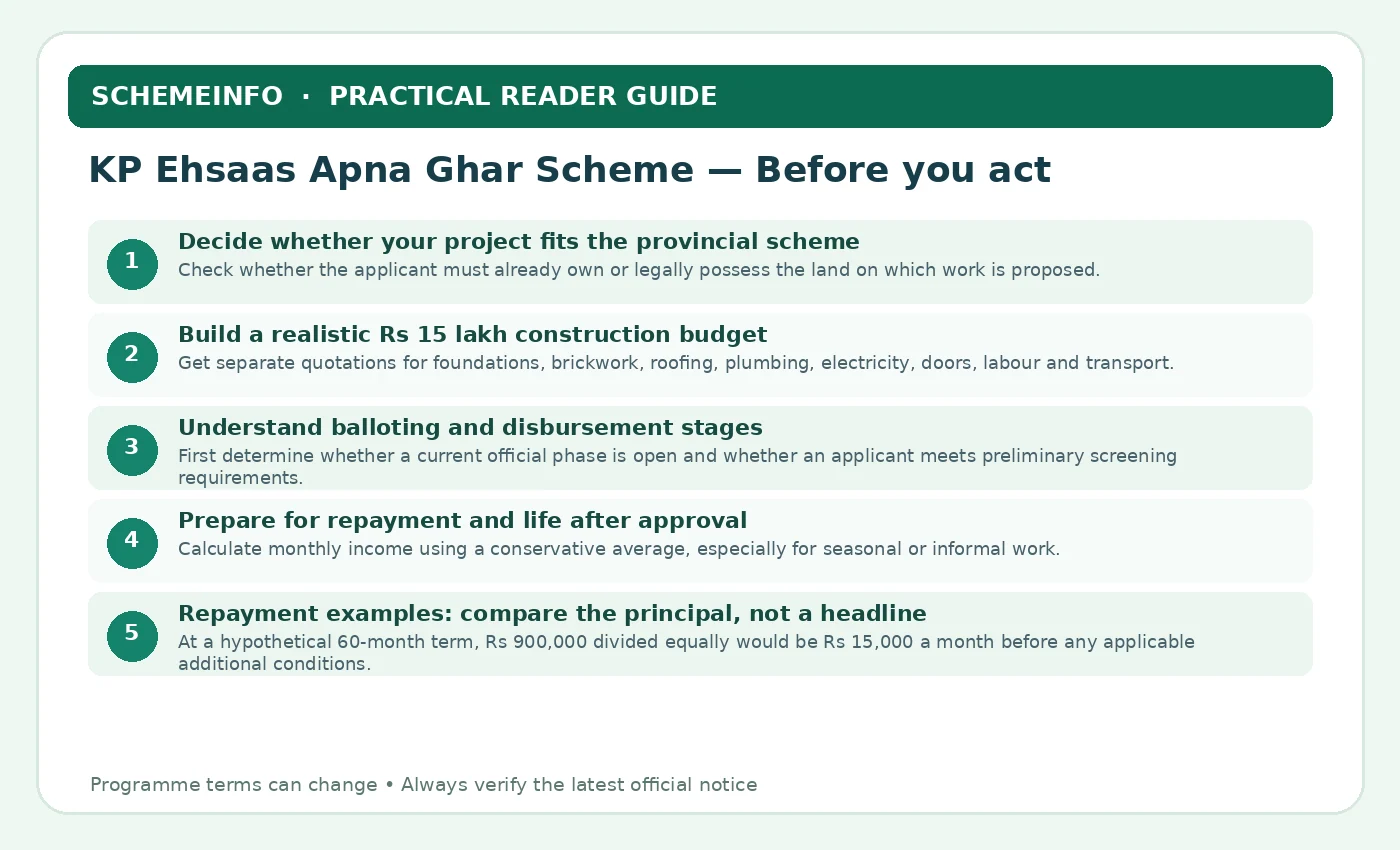
KP Ehsaas Apna Ghar Scheme: practical decisions after checking the rules
These steps translate the published rules into concrete decisions. Use them as preparation, and allow the official department to determine eligibility, payment or selection.
Understand balloting and disbursement stages
KP’s 2026 record confirms that some applicants have received cheques, while phase-two planning was underway. The existence of a real pilot does not make a social-media application form official.
- First determine whether a current official phase is open and whether an applicant meets preliminary screening requirements.
- If a computerised ballot is used, distinguish being entered, being selected provisionally and receiving final bank or department approval.
- Ask whether the lender conducts property verification, bank review or site inspections before releasing money.
- Check how many construction stages are supported and whether later instalments depend on work completed.
- Keep the application reference and written approval terms; a message promising money without formal documents is not enough.
Avoid purchasing land or beginning costly work in expectation of an uncertain ballot result.
Prepare for repayment and life after approval
Families often focus on a maximum loan figure and overlook cash-flow stability. Interest-free principal remains a serious monthly obligation alongside household food, school, utilities and medical needs.
- Calculate monthly income using a conservative average, especially for seasonal or informal work.
- Subtract essential expenses and existing debts before deciding what repayment level would be manageable.
- Ask how late payment, grace periods, insurance or guarantor requirements are addressed in the approved contract.
- Maintain dated receipts and photographs of building progress if stage verification is required.
- If an application is still pending, request its formal status rather than reapplying through an unrelated federal portal.
The safest financial plan is one that still works if material costs rise or household earnings fall temporarily.
KP Ehsaas Apna Ghar Scheme: practical decisions after checking the rules
These steps translate the published rules into concrete decisions. Use them as preparation, and allow the official department to determine eligibility, payment or selection.
Repayment examples: compare the principal, not a headline
A government description may say interest-free, but a borrower must still return the amount advanced. The exact contract determines repayment period, payment dates and any other permitted charges.
- At a hypothetical 60-month term, Rs 900,000 divided equally would be Rs 15,000 a month before any applicable additional conditions.
- At the same hypothetical term, Rs 1.5 million divided equally would be Rs 25,000 a month; a bigger ceiling can create a heavier household obligation.
- If income varies by season, use the weakest reasonable month rather than a peak earning month to test affordability.
- Add unavoidable household utilities, schooling, transport and medicine before choosing a repayment target.
- Confirm the actual term with the authorised implementing bank or department; these examples are not advertised scheme instalments.
A small affordable project completed safely can be more valuable than the largest possible loan that strains family cash flow.
Construction stages and evidence for a site visit
Housing projects are not ordinary consumer purchases: work is built in stages and costs can change after excavation begins. Project evidence should be clear enough for a supervising officer to understand what has been done.
- Create a materials estimate with quantities, supplier quotes and expected delivery dates for foundation, walls, roof and finishing.
- Photograph the site before work begins, with an agreed date and location record, while respecting neighbours’ privacy.
- Keep separate invoices for labour and materials; vague contractor receipts make later cost reconciliation difficult.
- Ask whether inspection or release of subsequent loan portions depends on progress certificates or quality checks.
- Confirm safe construction standards with a qualified local professional, particularly where structural work is planned.
Do not skip necessary building approvals or compromise on structural safety to match an optimistic online budget.
Reader worksheet: make the next step clear
Use the questions below as a short decision worksheet for KP Ehsaas Apna Ghar Scheme. Each answer should be supported by your own records, a current notice or a written response from the authorised office. This is more useful than a generic checklist copied between unrelated welfare schemes.
- Check 1: Which specific official announcement or policy version applies to my household, student, patient or construction project?
- Check 2: Who makes the final decision, and what document proves that this office has processed my case?
- Check 3: Which eligibility condition could rule me out even if I genuinely need support?
- Check 4: Which expenses are definitely included, which are conditional, and which will remain my responsibility?
- Check 5: What dates, records or verification steps could cause an avoidable delay?
- Check 6: How will I distinguish a provisional result from a final award, approved payment or signed loan?
- Check 7: What safe alternative will I use if the award or instalment does not arrive?
- Check 8: Who can answer a complaint without charging an unofficial fee or demanding a password?
Four topic-specific checks before making a commitment
Keep the provincial scheme separate from federal subsidised housing mortgages and other provincial loan cards.
Do not give contractors a large non-refundable advance solely because the application has entered balloting.
Keep the application reference and written approval terms; a message promising money without formal documents is not enough.
If an application is still pending, request its formal status rather than reapplying through an unrelated federal portal.
Confirm the actual term with the authorised implementing bank or department; these examples are not advertised scheme instalments.
Confirm safe construction standards with a qualified local professional, particularly where structural work is planned.
Do not assume that a promising website headline has settled all eight questions. A time-sensitive government payment or school result can be genuine while an individual application remains incomplete.
Two realistic situations and what to do
These scenarios are illustrations, not real applicants, case-law findings or promised outcomes. Their purpose is to show what a careful next decision looks like when one key detail is uncertain.
A family wins a ballot but has a disputed inheritance plot
They need a clear title and any required family consent before committing to construction; provisional selection does not cure a land dispute.
A household budgets the full maximum as a gift
The Rs 1.5 million is a loan ceiling, not a grant. The family must calculate principal repayment under the actual approved contract before proceeding.
How to proceed with KP Ehsaas Apna Ghar Scheme
For the KP Ehsaas Apna Ghar Scheme, the proper sequence is shaped by the administering office and the current phase. Follow the published instructions wherever they differ from a general checklist.
- Find the real office: Open one of the official KP Ehsaas Apna Ghar Scheme sources below and check the agency name, contact details and any current notice rather than an unofficial social-media form.
- Check the exact rule: Compare the relevant class, household benefit, financial-need threshold, clinical condition or ownership document against the formal criterion for your situation.
- Prepare only the right documents: Match names, CNIC or B-form details, educational or medical records and current contact information. Mark conditional papers rather than treating every checklist item as compulsory.
- Resolve uncertainties before travel: Ask the receiving institution whether the phase is open, which office will verify the file and how an acknowledgement or reference will be issued.
- Submit through an authorised channel: Use the official online application if one is genuinely open, or the named welfare office, school, hospital or local committee where the rules require it.
- Save the result and plan the next action: Keep an acknowledgement, payment advice, academic result or decision letter; confirm any appeal, correction or next-round process through the same authority.
Official sources and independence
The links below are owned by the programme administrators or responsible public bodies. Their current instructions outrank summaries and old dates. SchemeInfo is an independent information publisher: it is not a government agency, bank, hospital, school or scholarship administrator.
Editorial review: 12 November 2026. Scheme rules and payments may change after this date. Verify before applying or sharing sensitive personal information.
Frequently asked questions
Each answer is based on the specific policy or programme history discussed above. A later official announcement, hospital letter, school notice or signed loan agreement may supersede an older online summary.
Is the KP housing scheme the federal Apna Ghar programme?
No. They are separate provincial and federal products.
What is the announced loan ceiling?
KP official reporting describes up to PKR 1.5 million.
Is interest charged?
Provincial communications describe the intended facility as interest-free; review the actual agreement.
Is a new 2026 application window confirmed?
The official roadmap documents development and delays; confirm current intake through the department.
Can applicants buy any home with this loan?
Published provincial statements emphasize construction and expansion; check the specific phase’s permitted uses.
Does registration guarantee approval?
No. Eligibility, verification and selection remain necessary.
Was balloting used?
KP’s implementation records refer to a pilot and computerised balloting.
What documents should I prepare first?
Start with CNIC, contact details and lawful property evidence, then confirm the current notice.
Should I pay an agent?
Do not pay any unofficial agent for approval or a ballot result.
Where can I check programme status?
Use the KP official roadmap and provincial housing information channel.