SchemeInfo • Independent Pakistan programme guide • Reviewed 12 November 2026
The practical starting point for Punjab Zakat Rashan Card is to understand who runs it, what applicants actually qualify for, and whether the current route is open. This guide focuses on source-backed facts, careful document preparation, affordable decisions and scam prevention rather than promising an approval.
Explore this guide — table of contents
- Key facts at a glance
- Eligibility requirements
- Required documents
- How the programme works
- Selection, verification and payment explained
- Documents, costs and practical circumstances
- Practical decisions before applying
- Practical decisions after verification
- More topic-specific planning checks
- Reader decision worksheet
- Worked examples
- How to proceed
- Related guides
- Frequently asked questions
- Official sources and disclaimer
At a glance: programme facts that matter
These are the central published facts for the Punjab Zakat Rashan Card, not a guarantee of admission, approval or an open registration window. The references at the bottom distinguish current official pages from historical phases.
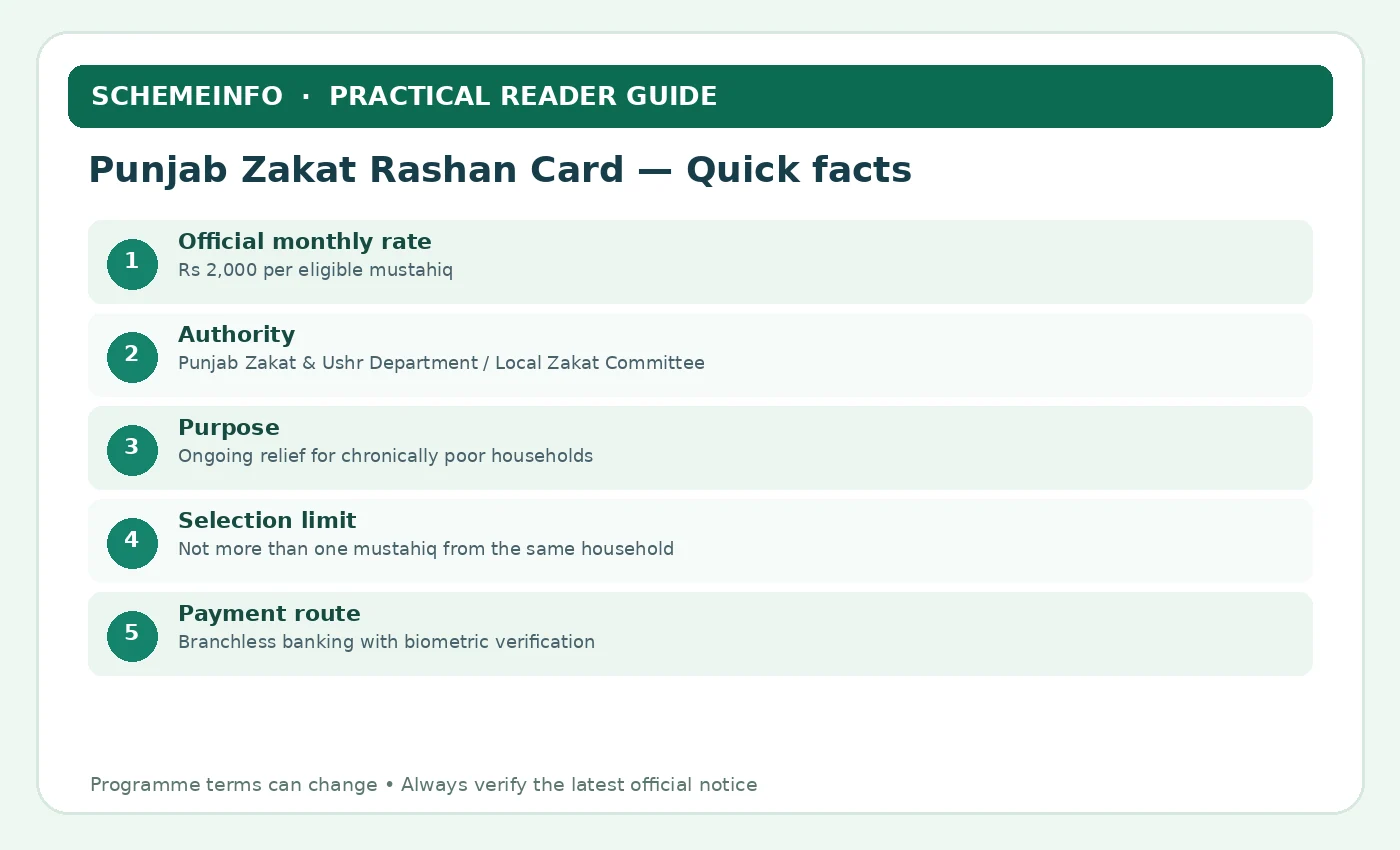
| Official monthly rate | Rs 2,000 per eligible mustahiq |
|---|---|
| Authority | Punjab Zakat & Ushr Department / Local Zakat Committee |
| Purpose | Ongoing relief for chronically poor households |
| Selection limit | Not more than one mustahiq from the same household |
| Payment route | Branchless banking with biometric verification |
Eligibility: who should check the rules?
Begin with the institution’s written eligibility rules for Punjab Zakat Rashan Card. These checks are not a promise of approval; eligibility is decided through the named programme’s actual verification process.
- Applicant is an adult Muslim living below the poverty line and entitled to receive Zakat under Shariah, as assessed locally.
- Applicant is unemployed and is neither a government servant nor a pensioner under the published programme rules.
- Applicant is not a sahib-e-nisab or a habitual beggar under the official eligibility conditions.
- Only one mustahiq may be selected from the same household.
- Applicants receiving assistance from BISP, public Bait-ul-Mal or other listed public institutions may be excluded; verify overlapping benefits.
- Priority may be given to widows, orphans, persons with disabilities, elderly people and the poorest families, but priority is not automatic approval.
Documents to prepare, and who verifies them
Keep essential records legible and separate from optional supporting papers. For Punjab Zakat Rashan Card, confirm which forms the responsible office requires before sharing identity or family information.
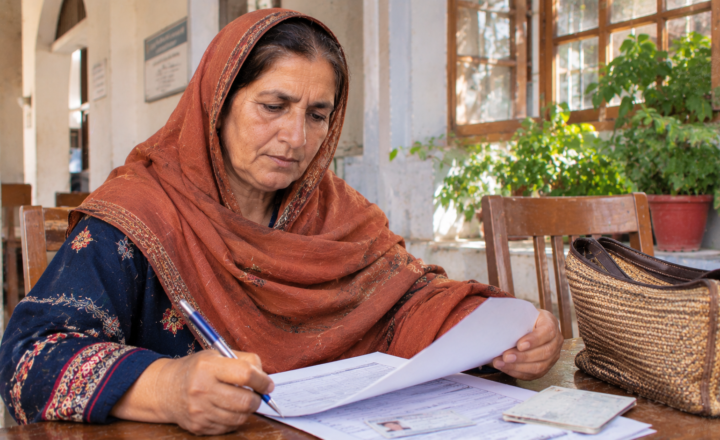
- Prescribed Zakat Rashan Card application form (official Urdu or English format).
- Valid original CNIC and a clear copy for the applicant.
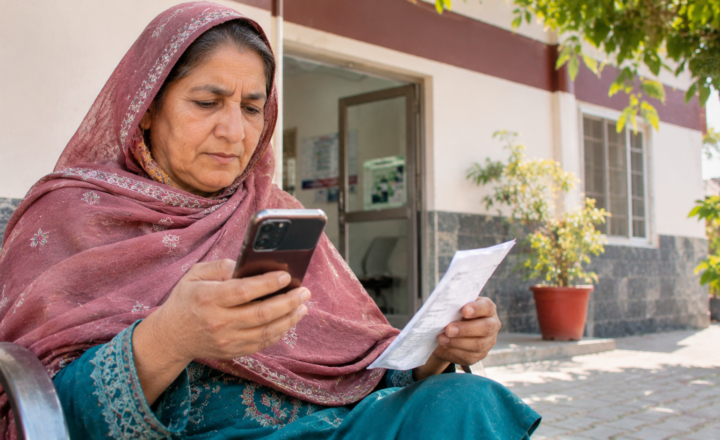
- A working mobile number registered to the applicant’s CNIC.
- Household and income circumstances that the local committee may request for its assessment; ask which supporting evidence is currently accepted.
- Local Zakat Committee resolution and istehqaq register entries are committee-generated records, not documents an applicant should fabricate.
What the published programme actually means
Use these programme-specific details to check the official route and to avoid interpreting a rule more broadly than it was written.
What the Zakat Rashan Card actually provides
The government description identifies the Punjab Zakat Rashan Card as a modest monthly grant intended to reduce hunger among chronically poor households. It is not a cash loan, revolving credit card or commercial grocery discount. The published PKR 2,000 figure is a reference point, not a promise about the amount a particular applicant will receive in November 2026. An applicant should first confirm the programme is funded and operating locally.
Why this is different from the Punjab Ration Card
The Zakat Rashan Card is administered through the Zakat & Ushr committee structure and relies on istehqaq, meaning eligibility for Zakat. Punjab’s other Ration Card arrangements use different provincial registration methods and income-screening rules. Mixing the programmes can lead people to approach the wrong office, expect the wrong payment method or submit a form that the receiving department cannot process.
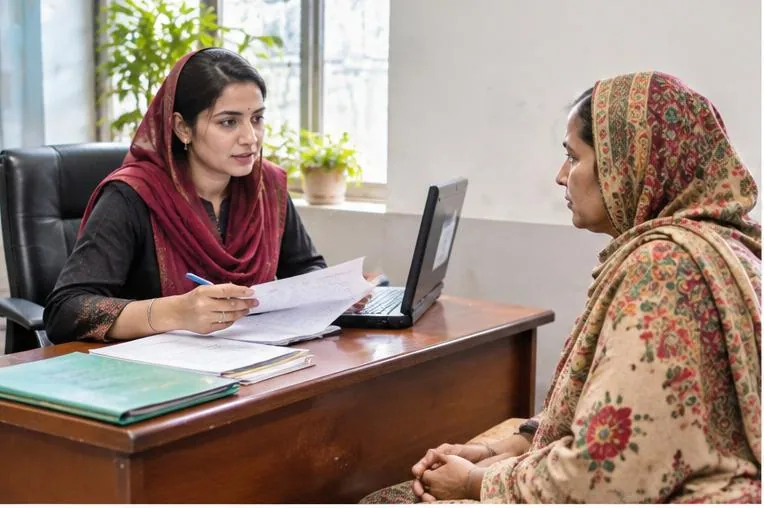
How the local Zakat Committee decides
The committee considers the actual household circumstances instead of approving every person who brings a CNIC. Its published rules refer to unemployment, poverty, overlapping government benefits and one selection per household. A genuine account of the family’s living situation is more useful than a rehearsed answer. Applicants can ask the committee to explain whether it requires additional documents before a decision. For Punjab Zakat Rashan Card, this is more productive than repeatedly completing unrelated web forms. Readers should verify whether a rule is compulsory, conditional or merely suggested preparation.
Priority groups and realistic expectations
Widows, older people, persons with disabilities and orphans receive explicit priority in official language, especially where children depend on a widowed or divorced parent. Priority does not cancel eligibility rules; some family pensions and public benefits remain exclusion factors. A helpful guide must explain both sides so households do not assume an online advertisement automatically overrides the committee’s determination. In the context of Punjab Zakat Rashan Card, this difference can change both the applicant’s next action and expectations. When examining Punjab Zakat Rashan Card, look for the latest dated primary-source update and identify which stage it confirms.
Selection, verification and payment explained
The written application process
Begin with the Chairman or Administrator of the Local Zakat & Ushr Committee serving the applicant’s residence. Request the prescribed form, complete it with matching CNIC information and provide a reachable number. Ask for an acknowledgement or note of submission. If the case is sent onward, request the correct follow-up office rather than visiting an unrelated scheme portal. A credible guide to Punjab Zakat Rashan Card needs to acknowledge limits as clearly as the possible benefits. Under Punjab Zakat Rashan Card, any authorised support should be matched to the permitted purpose rather than spent on unrelated purchases.
CNIC, phone and biometric verification
The Zakat Department says payments have used branchless banking and biometric verification. A phone number that belongs to another person or is not registered with NADRA-linked records can cause avoidable problems. Keep the original CNIC ready for lawful verification and never disclose PINs or one-time passwords to self-appointed agents. Biometric failure should be reported through the authorised payment service. People researching Punjab Zakat Rashan Card should keep the original document date beside any figures they encounter. People seeking Punjab Zakat Rashan Card should never hand original identity papers to an unofficial intermediary.
Household exclusions and overlapping aid
The official exclusion list is more detailed than a simple low-income test. It mentions public-sector employment, pensions, sahib-e-nisab status and certain other state benefits. If a household already receives BISP assistance, an applicant should disclose that rather than omit it. Clarifying overlap in advance is safer than receiving an incorrect payment and facing a later audit or recovery process. Any decision involving Punjab Zakat Rashan Card is stronger when the applicant can show accurate records and a manageable budget. For Punjab Zakat Rashan Card, keep the application or reference number and ask a precise question: which stage is recorded and what, if anything, is outstanding?
When payments are delayed or interrupted
A positive local assessment does not guarantee instant disbursement or an uninterrupted monthly schedule. Committee processing, available programme funds, identity checks and bank-side payment delivery can each create delays. The appropriate follow-up is to ask for the recorded status and whether disbursement has actually been authorised. Do not treat social-media countdowns as official payment dates. The practical value of Punjab Zakat Rashan Card depends on the approved conditions, not the size of a headline. If Punjab Zakat Rashan Card concerns construction or enterprise equipment, keep receipts and truthful progress records.
Documents, costs and practical circumstances
Protecting applicants from fake forms
Scammers may exploit the similar names of food-support programmes, offering paid registration or a promise to accelerate approval. The authentic application route described on the Zakat Department website is through the local committee. A link demanding advance “activation charges,” access to contact lists or a shared OTP is a warning sign. Families should keep copies of messages and report suspected deception. A family comparing Punjab Zakat Rashan Card should look at personal eligibility before relying on publicised amounts. Stop and compare the demand with the official process for Punjab Zakat Rashan Card.
Budgeting grocery support responsibly
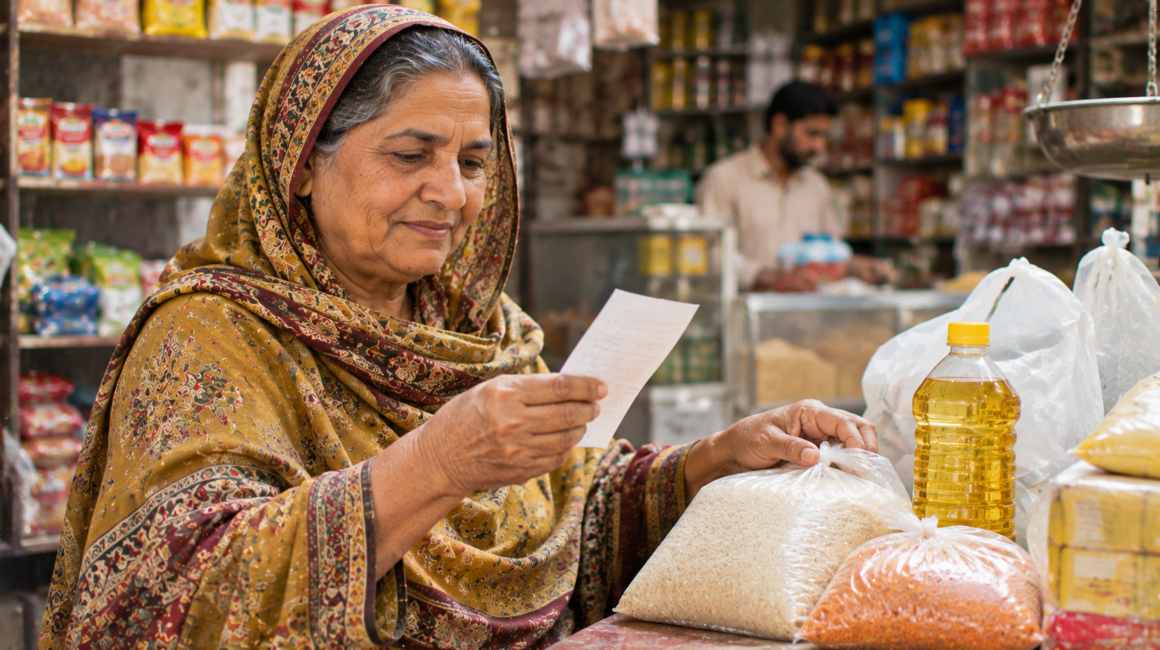
A limited monthly grant is best viewed as support for essentials, not as a permanent replacement for household income. Compare local prices of flour, pulses, oil and milk, plan purchases around actual receipt and leave room for changes in prices. If a payment arrives late, avoid a high-fee short-term loan merely to maintain an optimistic shopping plan. Community support and other lawful services may be safer. If the details of Punjab Zakat Rashan Card are disputed, ask the responsible office for its current written explanation. In discussing Punjab Zakat Rashan Card, use the amount’s correct unit and date.
After refusal or an unclear decision
Ask the local committee whether the application was declined for a published rule, missing evidence or simply a lack of authorised allocation. Keep the question respectful and specific; a written reason is more useful than approaching a new unofficial broker. Where the underlying facts change, ask whether reassessment is available. Preserve originals and avoid submitting altered household or income documents. An article about Punjab Zakat Rashan Card should help readers decide not to apply when conditions do not match. A safe application never depends on an unofficial promise of selection.
Practical pre-application workbook
Use this decision worksheet before sharing documents or paying money. It helps distinguish confirmed information from assumptions and compare the possible benefits with your own circumstances.
Punjab Zakat Rashan Card: practical decisions before you apply
These steps translate the published rules into concrete decisions. Use them as preparation, and allow the official department to determine eligibility, payment or selection.
Check the exclusions before completing a form
This Zakat benefit has more specific restrictions than a general low-income ration promotion. Applicants should read the exclusions and local committee rules before travelling with a file.
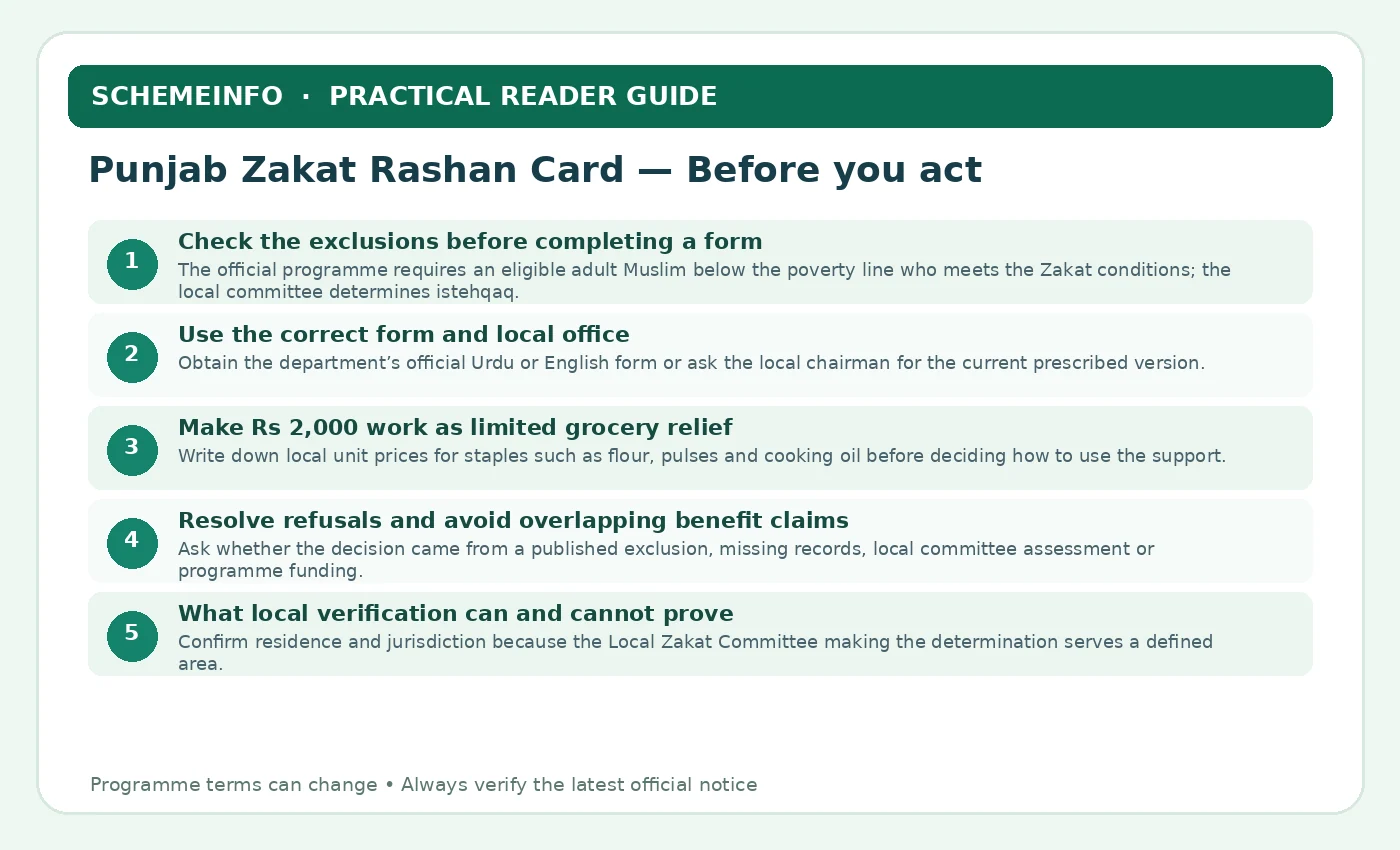
- The official programme requires an eligible adult Muslim below the poverty line who meets the Zakat conditions; the local committee determines istehqaq.
- Published exclusions include government employment, pension status, sahib-e-nisab status and other specified circumstances.
- An applicant receiving certain public assistance, including BISP or named Bait-ul-Mal support, may be excluded under the published rule.
- Only one eligible person can be selected from a household. Several adult relatives should not submit parallel claims as separate households if they live together.
- The programme gives preference to widows, older people, orphans, persons with disabilities and other chronically poor applicants where its criteria are met.
Eligibility is not decided merely by possessing a CNIC or being unemployed; the Local Zakat Committee must complete its assessment.
Use the correct form and local office
Punjab Zakat Rashan Card is not the same product as another Punjab Ration Card. The correct department, form and payment route matter because each programme has separate eligibility checks.
- Obtain the department’s official Urdu or English form or ask the local chairman for the current prescribed version.
- Apply in writing to the Local Zakat & Ushr Committee responsible for the home address.
- Keep a valid CNIC and confirm that the contact phone number is registered to the applicant where the department requires it.
- Ask which committee registers the resolution and istehqaq determination; these entries are part of the formal decision, not records an applicant should forge.
- After selection, ask how biometric branchless payment is arranged and what to do if the authorised phone number changes.
Avoid third-party “Punjab Rashan registration” websites unless the precise card and department are clearly the same official scheme.
Punjab Zakat Rashan Card: practical decisions after checking the rules
These steps translate the published rules into concrete decisions. Use them as preparation, and allow the official department to determine eligibility, payment or selection.
Make Rs 2,000 work as limited grocery relief
The current published amount is a modest cash grant. It can reduce essential spending but is not a replacement for monthly household income or a guaranteed grocery package of unlimited value.
- Write down local unit prices for staples such as flour, pulses and cooking oil before deciding how to use the support.
- Buy within a simple list; purchasing large quantities can exhaust the assistance before essential food needs are met.
- Keep inflation changes visible in the family budget instead of assuming the published amount buys the same goods each month.
- Confirm the actual payment release before committing to purchases on credit.
- If a payment is absent, ask the committee or authorised bank whether it is an allocation, biometric or account issue.
A grant that arrives irregularly should be budgeted conservatively, not treated as collateral for a loan.
Resolve refusals and avoid overlapping benefit claims
A polite request for a clear reason can save time when an application is declined. Submitting more copies of the same form will not resolve a statutory exclusion.
- Ask whether the decision came from a published exclusion, missing records, local committee assessment or programme funding.
- If your household already receives BISP support, disclose it and seek written guidance about the overlapping-benefit rule.
- Where identity or phone data are wrong, correct the originating official record before asking for a second payment attempt.
- Do not allow agents to promise approval for a “service charge”. The committee, not a social-media representative, determines need.
- Use other public welfare offices for programmes with different criteria when this Zakat card is not available.
Keep an application diary with dates, names of official contacts and the next documented step, without posting personal details online.
Punjab Zakat Rashan Card: practical decisions after checking the rules
These steps translate the published rules into concrete decisions. Use them as preparation, and allow the official department to determine eligibility, payment or selection.
What local verification can and cannot prove
A low income may explain why a family needs help, but the Zakat Rashan Card has explicit conditions beyond a simple poverty claim. Applicants should identify an exclusion before presenting a file.
- Confirm residence and jurisdiction because the Local Zakat Committee making the determination serves a defined area.
- Check the rule about one mustahiq per household; multiple CNICs do not create multiple household entitlements.
- Disclose pension, government employment or existing public assistance wherever the prescribed form asks about it.
- Ask the committee how it considers urgent family circumstances such as dependent children or disability within the official preference rules.
- If denied, ask whether the reason is an exclusion, an incomplete application or a shortage of sanctioned funds.
A truthful declaration protects the applicant from later disputes and makes it easier to seek another suitable programme if this one is unavailable.
Budget the published grant under real market conditions
The official Rs 2,000 per month can help with staple-food purchases, but commodity prices fluctuate by district and season. A practical budget should make the limits transparent rather than implying the Punjab Zakat Rashan Card provides unlimited food.
- Choose a few essential products and write down their current prices from a nearby reliable shop.
- For example, if two staple purchases cost Rs 650 and Rs 500, only Rs 850 remains for other necessities from an illustrative Rs 2,000 grant.
- Check whether the grant was actually received before purchasing on credit; a published programme rate is not a bank confirmation.
- Keep a small record of purchases and identify which essentials still need support from ordinary household income.
- Where prices rise sharply, prioritise basic nutrition and ask local welfare staff about other appropriate services with non-conflicting eligibility rules.
This is budgeting guidance, not a requirement to spend Zakat assistance at any named retailer.
Reader worksheet: make the next step clear
Use the questions below as a short decision worksheet for Punjab Zakat Rashan Card. Each answer should be supported by your own records, a current notice or a written response from the authorised office. This is more useful than a generic checklist copied between unrelated welfare schemes.
- Check 1: Which specific official announcement or policy version applies to my household, student, patient or construction project?
- Check 2: Who makes the final decision, and what document proves that this office has processed my case?
- Check 3: Which eligibility condition could rule me out even if I genuinely need support?
- Check 4: Which expenses are definitely included, which are conditional, and which will remain my responsibility?
- Check 5: What dates, records or verification steps could cause an avoidable delay?
- Check 6: How will I distinguish a provisional result from a final award, approved payment or signed loan?
- Check 7: What safe alternative will I use if the award or instalment does not arrive?
- Check 8: Who can answer a complaint without charging an unofficial fee or demanding a password?
Four topic-specific checks before making a commitment
The Punjab Zakat Rashan Card gives preference to widows, older people, orphans, persons with disabilities and other chronically poor applicants where its criteria are met.
After selection, ask how biometric branchless payment is arranged and what to do if the authorised phone number changes.
If a payment is absent, ask the committee or authorised bank whether it is an allocation, biometric or account issue.
Use other public welfare offices for programmes with different criteria when this Zakat card is not available.
If denied, ask whether the reason is an exclusion, an incomplete application or a shortage of sanctioned funds.
Where prices rise sharply, prioritise basic nutrition and ask local welfare staff about other appropriate services with non-conflicting eligibility rules.
Do not assume that a promising website headline has settled all eight questions. A time-sensitive government payment or school result can be genuine while an individual application remains incomplete.
Two realistic situations and what to do
These scenarios are illustrations, not real applicants, case-law findings or promised outcomes. Their purpose is to show what a careful next decision looks like when one key detail is uncertain.
Two adults in one household both want the card
The published rule limits selection to one mustahiq in the same household. The family should not try duplicate registrations to bypass the limit.
An applicant already receives Kafaalat
The official Zakat page includes an overlapping-public-assistance exclusion. The applicant should disclose existing support and ask for another eligible route rather than hide the Punjab Zakat Rashan Card.
How to proceed with Punjab Zakat Rashan Card
For this programme, the proper sequence is shaped by the administering office and the current phase. Follow the published instructions wherever they differ from a general checklist.
- Find the real office: Open one of the official Punjab Zakat Rashan Card sources below and check the agency name, contact details and any current notice rather than an unofficial social-media form.
- Check the exact rule: Compare the relevant class, household benefit, financial-need threshold, clinical condition or ownership document against the formal criterion for your situation.
- Prepare only the right documents: Match names, CNIC or B-form details, educational or medical records and current contact information. Mark conditional papers rather than treating every checklist item as compulsory.
- Resolve uncertainties before travel: Ask the receiving institution whether the phase is open, which office will verify the file and how an acknowledgement or reference will be issued.
- Submit through an authorised channel: Use the official online application if one is genuinely open, or the named welfare office, school, hospital or local committee where the rules require it.
- Save the result and plan the next action: Keep an acknowledgement, payment advice, academic result or decision letter; confirm any appeal, correction or next-round process through the same authority.
Official sources and independence
The links below are owned by the programme administrators or responsible public bodies. Their current instructions outrank summaries and old dates. SchemeInfo is an independent information publisher: it is not a government agency, bank, hospital, school or scholarship administrator.
Editorial review: 12 November 2026. Scheme rules and payments may change after this date. Verify before applying or sharing sensitive personal information.
Frequently asked questions
Each answer is based on the specific policy or programme history discussed above. A later official announcement, hospital letter, school notice or signed loan agreement may supersede an older online summary.
Is this the same as the CM Punjab Ration Card?
No. The Zakat Rashan Card is a committee-assessed Zakat benefit; the separate Ration Card has different registration procedures.
How much is the monthly payment?
The Zakat Department’s programme page states PKR 2,000 per month, but confirm the current rate and funding locally.
Can I register through a loan app?
The official guidance directs applicants to their Local Zakat & Ushr Committee, not a commercial lending app.
Is CNIC necessary?
Yes, the department lists a valid applicant CNIC and a registered mobile number.
Can two members of one household receive it?
The published conditions limit selection to one mustahiq per household.
Are pensioners eligible?
The published eligibility criteria exclude pensioners, subject to official clarification of individual circumstances.
What if I already receive BISP?
The departmental exclusions mention BISP and certain other public assistance; disclose that benefit and ask the committee.
Is the payment guaranteed once I apply?
No. The committee assesses eligibility, and disbursement follows authorised processes.
Who handles a rejected application?
Contact the local Zakat Committee for reasons and any available review route.
Should I pay an agent to speed things up?
No unofficial agent can guarantee approval; use the documented committee process.