SchemeInfo • Independent Pakistan programme guide • Reviewed 12 November 2026
The right loan scheme for house depends on whether you already own a plot, need free land, want to build or plan to buy a completed home. This guide separates Punjab construction finance, free-plot support, government-employee advances and bank mortgages with practical budgets.
Explore this guide — table of contents
- Key facts at a glance
- Eligibility requirements
- Required documents
- How this scheme works
- Land title, construction budgets and mortgage choices
- Costs, documents and decisions
- Troubleshooting, safer alternatives and next steps
- Detailed decision guide, part 1
- Detailed decision guide, part 2
- Reader decision worksheet
- Worked decision example
- Mistakes to avoid
- Worked examples
- How to proceed
- Related guides
- Frequently asked questions
- Official sources and disclaimer
Loan Scheme for House: key facts at a glance
These are the central published facts for the Loan Scheme for House, not a guarantee of admission, approval or an open registration window. The references at the bottom distinguish current official pages from historical phases.
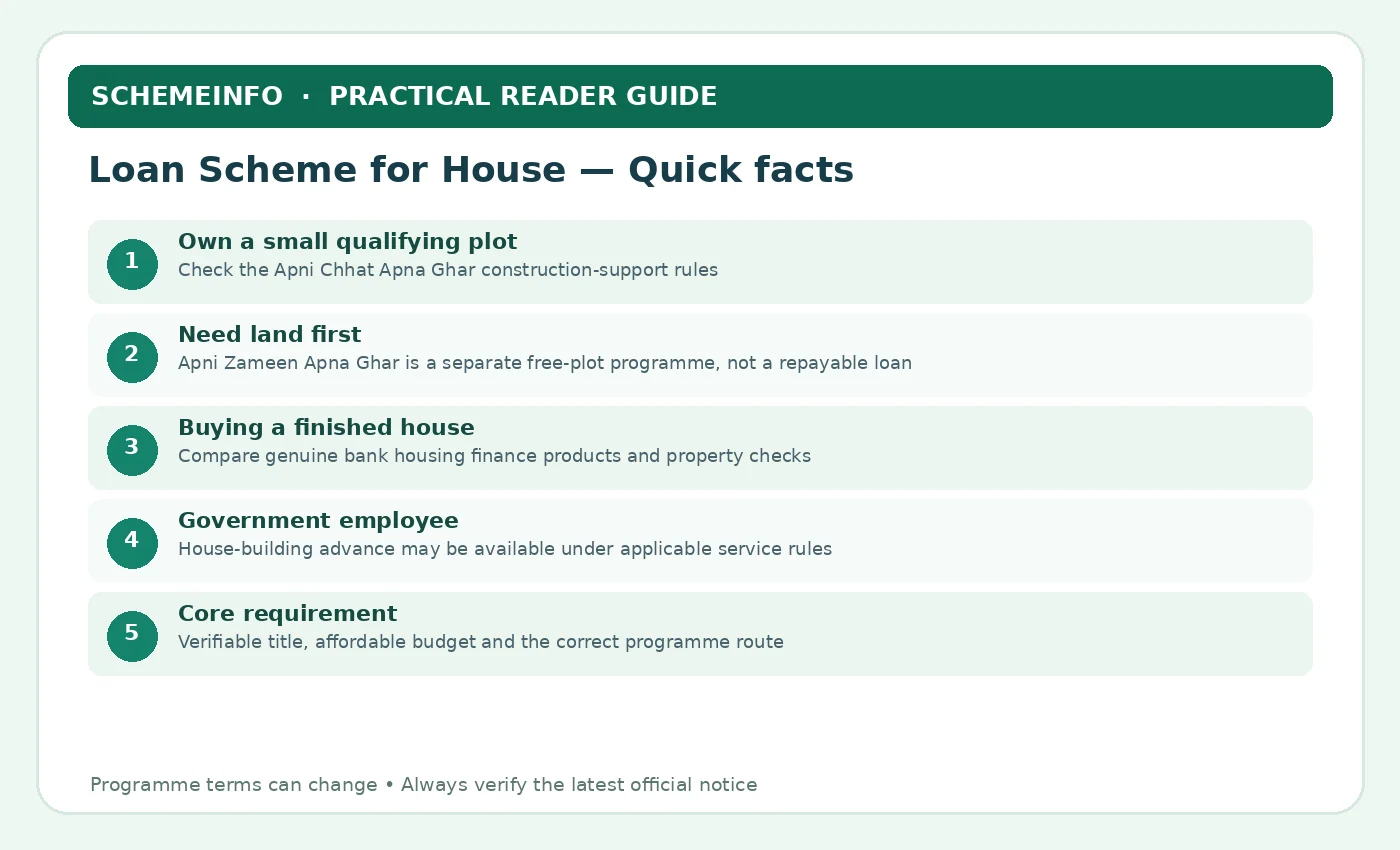
| Own a small qualifying plot | Check the Apni Chhat Apna Ghar construction-support rules |
|---|---|
| Need land first | Apni Zameen Apna Ghar is a separate free-plot programme, not a repayable loan |
| Buying a finished house | Compare genuine bank housing finance products and property checks |
| Government employee | House-building advance may be available under applicable service rules |
| Core requirement | Verifiable title, affordable budget and the correct programme route |
Which housing programme fits your property
Begin with the responsible institution’s written eligibility rules for Loan Scheme for House. These checks are not a promise of approval; eligibility is decided through the named programme’s actual verification process.
- CNIC and residence within the chosen housing programme’s geographic coverage.
- Qualifying property ownership and plot limits if applying for Punjab Apni Chhat Apna Ghar construction finance.
- Land title, legal ownership and acceptable property valuation for bank mortgage financing where applicable.
- Household income and creditworthiness sufficient for a sustainable repayment schedule.
- Relevant NSER, PMT and family-head tests for Punjab programme applicants where published.
- Any applicant age, existing homeownership, guarantor and prior-loan restrictions set by the specific lender.
Property and household records to prepare
Keep essential records legible and separate from optional supporting papers. For Loan Scheme for House, confirm which forms the responsible office requires before sharing identity or family information.
- CNIC, address and family information.
- Property ownership deed, mutation/fard, allotment and site details where required.
- Property valuation, approved construction plan or estimated costs if a bank or programme asks.
- Bank statements, salary/business income evidence and current debt declarations for mortgage finance.
- NSER or PMT evidence, where applicable to Punjab housing support.
- Offer letter, mortgage, insurance and repayment documents required at sanction stage.
How Loan Scheme for House works: rules, evidence and decisions
The following sections unpack the Loan Scheme for House rules, common misunderstandings and evidence needed for a responsible decision. Check the original official source whenever a condition affects your eligibility.
Decide whether land is already owned
Housing assistance changes according to whether the applicant owns a plot, needs a plot or wants to purchase a completed home. A construction loan may exclude a household with no land title. Do not assume free plot allotment and construction finance are interchangeable. A couple renting in Lahore without any land should investigate land-allotment criteria rather than claim they own a qualifying construction plot.
Punjab Apni Chhat Apna Ghar construction support
The Punjab programme includes interest-free construction finance for qualified households with small owned plots, with different plot limits for urban and rural areas. The official page lists family and socioeconomic conditions. Check head-of-family status, CNIC residence, land extent and the NSER PMT requirement on the current portal. An urban applicant with a property larger than the published plot limit may not qualify for the construction-loan route.
Punjab free plots are not a loan
Apni Zameen Apna Ghar is a separate free residential plot programme for eligible houseless families in specified districts and phases. Allotment does not itself mean a repayable mortgage has been approved. A selected beneficiary should verify official allotment instructions instead of borrowing money to pay a fake “plot release fee.”
Federal housing finance and bank participation
SBP’s housing information describes federal markup-subsidy frameworks and other market-financing measures, with conventional and Islamic bank participation depending on the actual product. A bank displaying an old Mera Pakistan Mera Ghar brochure does not, on its own, prove a fresh government subsidy is available now.
Land title, construction budgets and mortgage choices
Bank mortgage versus government construction loan
A mortgage generally involves property valuation, secured lending and affordability underwriting, whereas a provincial construction programme can apply social eligibility and plot-size tests. A salaried family buying a built apartment should examine mortgage conditions rather than a landowner-only construction facility.
Plot size, ownership and mutation records
Land documents must establish who can legally mortgage or build on the property. CNIC address, physical possession and mutation may not all be consistent. Obtain authentic records from the land authority, resolve ownership disputes and identify whether the plot is urban or rural under the applicable programme definitions. Shared family land without a clear independent title can raise questions for secured finance.
Housing budgets beyond the advertised limit
Construction costs include materials, labour, utilities, supervision, approvals and contingency, while purchasing has taxes, transfer and maintenance costs. A loan cap does not establish the total project cost. Building with a fixed subsidy may require additional savings when prices rise or construction takes longer than anticipated.
How staged disbursement affects construction
Some housing programmes disburse financing in tranches linked to milestones or verification, rather than paying the full sanction upfront. Ask the lender which milestones release funds and what inspection evidence is required. A builder demanding the full contract price on day one may not fit a phased finance schedule.
Costs, documents and decisions
Income, debts and repayment capacity
Banks assess verified cash flow and credit history and may require income evidence, existing loan details and collateral. Government support may reduce a rate without eliminating risk. A family should avoid assuming a subsidised rate continues forever if the contractual subsidy covers only a specified period.
Interest-free is not always fee-free
Even a zero-markup construction loan may have legal, property, registration, insurance, valuation or penalty costs depending on the arrangement. Banking mortgage products can have other charges and reset conditions. Ask for total disbursement, all fees, tenure, security and cost after any introductory rate. A low initial instalment can change after a fixed-rate subsidy ends or the property valuation limits the borrowing amount.
Government employee house-building advances
Eligible government employees may access distinct service-rule advances, but federal, provincial and autonomous-body rules must not be treated as identical. A civil servant’s departmental advance is not the same as a public low-income construction subsidy.
How to apply to Punjab housing programmes
Start from the Punjab government’s official housing page and follow the appropriate scheme portal. The application may involve family, land and socioeconomic records before selection or sanction. Save the reference ID and distinguish registration from verification, approval and disbursement. An initial citizen account does not guarantee that the housing office will approve a family’s plot record.
Troubleshooting, safer alternatives and next steps
What a property valuation means
A bank may base financing on a professional valuation and approved loan-to-value limit rather than an asking price agreed privately. The borrower needs savings for the difference. A seller may demand an unrealistic price that a bank’s valuer cannot support.
Using an Islamic housing arrangement
Islamic housing finance is not necessarily cost-free. The contract can involve rent, profit or diminishing partnership arrangements and should be read on its own terms. Compare the total payment schedule and ownership transfer provisions rather than equating “Islamic” with a guaranteed grant. Two monthly figures that appear equal may have different ownership, early-settlement and security conditions.
Avoiding fake land and housing offers
Fraudsters may publish fabricated selected lists or request payment before allotment, mortgage release or grant disbursement. Property finance involves particularly sensitive title documents. A PDF without an official website or reference cannot prove a family has won a housing plot.
Choosing the best-fit housing route
Start with the property situation, then compare eligibility, expected funds, repayment and application status. Housing planning should be based on legal title and affordability, not just the highest financing cap. A household with no land may need an allotment route, whereas a family with an eligible plot may explore construction finance.
Choosing land, construction or purchase finance
Use the named programme’s actual rules and documents to evaluate these decisions. Each item below addresses a different obstacle that applicants commonly face.
Choose your housing route by what you already own
The first question for a house-seeking family is not the interest rate. It is whether the household owns a legally documented plot, seeks land, wants to buy a finished home or needs to renovate an existing one. A loan for constructing on land cannot solve a missing-title problem, and a free-plot programme is not the same as cash for building materials.
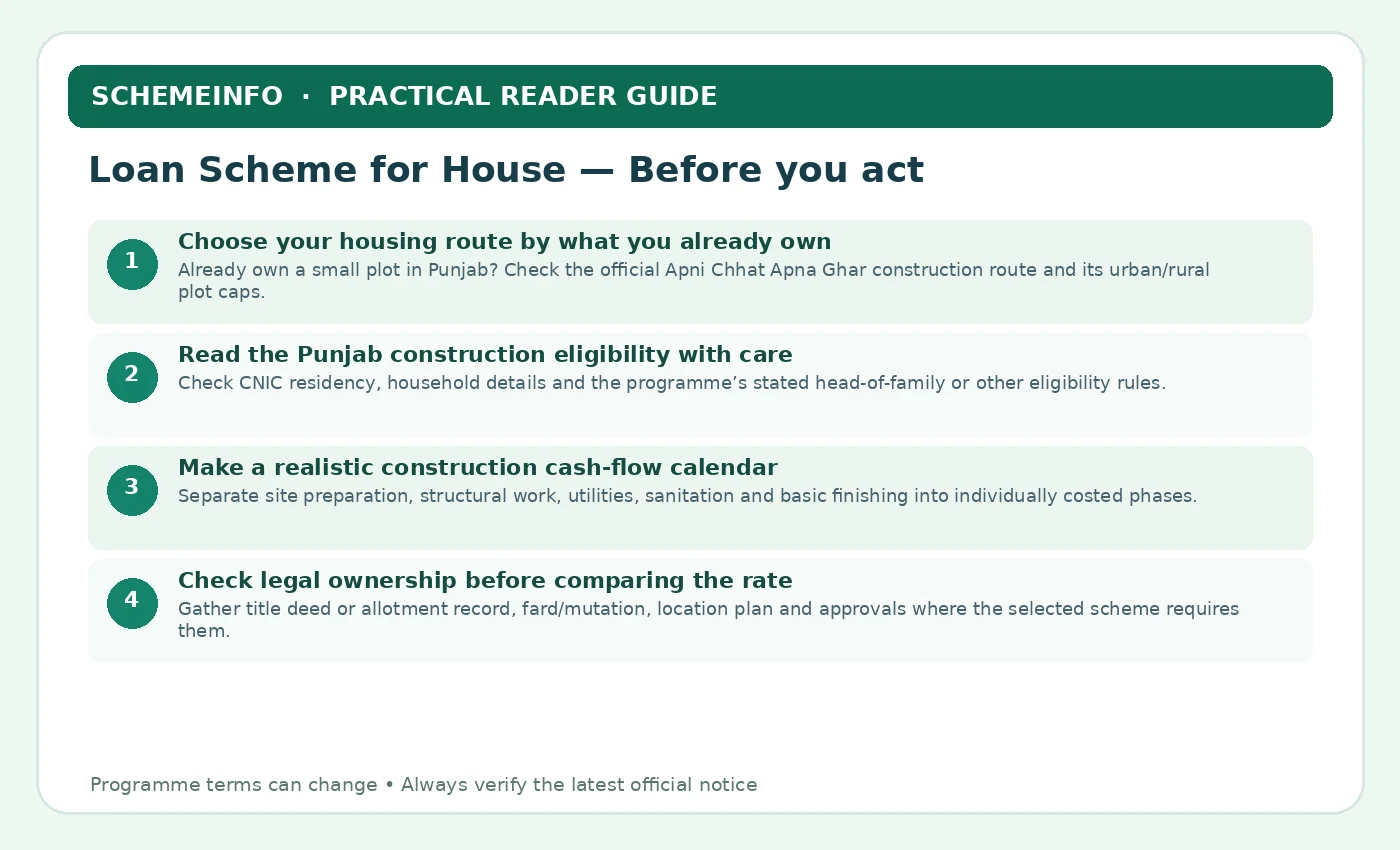
- Already own a small plot in Punjab? Check the official Apni Chhat Apna Ghar construction route and its urban/rural plot caps.
- Have no qualifying land? Read the separate Apni Zameen Apna Ghar allocation conditions and eligible district phases.
- Buying a complete dwelling? Ask regulated lenders for their genuine mortgage financing criteria and full legal-cost estimate.
- Employed under government service rules? Check whether a departmental house-building advance is authorised for your purpose.
This four-way classification saves time, protects identity records and avoids comparing products designed for fundamentally different housing situations.
Read the Punjab construction eligibility with care
Punjab’s Apni Chhat Apna Ghar programme describes assistance for qualifying families who own and possess a modest parcel of land. The public SMU guidance refers to up to five marla in urban areas and up to ten marla in rural areas, with additional residency, record and financial conditions. These are not permissions to submit an application using someone else’s property.
- Check CNIC residency, household details and the programme’s stated head-of-family or other eligibility rules.
- Verify the plot’s registered owner, location, area and possession; resolve mutation or inheritance disputes before claiming clear title.
- Confirm no disqualifying default or other condition applies under the latest official programme notice.
- Use the authorised portal and save the application receipt, because approval, inspection and disbursement can be separate steps.
An incomplete title or an ineligible urban plot cannot be fixed by paying an agent. Seek the responsible land-record office’s legitimate correction process.
Housing title, stage budget and repayment risks
Use the named programme’s actual rules and documents to evaluate these decisions. Each item below addresses a different obstacle that applicants commonly face.
Make a realistic construction cash-flow calendar
Construction rarely follows a smooth monthly budget. Excavation, foundations, wall materials, roofing, labour and finishing costs arrive at different stages. A financing announcement stating a maximum amount does not prove that each household receives the whole amount at once or that it will cover the finished home.
- Separate site preparation, structural work, utilities, sanitation and basic finishing into individually costed phases.
- Obtain at least two comparable local material and labour estimates instead of copying a generic national square-foot rate.
- Ask how progress checks or stages affect disbursement timing and how suppliers will be paid between instalments.
- Reserve a contingency for price changes and unexpected site problems, and avoid borrowing privately to cover an assumed payment date.
A small, habitable and legally compliant construction plan is safer than a larger unfinished house that cannot meet the repayment or stage requirements.
Check legal ownership before comparing the rate
Banks and government programmes cannot treat disputed property as a simple asset. The applicant should establish clear ownership, registered location and any mortgage, co-owner or inheritance issues early. In a bank-funded purchase, valuation and legal checks may change both the possible financed amount and the amount the buyer must contribute.
- Gather title deed or allotment record, fard/mutation, location plan and approvals where the selected scheme requires them.
- Ask who is responsible for valuation, conveyance, registration, taxes, insurance or takaful and mortgage documentation.
- Do not make a non-refundable payment to a seller before the lender’s legal and valuation conditions are understood.
- Calculate affordability after utilities, maintenance and existing debts, not only the first advertised instalment.
If the property documents are unclear, resolve the legal position before submitting repeated applications or paying non-refundable lender charges.
Reader verification worksheet: Loan Scheme for House
For Loan Scheme for House, work through these questions before providing personal records or accepting a financing offer. This is an independent reader decision tool, not a government or lender application form. Write the evidence or published rule that answers each question.
- Decision 1: Do I own an eligible plot, need a plot, intend to buy, or want to renovate?
- Decision 2: Are my land ownership, fard/mutation, area and possession records legally clear?
- Decision 3: Does the chosen housing programme cover my district and exact type of property?
- Decision 4: What are the stage-by-stage structural, utility and finishing costs?
- Decision 5: How much money must the family contribute, and when will it be needed?
- Decision 6: How are financing releases, inspections and lender repayments scheduled?
- Decision 7: Are there mortgage, registration, valuation or insurance conditions?
- Decision 8: Could the household still cover necessities and repayments if construction costs rise?
Four checks specific to this financing question
Employed under government service rules? Check whether a departmental house-building advance is authorised for your purpose.
Use the authorised portal and save the application receipt, because approval, inspection and disbursement can be separate steps.
Reserve a contingency for price changes and unexpected site problems, and avoid borrowing privately to cover an assumed payment date.
Calculate affordability after utilities, maintenance and existing debts, not only the first advertised instalment.
A short written checklist makes it easier to distinguish an official fact, an unverified claim and a remaining question. Keep the record private and update it when the responsible organisation releases new information.
Housing affordability: phased construction example
A family planning a small home can create a construction schedule before applying. Suppose the initial project estimate is Rs 1.8 million, with Rs 300,000 available in savings. The gap is an illustration, not an approved financing amount.
| Illustrative total budget | Rs 1,800,000 |
|---|---|
| Own savings | Rs 300,000 |
| Initial financing gap | Rs 1,500,000 |
| Important variable | Actual eligible scheme limit, sanctioned amount and stage payment plan |
| Additional budget line | Land-record correction, utilities, sanitation and cost contingency |
What the comparison means before you act
- Split the Rs 1.8m estimate into foundations, walls, roof, utilities and basic finishing.
- Verify the applicant owns the qualifying plot before preparing a construction-loan application.
- Do not treat free-plot selection as cash to construct the house.
- Ask whether government or bank funds are advanced in stages and what documents unlock each stage.
The right housing route depends on lawful ownership and stage affordability, not only the headline loan amount.
Illustrative worksheet: Figures are educational examples, not a real lender quotation or confirmed approval. Always use the responsible institution’s current written terms.
Seven housing checks that can prevent an expensive mistake
The following checklist is tailored to this exact topic. Use it as a final check before registering, signing, sharing identity records or acting on a purported result.
- Confirm the registered owner and parcel boundaries before assuming a family-owned plot makes the applicant eligible.
- Check the urban or rural plot-size threshold against the official Punjab construction programme rather than social-media claims.
- Distinguish a free plot allotment from cash financing to build on the plot; the two schemes are administered separately.
- Investigate mutation, inheritance, co-owner or mortgage restrictions before paying non-refundable application or valuation charges.
- Prepare a staged bill for foundations, walls, roofing, drainage and finishing instead of one unsupported total figure.
- Ask whether bank or programme releases are phased; a supplier may want payment before the next authorised disbursement.
- Include utility connections, title registration, site contingencies and household debt in the affordability calculation.
{esc(closing)}
Two realistic Loan Scheme for House situations
These scenarios are illustrations, not real applicants, case-law findings or promised outcomes. Their purpose is to show what a careful next decision looks like when one key detail is uncertain.
Family with land but no construction budget
A family owns a 4-marla urban plot and seeks support for a modest house. They check the authorised Punjab construction programme, verify their title and develop staged bills. They do not assume the free-plot scheme is another construction-loan source.
Buyer comparing a bank mortgage with a subsidy
A worker wants to purchase a finished apartment but has no residential plot. A construction-on-owned-land programme is not an appropriate fit; the worker instead asks regulated banks for written purchase-finance terms, valuation steps and total fees.
How to proceed with Loan Scheme for House
Follow the official procedure for this specific topic. A submitted form or preliminary status is never proof of final selection or disbursement.
- Classify the housing need: Decide whether you own a plot, need land, will build or want to purchase a completed home.
- Verify the property status: Check legal title, plot size, location, mutation and any unresolved ownership issue.
- Choose the matching scheme: Do not confuse Apni Chhat Apna Ghar construction support with free-plot allocation.
- Build the stages budget: Cost groundwork, structure, utilities and finishing separately with a contingency.
- Prepare genuine documents: Collect current CNIC, family and property records plus required construction plans and estimates.
- Confirm release conditions: Ask about inspection, legal charges, mortgage conditions, sanction and stage disbursement.
- Track affordability and progress: Save receipts, construction evidence and the exact repayment schedule throughout the project.
Official Loan Scheme for House sources and independence
The links below lead to the responsible government or regulator information services, including public rules that can supersede older summaries. Their current instructions outrank summaries and old dates. SchemeInfo is an independent information publisher: it is not a government agency, bank, lending institution or government loan administrator.
Editorial review: 12 November 2026. Scheme rules and payments may change after this date. Verify before applying or sharing sensitive personal information.
Frequently asked questions about Loan Scheme for House
Housing support varies with lawful plot ownership, geographic coverage and the selected purchase or construction route.
Is Apni Zameen Apna Ghar a housing loan?
No. It is a separate free residential plot allotment programme for qualifying beneficiaries.
Can I get Punjab construction finance with no plot?
The published Apni Chhat construction criteria include qualifying plot ownership; check alternatives if you own no land.
Do banks guarantee current federal subsidy rates?
No. Confirm current participation and final contract terms with the specific bank.
Can house finance cover all construction costs?
Not necessarily. Compare verified project costs with the sanctioned loan and required contribution.
Can government employees get a house-building advance?
Some can under applicable service rules, which differ from public housing programmes.
For loan scheme for house, what matters about punjab apni chhat apna ghar construction support?
The Punjab programme includes interest-free construction finance for qualified households with small owned plots, with different plot limits for urban and rural areas. Check head-of-family status, CNIC residence, land extent and the NSER PMT requirement on the current portal..
For loan scheme for house, what matters about federal housing finance and bank participation?
SBP’s housing information describes federal markup-subsidy frameworks and other market-financing measures, with conventional and Islamic bank participation depending on the actual product. Confirm whether the lender presently participates in the exact subsidy and what pricing period applies..
For loan scheme for house, what matters about plot size, ownership and mutation records?
Land documents must establish who can legally mortgage or build on the property. Obtain authentic records from the land authority, resolve ownership disputes and identify whether the plot is urban or rural under the applicable programme definitions..
For loan scheme for house, what matters about interest-free is not always fee-free?
Even a zero-markup construction loan may have legal, property, registration, insurance, valuation or penalty costs depending on the arrangement. Ask for total disbursement, all fees, tenure, security and cost after any introductory rate..
For loan scheme for house, what matters about using an islamic housing arrangement?
Islamic housing finance is not necessarily cost-free. Compare the total payment schedule and ownership transfer provisions rather than equating “Islamic” with a guaranteed grant..