SchemeInfo • Independent Pakistan programme guide • Reviewed 12 November 2026
A loan for business in Pakistan without interest can still carry genuine processing, legal or other charges. This guide compares zero-markup tiers, eligibility and restricted-spending products, then shows how to test costs and instalments against real business earnings.
Explore this guide — table of contents
- Key facts at a glance
- Eligibility requirements
- Required documents
- How this scheme works
- Zero-markup products and total cost
- Costs, documents and decisions
- Troubleshooting, safer alternatives and next steps
- Detailed decision guide, part 1
- Detailed decision guide, part 2
- Reader decision worksheet
- Worked decision example
- Mistakes to avoid
- Worked examples
- How to proceed
- Related guides
- Frequently asked questions
- Official sources and disclaimer

Loan for Business in Pakistan Without Interest: key facts at a glance
These are the central published facts for the Loan for Business in Pakistan Without Interest, not a guarantee of admission, approval or an open registration window. The references at the bottom distinguish current official pages from historical phases.
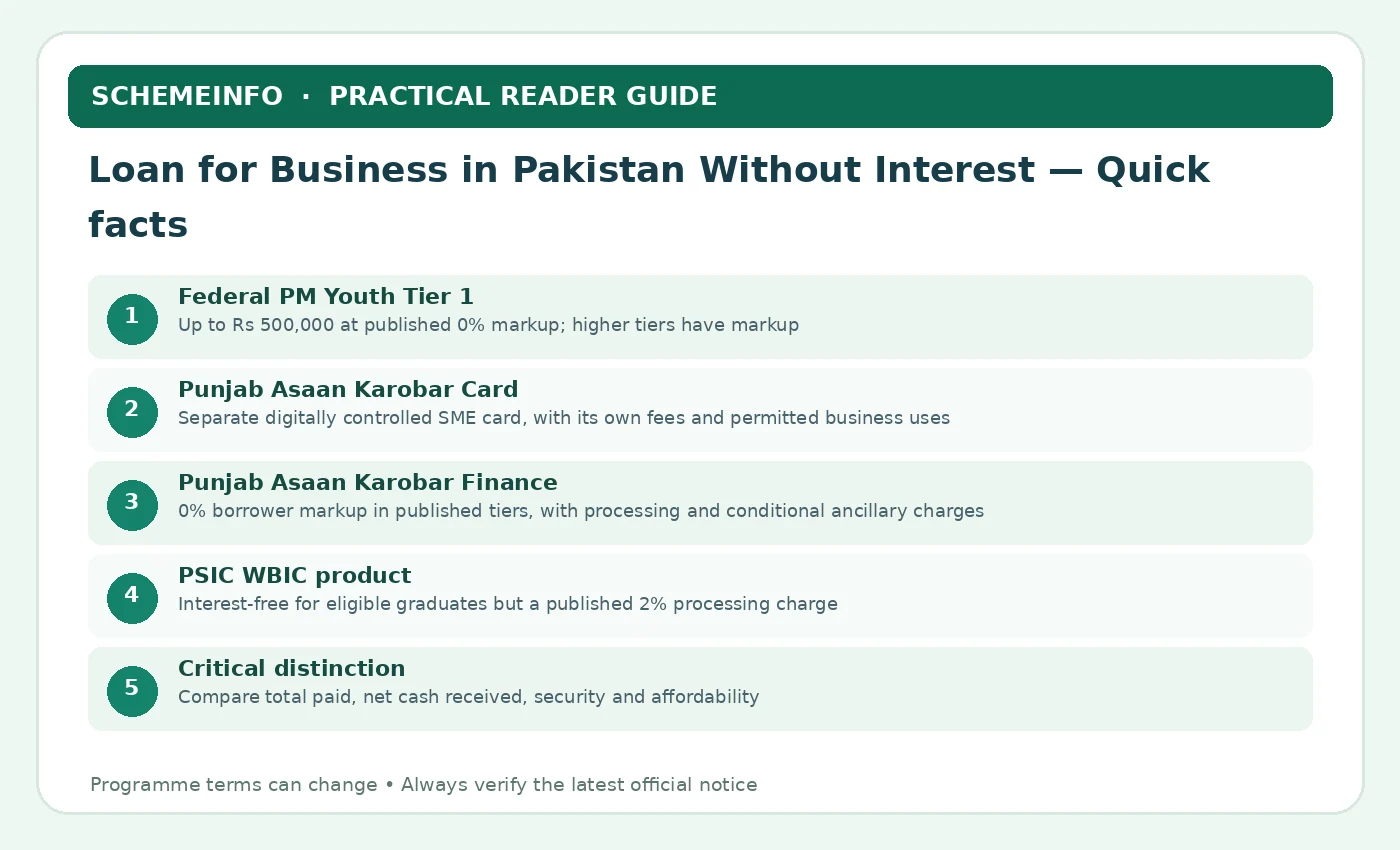
| Federal PM Youth Tier 1 | Up to Rs 500,000 at published 0% markup; higher tiers have markup |
|---|---|
| Punjab Asaan Karobar Card | Separate digitally controlled SME card, with its own fees and permitted business uses |
| Punjab Asaan Karobar Finance | 0% borrower markup in published tiers, with processing and conditional ancillary charges |
| PSIC WBIC product | Interest-free for eligible graduates but a published 2% processing charge |
| Critical distinction | Compare total paid, net cash received, security and affordability |
Who qualifies for zero-markup business funding
Begin with the responsible institution’s written eligibility rules for Loan for Business in Pakistan Without Interest. These checks are not a promise of approval; eligibility is decided through the named programme’s actual verification process.
- Clear business purpose that fits the selected financing product.
- Valid CNIC and the required jurisdiction or provincial residence where applicable.
- PM Youth programme age rules if using its federal Tier 1 and the relevant IT/e-commerce exception.
- Asaan Karobar tax registration, business location and credit requirements where those products are selected.
- Ability to make instalments despite absence of interest; financing principal remains repayable.
- Branch assessment, guarantors or references for Akhuwat facilities where specified by that organisation.
Documents for a zero-markup business application
Keep essential records legible and separate from optional supporting papers. For Loan for Business in Pakistan Without Interest, confirm which forms the responsible office requires before sharing identity or family information.
- CNIC and applicant-controlled mobile.
- Costed business plan and clear record of what financing will purchase.
- NTN, active tax-filer and business premises documents for qualifying provincial SME finance.
- Bank statements or evidence of sales/cash flow as demanded by the provider.
- Guarantor, personal guarantee or secured collateral according to the loan size and product.
- Official contract, fee breakdown, instalment calendar and submitted reference.
How Loan for Business in Pakistan Without Interest works: rules, evidence and decisions
The following sections unpack the Loan for Business in Pakistan Without Interest rules, common misunderstandings and evidence needed for a responsible decision. Check the original official source whenever a condition affects your eligibility.
What “without interest” means in practice
In Pakistan, programmes can describe subsidised markup at 0%, charitable Qarz-e-Hasan or other funding models. The legal arrangement and who subsidises the financing cost are not necessarily the same. A zero-markup government SME loan is repayable principal, not money the borrower can retain without repayment.
PM Youth Tier 1 zero-markup route
The federal PM Youth Business and Agriculture Loan Scheme lists Tier 1 up to Rs 0.5 million with zero markup; higher tiers carry 5% and 7% published rates. Decide whether the business plan and requested amount belong within Tier 1; do not apply the Tier 1 rate to amounts beyond its limit. A startup seeking Rs 400,000 may examine Tier 1, but Rs 2 million belongs to a different tier with a different cost.
Punjab Asaan Karobar Card
Punjab’s Card programme lists financing up to Rs 1 million at 0% borrower markup, delivered through controlled business spending channels. The annual card fee and processing charge still matter. A service firm paying online suppliers might find spending controls manageable, while someone needing informal cash payments must examine restrictions carefully.
Punjab Asaan Karobar Finance tiers
The main Punjab scheme is aimed at qualifying SMEs with loans from Rs 1 million to Rs 30 million, subject to its tax, age, security and business location rules. A workshop seeking Rs 8 million of new machinery cannot treat that as a simple no-document microloan.
Zero-markup products and total cost
Akhuwat Qarz-e-Hasan through branches
Akhuwat provides interest-free microfinance through a branch network and applicant assessment. Its official website explicitly says it does not offer loans online. A small grocery vendor may explore community microfinance if formal tax and security conditions of a larger SME scheme are unsuitable.
Interest-free loan versus grant
An interest-free loan creates a repayment obligation, whereas a grant normally transfers support under different rules. A livestock asset programme, fee waiver or startup training is not automatically a loan. Read the funding instrument and ask who receives the asset, whether principal must be repaid and what happens after late payment. A business should not plan to keep the Loan for Business in Pakistan Without Interest amount permanently simply because promotional materials say “free.”
Application eligibility and income evidence
Lenders still care whether a borrower can repay principal. Formal programmes may need tax registration, enterprise records, age eligibility and a clean credit report. A shop purchasing a refrigerator should estimate the additional daily gross margin after power and maintenance costs.
Hidden and indirect costs of borrowing
A 0% markup rate can coexist with processing, annual card, documentation, insurance, legal and late-payment costs. Punjab official pages publish some of these charges openly. Compare a written net disbursement and total cash paid over the term, including costs outside monthly principal instalments. An annual fee affects a small business even when the monthly principal payment looks affordable.

Costs, documents and decisions
Compare cashflow rather than maximum amount
A loan's appropriate size is determined by the Loan for Business in Pakistan Without Interest’s realistic cost and capacity to repay. The maximum programme amount is not a target every borrower should seek. A Rs 300,000 inventory need can be damaged by borrowing Rs 1 million without a profitable use for the difference.
Repayment terms and missed instalments
Late charges, recovery rights and collection practices should be understood before signing. An interest-free offer is not permission to miss instalments or roll debts into other expensive products. Read the contract for due dates, grace period, consequences of default and provider complaint contacts. A young entrepreneur whose main sales arrive quarterly must plan cash reserves for monthly deductions.
Business purpose and prohibited uses
Subsidised business finance may restrict spending to approved categories such as inventory, working capital, machinery or operating expenses; some products enforce this through digital payment rails. A company using business funds to cover unrelated personal spending can breach a financing agreement even when it repays on time.
Documents for formal and informal businesses
A business with an NTN and dedicated account has different evidence available from a home-based producer without formal registration. Not every scheme accepts the same alternative documentation. Choose a product whose official conditions fit the real business instead of inventing tax documents, turnover or ownership. A seller with real sales but no NTN should not falsely claim FBR filer status to reach the higher tier.
Troubleshooting, safer alternatives and next steps
Common fraud involving interest-free promises
Scams frequently advertise “no interest, no guarantor, no checks” and ask for an unlocking fee, identity scans or remote phone access. An attractive label does not prove official backing. Never transfer money to an agent because they claim to approve a Qarz-e-Hasan loan overnight.
The best comparison table
A useful comparison includes maximum amount, purpose, who qualifies, markup, fees, security, repayment, and application channel. Leave unknown costs clearly marked as unverified. Use the original source for each entry and date the information to avoid repeating obsolete terms. Two zero-markup products can still have different real costs because of annual fees and repayment periods.
Selecting a programme for women and youth
Some national and provincial products provide age exceptions, training-linked financing or different equity contributions for specific groups. A lower interest figure does not override those conditions. A 20-year-old software founder might qualify for the federal IT-age exception but not a provincial programme requiring age 25.
What to do if no programme fits
An applicant may be too young, outside the region, missing required records or facing an unaffordable instalment. The right response is to reassess financing need, not falsify the application. A business that cannot service even a zero-interest principal payment may need a smaller project before borrowing.
Comparing federal and Punjab 0% products
Use the named programme’s actual rules and documents to evaluate these decisions. Each item below addresses a different obstacle that applicants commonly face.
Understand three meanings of interest-free
A product described as interest-free may be a government-subsidised zero-borrower-markup facility, an Islamic charitable Qarz-e-Hasan arrangement or a product where charges appear under other headings. These are not interchangeable legal or financial terms. The correct test is the lender’s contract and a complete rupee-by-rupee cash-flow schedule, not the headline alone.
- Ask how much principal is approved and exactly how much reaches the borrower after authorised deductions.
- Request a list of application, processing, documentation, insurance, legal, card-maintenance and late charges where applicable.
- Confirm whether any quoted rate is 0% for the entire approved financing amount or only a lower tier.
- Check whether repayment is monthly, seasonal or tied to business turnover; cash-flow mismatch can be costly even without interest.
Use a comparison sheet showing money received, money repaid and additional costs. This avoids accidentally calling a fee-bearing product completely free.
Use PM Youth Tier 1 for the appropriate amount
The official PM Youth Business and Agriculture Loan Scheme publishes Tier 1 financing up to Rs 500,000 at 0% markup. It is aimed at qualifying entrepreneurial use and has age and eligibility conditions; higher tiers publish positive markup rates. The distinction matters when a borrower tries to stretch a small start-up budget into a much larger proposal.
- Check the current official portal’s age, residency and business-purpose rules; the IT/e-commerce age exception is different.
- Match each intended purchase to quotations and a simple business plan, leaving out unrelated personal expenses.
- Consider whether the amount really needs to exceed Tier 1, because moving into higher tiers changes the published rate.
- Keep a record of the participating bank and the exact application number; do not pay a social-media operator for “guaranteed PM Youth approval.”
Approval remains with the participating institution under its checks. A zero-markup product is still a repayable liability, not a cash grant.
Full costs, repayment risk and responsible borrowing
Use the named programme’s actual rules and documents to evaluate these decisions. Each item below addresses a different obstacle that applicants commonly face.
Compare Punjab Card and larger SME finance
Punjab’s Asaan Karobar Card and Asaan Karobar Finance are not one interchangeable loan. The Loan for Business in Pakistan Without Interest supports controlled business expenditures through a digital card structure, while larger SME finance is assessed within defined tiers and may require tax, premises, equity and collateral evidence. A food kiosk and a registered medium enterprise need different routes.
- Decide whether the expense can be paid through a restricted business card or requires financing for machinery, premises or working capital.
- Confirm the published card application fee and account conditions; compare them with tier-based SME finance processing charges.
- Read the larger scheme’s rules on borrower equity, conditional handling charges, insurance and legal costs before calling it free.
- Assess instalments from profit after realistic operating costs. Promotional maximums are not affordability targets.
Both products should be accessed through their published Punjab government channels, not a generic “interest-free instant cash” advertisement.
Build a zero-markup cash-flow test
Even when there is no annual markup, principal repayments can consume most of a fragile business’s free cash. An equipment loan should be supported by a credible estimate of how equipment increases output or reduces costs. A working-capital loan should match the interval between paying a supplier and collecting from customers.
- Estimate average monthly sales, gross margin, stock replacement, utilities, staff and tax before calculating free cash.
- Model a weak month at 25% lower sales; ask whether the instalment can still be paid without taking another loan.
- Record repayment dates and keep at least one instalment buffer where feasible rather than spending every rupee of disbursement.
- Check default charges and security consequences; zero markup does not mean missed payments have no effect.
Small, sustainable financing that can be repaid is usually more useful than a large advertised amount that forces emergency borrowing later.

Reader verification worksheet: Loan for Business in Pakistan Without Interest
For Loan for Business in Pakistan Without Interest, work through these questions before providing personal records or accepting a financing offer. This is an independent reader decision tool, not a government or lender application form. Write the evidence or published rule that answers each question.
- Decision 1: Is the advertised zero-markup rate valid for my actual financing tier and amount?
- Decision 2: Is the product a spending-restricted card or ordinary business financing?
- Decision 3: What legitimate fees and charges apply despite the stated 0% borrower markup?
- Decision 4: How much usable cash or purchasing capacity will I actually receive?
- Decision 5: Does the scheme permit the exact equipment, stock or working capital purpose?
- Decision 6: Is the monthly or seasonal repayment affordable after operating expenses?
- Decision 7: Are any guarantees, security, own contributions or tax filings necessary?
- Decision 8: Can I explain the total contractual cost before signing or accepting?
Four checks specific to this financing question
Check whether repayment is monthly, seasonal or tied to business turnover; cash-flow mismatch can be costly even without interest.
Keep a record of the participating bank and the exact application number; do not pay a social-media operator for “guaranteed PM Youth approval.”
Assess instalments from profit after realistic operating costs. Promotional maximums are not affordability targets.
Check default charges and security consequences; zero markup does not mean missed payments have no effect.
A short written checklist makes it easier to distinguish an official fact, an unverified claim and a remaining question. Keep the record private and update it when the responsible organisation releases new information.
Zero-markup financing: a real-cost comparison worksheet
A business loan can have zero borrower markup and still involve deductions or costs. In this illustration, compare the cash actually received with the contractual principal and other mandatory payments before concluding that the product costs nothing.
| Illustrative principal | Rs 400,000 |
|---|---|
| Illustrative processing deduction | Rs 5,000 (hypothetical; not an asserted charge for any specific product) |
| Illustrative net amount available | Rs 395,000 if deducted from disbursement |
| Principal repayable | Rs 400,000 plus any separately applicable fees/charges |
| Effective planning question | Is Rs 395,000 enough to buy the planned equipment and still pay each instalment? |
What the comparison means before you act
- Use the current term sheet to distinguish actual fees from the hypothetical demonstration above.
- Check whether a programme uses a restricted spending card or disburses ordinary funds.
- Look for conditional handling, insurance, legal, account and late-payment charges.
- Use conservative profit, not gross turnover, when deciding whether repayment is affordable.
An interest-free headline should start the research, not end the cost calculation.
Illustrative worksheet: Figures are educational examples, not a real lender quotation or confirmed approval. Always use the responsible institution’s current written terms.
Seven zero-markup traps worth checking line by line
The following checklist is tailored to this exact topic. Use it as a final check before registering, signing, sharing identity records or acting on a purported result.
- The quoted 0% may apply only to PM Youth Tier 1 and not to an amount that moves the application into a higher tier.
- A card-based facility may restrict where business expenditure can be made even though a headline advert says loan.
- A processing or annual card fee can reduce net usable funds or add a cost despite no borrower markup.
- Legal, valuation, insurance or documentation costs may be payable separately under a larger SME product.
- Late charges and recovery provisions still apply when a borrower misses an instalment on a zero-markup loan.
- A lender may require an own contribution or qualifying tax registration even when the advertised interest rate is zero.
- An agent promising an unrestricted cash grant may misrepresent a repayable, purpose-limited business product.
{esc(closing)}
Two realistic Loan for Business in Pakistan Without Interest situations
These scenarios are illustrations, not real applicants, case-law findings or promised outcomes. Their purpose is to show what a careful next decision looks like when one key detail is uncertain.
Tailor compares two 0% routes
A tailor needs Rs 350,000 for sewing machines and stock. The federal Tier 1 ceiling may fit, but the business owner should compare the bank’s actual repayment calendar with the Loan for Business in Pakistan Without Interest’s restricted spending rules, not assume both deliver free cash.
Business owner overlooks a handling charge
An existing SME sees a 0% rate and ignores a published conditional annual handling fee. The owner asks for a complete sanction-letter cost breakdown before agreeing and discovers that “interest-free” is not “all expenses waived.”
How to proceed with Loan for Business in Pakistan Without Interest
Follow the official procedure for this specific topic. A submitted form or preliminary status is never proof of final selection or disbursement.
- Define a legitimate expense: Prepare a list of stock, machinery or qualifying working-capital items and real quotations.
- Compare zero-markup options: Check whether PM Youth Tier 1, Punjab Card, SME Finance or qualifying charity fits.
- Request the full costs: Identify all authorised processing, annual, legal, late or security-related charges.
- Check actual net proceeds: Confirm any deductions and whether a restricted card can pay the chosen supplier.
- Forecast sustainable repayments: Use realistic gross margin and operating expenses, including a slow-month scenario.
- Apply only through official channels: Save references, do not pay selection agents and disclose income and tax records truthfully.
- Read the final document: Accept only if the full repayment, fees and default provisions are understandable and affordable.
Official Loan for Business in Pakistan Without Interest sources and independence
The links below lead to the responsible government or regulator information services, including public rules that can supersede older summaries. Their current instructions outrank summaries and old dates. SchemeInfo is an independent information publisher: it is not a government agency, bank, lending institution or government loan administrator.
Editorial review: 12 November 2026. Scheme rules and payments may change after this date. Verify before applying or sharing sensitive personal information.
Frequently asked questions about Loan for Business in Pakistan Without Interest
These answers separate zero borrower markup from actual contractual costs, eligibility and permitted business spending.
Are all interest-free business loans available nationwide?
No. Provincial facilities can restrict residence and enterprise location, while federal products have their own conditions.
Is PM Youth Tier 3 interest-free?
No. The official page lists 7% for its higher Tier 3, unlike 0% Tier 1.
Does zero markup remove processing charges?
Not automatically. Review the official fees and the signed contract.
Can I apply for an Akhuwat loan online?
Akhuwat’s official website directs applicants to branches and says it does not offer online loans.
Can a new business get a zero-markup loan?
Possibly, depending on the selected programme’s age, business, tax, security and repayment requirements.
For loan for business in pakistan without interest, what matters about pm youth tier 1 zero-markup route?
The federal PM Youth Business and Agriculture Loan Scheme lists Tier 1 up to Rs 0.5 million with zero markup; higher tiers carry 5% and 7% published rates.. Decide whether the business plan and requested amount belong within Tier 1; do not apply the Tier 1 rate to amounts beyond its limit..
For loan for business in pakistan without interest, what matters about punjab asaan karobar finance tiers?
The main Punjab scheme is aimed at qualifying SMEs with loans from Rs 1 million to Rs 30 million, subject to its tax, age, security and business location rules.. Understand the differences between personal-guarantee and secured tiers and review application charges and possible handling costs..
For loan for business in pakistan without interest, what matters about interest-free loan versus grant?
An interest-free loan creates a repayment obligation, whereas a grant normally transfers support under different rules. Read the funding instrument and ask who receives the asset, whether principal must be repaid and what happens after late payment..
For loan for business in pakistan without interest, what matters about repayment terms and missed instalments?
Late charges, recovery rights and collection practices should be understood before signing. Read the contract for due dates, grace period, consequences of default and provider complaint contacts..
For loan for business in pakistan without interest, what matters about the best comparison table?
A useful comparison includes maximum amount, purpose, who qualifies, markup, fees, security, repayment, and application channel. Use the original source for each entry and date the information to avoid repeating obsolete terms..