
SchemeInfo • Independent Pakistan programme guide • Reviewed 12 November 2026
Benazir Taleemi Wazaif helps eligible Kafaalat households support children attending school. Families need the child's NADRA record, a verified admission slip and ongoing attendance that meets programme rules. This guide walks through registration, school verification and payment questions, including what to do when an enrolment or attendance record is wrong.
Explore this guide — table of contents
- Key facts at a glance
- Eligibility requirements
- Required documents
- How the programme works
- Selection, verification and payment explained
- Documents, costs and practical circumstances
- Problems, safer choices and next steps
- Practical decisions before applying
- Practical decisions after verification
- More topic-specific planning checks
- Reader decision worksheet
- Worked examples
- How to proceed
- Related guides
- Frequently asked questions
- Official sources and disclaimer

Benazir Taleemi Wazaif: key facts at a glance
These are the central published facts for the Benazir Taleemi Wazaif, not a guarantee of admission, approval or an open registration window. The references at the bottom distinguish current official pages from historical phases.
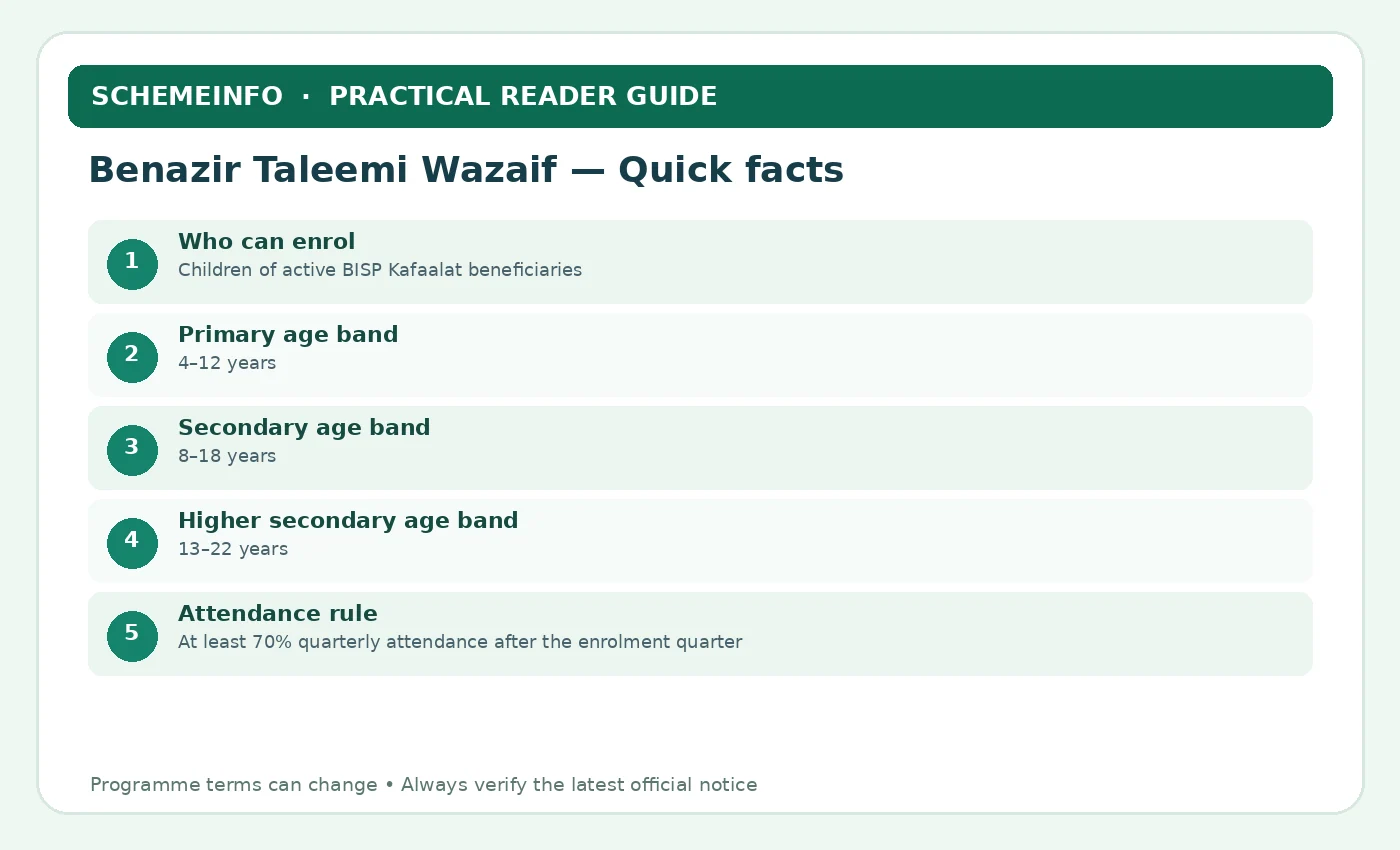
| Who can enrol | Children of active BISP Kafaalat beneficiaries |
|---|---|
| Primary age band | 4–12 years |
| Secondary age band | 8–18 years |
| Higher secondary age band | 13–22 years |
| Attendance rule | At least 70% quarterly attendance after the enrolment quarter |
Eligibility for Benazir Taleemi Wazaif: who should apply?
Begin with the institution’s written eligibility rules for Benazir Taleemi Wazaif. These checks are not a promise of approval; eligibility is decided through the named programme’s actual verification process.
- Child must belong to a household with an active BISP Kafaalat beneficiary.
- BISP lists primary-school ages 4–12, secondary 8–18 and higher secondary 13–22 for the relevant education level.
- Child must be admitted to an eligible school or college with verified enrolment.
- A minimum of 70% school attendance each quarter is required for continuing benefits after initial enrolment.
- The family must keep the child’s identity and school details current; repeated non-compliance can lead to suspension.
Documents for Benazir Taleemi Wazaif: what to verify?
Keep essential records legible and separate from optional supporting papers. For Benazir Taleemi Wazaif, confirm which forms the responsible office requires before sharing identity or family information.
- Mother or other active Kafaalat beneficiary’s original CNIC.
- Child’s NADRA B-form or Child Registration Certificate (CRC), subject to database verification.
- School or college admission slip showing institution, class and teacher-verified enrolment information.
- Child should attend the programme enrolment camp or BISP field-office appointment when required.
- Updated school transfer or admission records if the child changes institution.
How Benazir Taleemi Wazaif works: the published details
Use these programme-specific details to check the official route and to avoid interpreting a rule more broadly than it was written.
How the education stipend fits with Kafaalat
The Benazir Taleemi Wazaif adds conditional education support for school-age children of active BISP Kafaalat families. It is not a universal stipend for every pupil in Pakistan. Before visiting an enrolment camp, confirm that the mother’s Kafaalat record is active.
Age bands by education level
The official BISP page sets overlapping age bands: 4–12 for primary, 8–18 for secondary and 13–22 for higher secondary. The child must also be in the appropriate educational level; age alone does not qualify a child.
The verified admission slip
BISP specifically requires a school or college admission slip stating the class and institution name, verified by a teacher. A handwritten note without school verification may not satisfy the official enrolment procedure.
Why the B-form matters
NADRA’s Child Registration Certificate or B-form is used to validate the child’s identity and family link. If spelling or birth-date details differ, correct the official record before the enrolment visit.
Selection, verification and payment explained
The first quarter and continuing conditions
From the second quarter, the child must attend at least 70% of effective school days. Treat the attendance register as a financial-support record as well as an educational record.
When payments may be suspended
BISP states that three consecutive non-compliant quarters can lead to suspension for the beneficiary child. If attendance data seems wrong, speak to the school and BISP field office promptly with the relevant attendance evidence.
How to interpret published rates
The official BISP webpage gives older quarterly figures by school level and gender, from Rs. 1,500 to Rs. 4,000. Later increases are not uniformly reflected in that table. Ask BISP for the current amount for the child’s level rather than copying an unverified rate circulating on social media.
Supporting girls’ progression
The Benazir Taleemi Wazaif’s published table pays girls more than boys and refers to a primary-completion graduation bonus for girls. When a child moves to the next level, ensure the enrolment record and class category are updated.

Documents, costs and practical circumstances
What happens after a school transfer
Moving schools may leave an older institution in the payment record if the transfer is not verified. Collect new admission information and request an official update instead of assuming automatic migration.
How the family enrols a child
An eligible beneficiary visits the designated BISP camp or field office with the child, CNIC, B-form and verified school slip. There is no need to buy a private online application link; use the official service channel.
Attendance during illness or disruption
Serious illness, examination schedules or local closures may affect attendance records and require clarification. Document legitimate absences through the school while following the current BISP compliance rules.
Distinguishing this from merit scholarships
Taleemi Wazaif is linked to poverty support, Kafaalat enrolment and regular school attendance; it is not ranked solely on exam grades. Families can explore other scholarships separately, while checking rules about receiving overlapping assistance.
Problems, safer choices and next steps
Avoiding verification scams
A third party cannot guarantee that a child will be enrolled or paid. BISP warns that 8171 is its official message number. Do not share personal codes or pay a registration fee to someone offering a faster stipend.
Resolving a missing payment
A missing instalment can stem from school data, attendance, identity or payment scheduling. A family should identify the cause before resubmitting forms. Take the admission slip, original IDs and specific quarter details to the proper BISP office.
Keeping school support useful
The stipend is meant to encourage retention and reduce dropout; it works best alongside a practical study and travel plan. Monitor attendance monthly rather than discovering a problem only when a payment is missed.
Benazir Taleemi Wazaif: practical decisions before you apply
These steps translate the published rules into concrete decisions. Use them as preparation, and allow the official department to determine eligibility, payment or selection.
Check the three eligibility gates in the correct order
A child needs an active Kafaalat household link, the right age for the school level and verified admission. Fulfilling only one of those conditions is not enough for a Taleemi Wazaif enrolment.
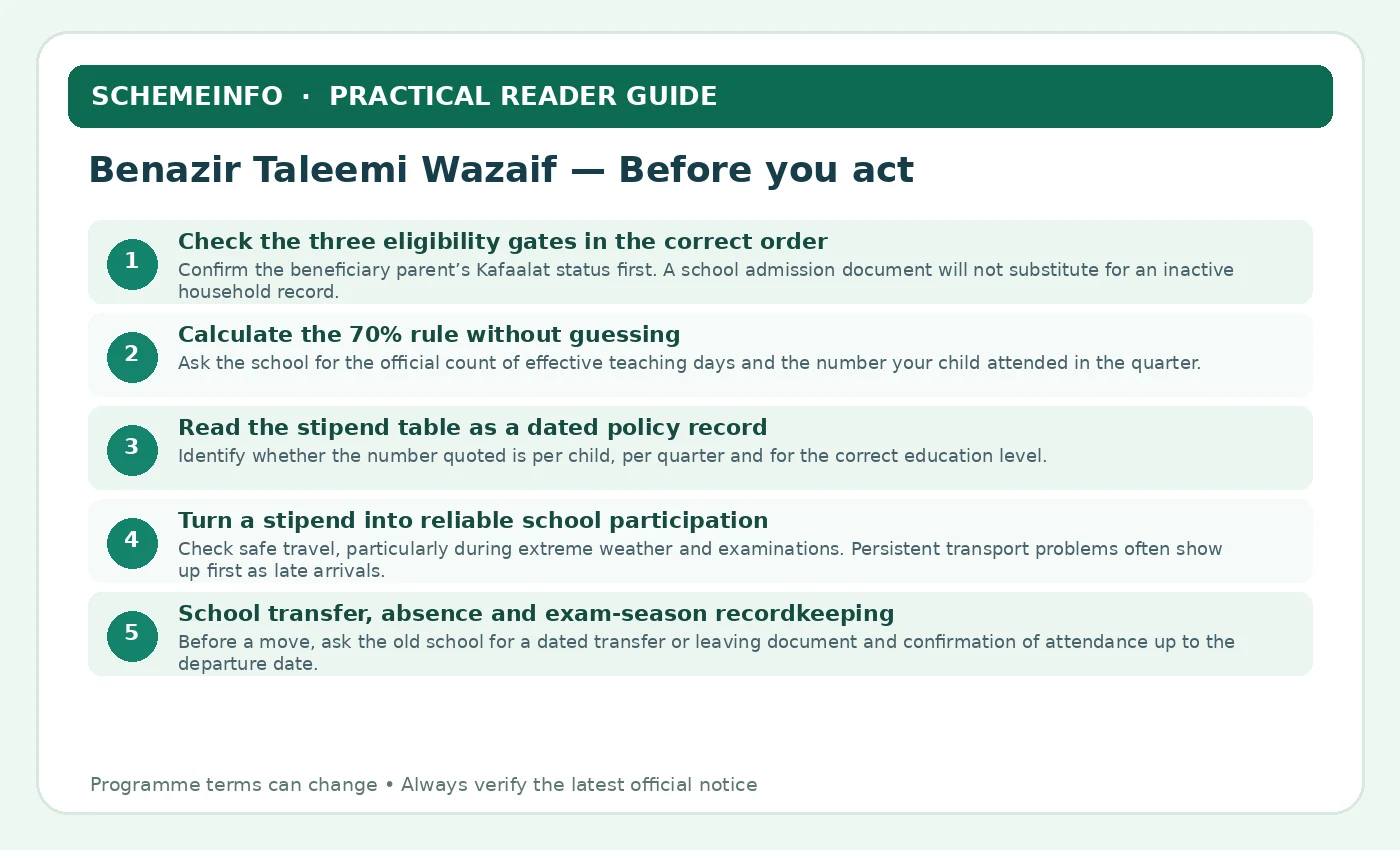
- Confirm the beneficiary parent’s Kafaalat status first. A school admission document will not substitute for an inactive household record.
- Match the child’s current educational level with the BISP age band, remembering that bands overlap but school level still matters.
- Ensure the NADRA B-form or Child Registration Certificate names and family details agree with the beneficiary CNIC.
- Obtain a school or college slip showing institution, class and the responsible teacher’s verification as required by BISP.
- Visit the authorised BISP enrolment office with the child and required original documents; do not pay an unrelated agent to submit a picture of the slip.
Where a child changes class during a cycle, confirm the recorded new class rather than assuming the old school details automatically update.
Calculate the 70% rule without guessing
The Benazir Taleemi Wazaif uses effective school days within a quarter, not simply the number of calendar days between stipend payments. Keeping an attendance record can prevent confusion after a temporary illness or transfer.
- Ask the school for the official count of effective teaching days and the number your child attended in the quarter.
- For example, if there were 60 effective days, 70% means at least 42 attended days. This is an illustration, not an alternative BISP formula.
- Review absence entries promptly when there was an exam, local closure or documented illness. Speak to the school before the quarterly verification is finalised.
- Inform the programme and new school when transferring a child so records are not checked against a class the child no longer attends.
- If a payment is suspended, ask whether the reason is attendance, identity or household status; the correct remedy depends on the cause.
The best attendance strategy is regular learning and safe travel—not asking anyone to falsify registers.
Benazir Taleemi Wazaif: practical decisions after checking the rules
These steps translate the published rules into concrete decisions. Use them as preparation, and allow the official department to determine eligibility, payment or selection.
Read the stipend table as a dated policy record
The official BISP page sets out different quarterly amounts for boys and girls at primary, secondary and higher-secondary levels. Rate updates sometimes reach announcements before an older information table is revised.
- Identify whether the number quoted is per child, per quarter and for the correct education level.
- Distinguish a first enrolment payment from continuing quarterly payments that depend on verified attendance.
- Ask whether a primary-completion bonus is applicable to an eligible girl; do not treat every promotion as a cash bonus.
- Do not multiply a published quarterly rate by twelve months. For a rough annual comparison, four quarters is the appropriate unit only if all instalments become due.
- Keep expenses such as books, shoes and bus fare separate, because actual schooling costs may exceed the payment.
BISP’s current written announcement, not an old shared graphic, controls any change to the stipend amount.
Turn a stipend into reliable school participation
The long-term benefit comes from keeping a child in school, not just receiving an instalment. Small practical decisions can help families turn the cash assistance into consistent attendance and learning.
- Check safe travel, particularly during extreme weather and examinations. Persistent transport problems often show up first as late arrivals.
- Allocate a basic share of school support to notebooks, shoes, uniform repairs and learning materials before non-essential purchases.
- Ask teachers about reading or mathematics gaps and create a short regular practice plan rather than relying only on tuition centres.
- Keep certificates, report cards, enrolment confirmations and transfer records together as the child progresses.
- If a child stops attending, seek school and community support early; payment suspension is a symptom of a bigger education problem.
The family should know both the BISP contact and the school contact for resolving the two different kinds of problem.
Benazir Taleemi Wazaif: practical decisions after checking the rules
These steps translate the published rules into concrete decisions. Use them as preparation, and allow the official department to determine eligibility, payment or selection.
School transfer, absence and exam-season recordkeeping
The 70% rule is simple to state but can become complicated when a child changes schools, attends an examination centre or misses classes for genuine reasons. The record held by the school and the record used by BISP should agree.
- Before a move, ask the old school for a dated transfer or leaving document and confirmation of attendance up to the departure date.
- At the new school, confirm the date of admission and that the child’s class and identity details match the B-form.
- For medical absence, keep the school’s accepted evidence and ask the head teacher how it affects the recorded effective-day count.
- Where local school closure affected all pupils, ask the institution how it reports effective teaching days rather than counting holidays as individual absences.
- Check the quarterly attendance record before the next reporting cycle and correct genuine clerical mistakes promptly.
The purpose of these checks is a truthful record, never manufactured attendance. Consistent schooling remains the main objective.
What a quarterly stipend can and cannot cover
The Benazir Taleemi Wazaif’s published rate table is better interpreted as partial education-cost support. A child still needs routine items throughout the quarter, and the amount actually paid can depend on continued compliance.
- Write four small categories for a quarter: transport, writing materials, shoes or uniform upkeep, and exam-related costs.
- Allocate the verified payment only once it is actually received; do not multiply it by monthly figures appearing in social-media advertisements.
- If the child has two siblings also enrolled, keep a separate record for each child so a missing or suspended payment can be investigated accurately.
- Ask the school about free textbooks, fee concessions or local educational support before purchasing everything privately.
- Use the stipend as an attendance-support tool: a small transport reserve can prevent several missed school days.
School support works best when the parent and teacher communicate directly about practical barriers, not only about the next instalment date.
Reader worksheet for Benazir Taleemi Wazaif
Use the questions below as a short decision worksheet for Benazir Taleemi Wazaif. Each answer should be supported by your own records, a current notice or a written response from the authorised office. This is more useful than a generic checklist copied between unrelated welfare schemes.
- Check 1: Which specific official announcement or policy version applies to my household, student, patient or construction project?
- Check 2: Who makes the final decision, and what document proves that this office has processed my case?
- Check 3: Which eligibility condition could rule me out even if I genuinely need support?
- Check 4: Which expenses are definitely included, which are conditional, and which will remain my responsibility?
- Check 5: What dates, records or verification steps could cause an avoidable delay?
- Check 6: How will I distinguish a provisional result from a final award, approved payment or signed loan?
- Check 7: What safe alternative will I use if the award or instalment does not arrive?
- Check 8: Who can answer a complaint without charging an unofficial fee or demanding a password?
Four topic-specific checks before making a commitment
Visit the authorised BISP enrolment office with the child and required original documents; do not pay an unrelated agent to submit a picture of the slip.
If a payment is suspended, ask whether the reason is attendance, identity or household status; the correct remedy depends on the cause.
Keep expenses such as books, shoes and bus fare separate, because actual schooling costs may exceed the payment.
If a child stops attending, seek school and community support early; payment suspension is a symptom of a bigger education problem.
Check the quarterly attendance record before the next reporting cycle and correct genuine clerical mistakes promptly.
Use the stipend as an attendance-support tool: a small transport reserve can prevent several missed school days.
Do not assume that a promising website headline has settled all eight questions. A time-sensitive government payment or school result can be genuine while an individual application remains incomplete.
Two Benazir Taleemi Wazaif decisions to think through
These scenarios are illustrations, not real applicants, case-law findings or promised outcomes. Their purpose is to show what a careful next decision looks like when one key detail is uncertain.
A child changes school halfway through a quarter
The family needs to update institution records and preserve the transfer certificate. Otherwise the old school may report missing attendance even though the child is attending elsewhere.
A family sees a bigger rate in a social-media poster
The published BISP programme table and any newer official notice should be compared by date and level; a viral poster is not evidence of an increase.
How to proceed with Benazir Taleemi Wazaif
For the Benazir Taleemi Wazaif, the proper sequence is shaped by the administering office and the current phase. Follow the published instructions wherever they differ from a general checklist.
- Find the real office: Open one of the official Benazir Taleemi Wazaif sources below and check the agency name, contact details and any current notice rather than an unofficial social-media form.
- Check the exact rule: Compare the relevant class, household benefit, financial-need threshold, clinical condition or ownership document against the formal criterion for your situation.
- Prepare only the right documents: Match names, CNIC or B-form details, educational or medical records and current contact information. Mark conditional papers rather than treating every checklist item as compulsory.
- Resolve uncertainties before travel: Ask the receiving institution whether the phase is open, which office will verify the file and how an acknowledgement or reference will be issued.
- Submit through an authorised channel: Use the official online application if one is genuinely open, or the named welfare office, school, hospital or local committee where the rules require it.
- Save the result and plan the next action: Keep an acknowledgement, payment advice, academic result or decision letter; confirm any appeal, correction or next-round process through the same authority.
Official Benazir Taleemi Wazaif sources and independence
The links below are owned by the programme administrators or responsible public bodies. Their current instructions outrank summaries and old dates. SchemeInfo is an independent information publisher: it is not a government agency, bank, hospital, school or scholarship administrator.
Editorial review: 12 November 2026. Scheme rules and payments may change after this date. Verify before applying or sharing sensitive personal information.
Frequently asked questions about Benazir Taleemi Wazaif
Each answer is based on the specific policy or programme history discussed above. A later official announcement, hospital letter, school notice or signed loan agreement may supersede an older online summary.
Is the programme accepting applications today?
BISP’s official programme page gives a historical stipend table; a 2026 adjustment has been reported separately, so current payments must be checked.
Who can meet the main eligibility conditions?
Child must belong to a household with an active BISP Kafaalat beneficiary. Applicants must also satisfy the remaining conditions and verification steps.
Which identity document should I prepare?
Mother or other active Kafaalat beneficiary’s original CNIC. Bring originals only when the authorized office requests them for inspection.
Is approval guaranteed after submitting a form?
No. Eligibility, verification, available allocation and current application rules determine the decision. A reference receipt is not an approval letter.
Where can I verify the latest deadline?
Use the official source page linked below and the office named in the current circular. Do not rely on an unofficial application countdown.
Can I use an agent to speed up approval?
Do not pay an unverified agent or share identity numbers and one-time passwords. Ask the responsible authority about its ordinary submission channel.
What if my information is incorrect?
Correct records with the issuing authority before resubmission. Keep proof of any accepted change and avoid submitting contradictory forms.
How do I check whether a payment or award was approved?
Use the designated official status mechanism or the responsible institution, with your application reference and valid identification.
Will I receive the maximum advertised amount?
Not automatically. The published benefit and an individual award are different things; approved terms, service coverage and available funding control the final result.
What is the safest next step?
For Benazir Taleemi Wazaif, review the two checklists above, verify BISP Taleemi Wazaif official programme and contact the responsible office if an important rule is unclear.