SchemeInfo • Independently edited guide • Reviewed 12 November 2026
The super seeder can help sow wheat after rice while reducing pressure to burn crop residue, but it needs the right tractor, soil conditions and operating plan. Here is what Punjab actually publishes about subsidy support and how farmers should check real availability.
Explore this guide — table of contents
- Eligibility: who this programme is actually for
- Required documents: organised and verifiable
- Verified facts at a glance
- Understand what a super seeder actually does
- Price the 60% support carefully
- Make crop-residue management the central decision
- Document the application without guessing
- Measure results after the first sowing season
- Programme details that often change the decision
- Cost and affordability worksheet
- Six mistakes that can undermine this application
- Real-life situations and the better decision
- How to apply for CM Punjab Super Seeder Subsidy: six verified steps
- Related guides
- Frequently asked questions
- Official sources and editorial independence
Eligibility: who this programme is actually for
For CM Punjab Super Seeder Subsidy, check these programme-specific conditions before preparing an application. Confirm that a new government Super Seeder intake is open before applying. Apply under the farmer or eligible machinery-service route specified for that round. Select the approved machine type and meet any district-allotment conditions. The publicly funded programme specifies 60% subsidy for Super Seeders. Plan to fund the applicant share and operate the equipment appropriately.
A quick self-screen before applying
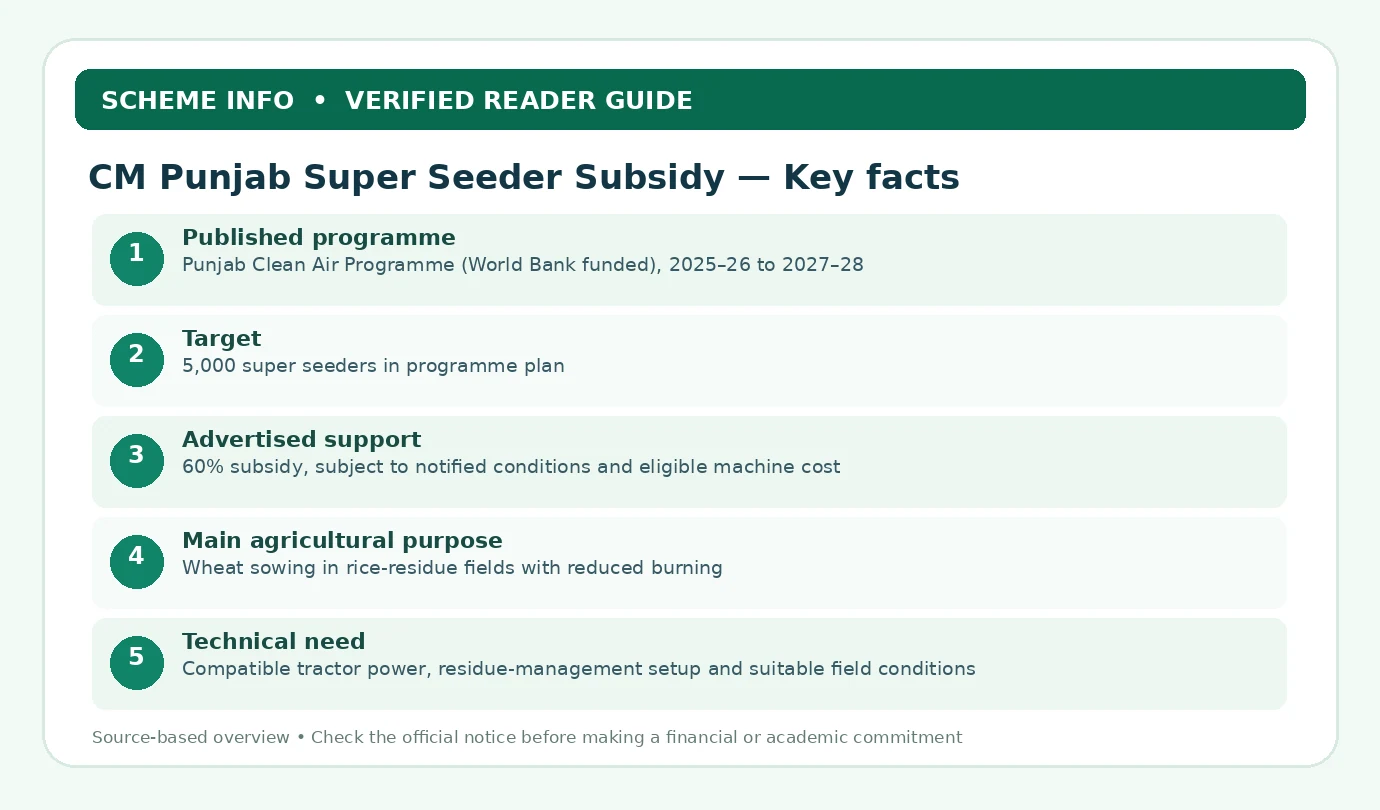
- Punjab Clean Air Programme (World Bank funded), 2025–26 to 2027–28
- 5,000 super seeders in programme plan
- 60% subsidy, subject to notified conditions and eligible machine cost
- Wheat sowing in rice-residue fields with reduced burning
- Compatible tractor power, residue-management setup and suitable field conditions
Where a location, degree, machine type or financial share is stated as a published condition, match it to your own document or quotation. An appealing programme title is not sufficient evidence of eligibility.
Required documents: organised and verifiable
The following documents and supporting evidence are relevant to CM Punjab Super Seeder Subsidy. Mandatory and conditional items are distinguished below. Keep CNIC and reachable telephone details ready. Prepare land or machinery-service evidence if the district form requests it. Obtain approved Super Seeder specifications and supplier quotation. Keep registration receipt or ballot/reference number after applying. Prepare bank and payment records when officially required after selection. The older published application window has closed. These are practical documents to prepare; new-round mandatory uploads are not yet verified.
Five checks before uploading anything
- CNIC or student ID exactly matching the application
- Dated and complete records supporting the published eligibility conditions
- Official evidence for any special category, land holding or finance claim
- The latest advertisement or application guidance saved for reference
- A secure copy of submission acknowledgement and correspondence
A list from an old intake is a useful starting checklist only. Follow the mandatory format and attestation rules issued for the actual round, and protect personal certificates from unofficial agents.
Verified facts at a glance
The published programme tells you which route may be relevant; it does not prove that a specific applicant is selected. Here are the conditions worth checking first.
| Published programme | Punjab Clean Air Programme (World Bank funded), 2025–26 to 2027–28 |
|---|---|
| Target | 5,000 super seeders in programme plan |
| Advertised support | 60% subsidy, subject to notified conditions and eligible machine cost |
| Main agricultural purpose | Wheat sowing in rice-residue fields with reduced burning |
| Technical need | Compatible tractor power, residue-management setup and suitable field conditions |
| Open status | Verify current district advertisement; do not use a past deadline as a live one |
Details reviewed 12 November 2026. Official advertisements and award letters control any later changes.
Understand what a super seeder actually does
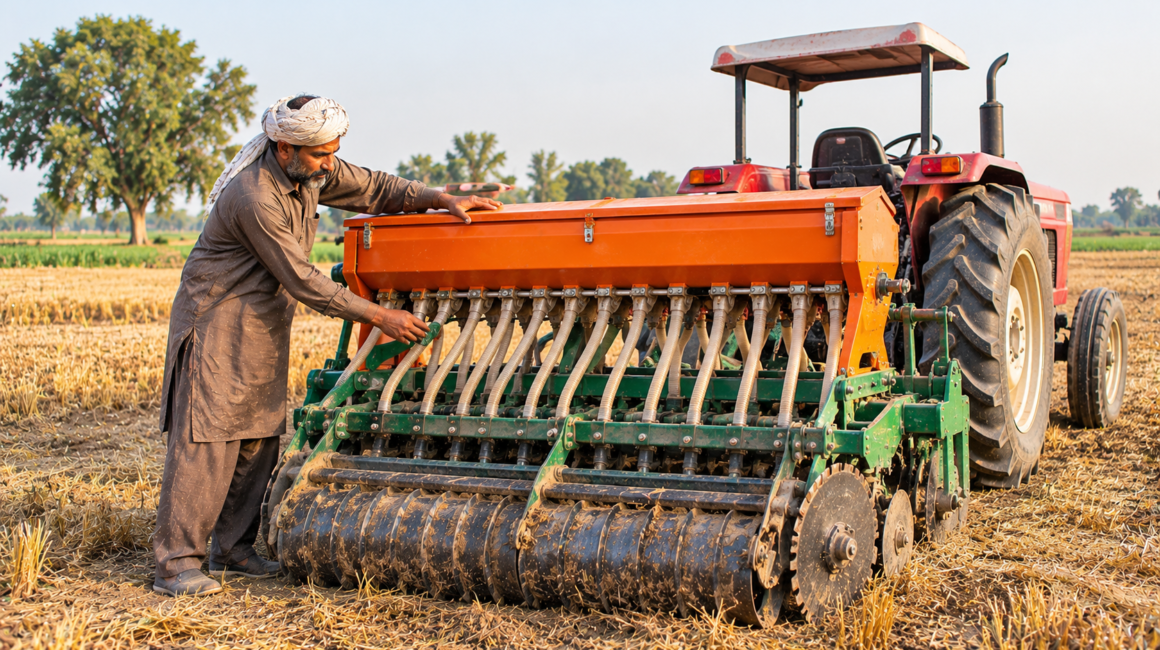
A super seeder is not simply a new name for a drill. It combines operations intended to manage standing rice residue and place wheat seed so that farmers have an alternative to open-field burning.
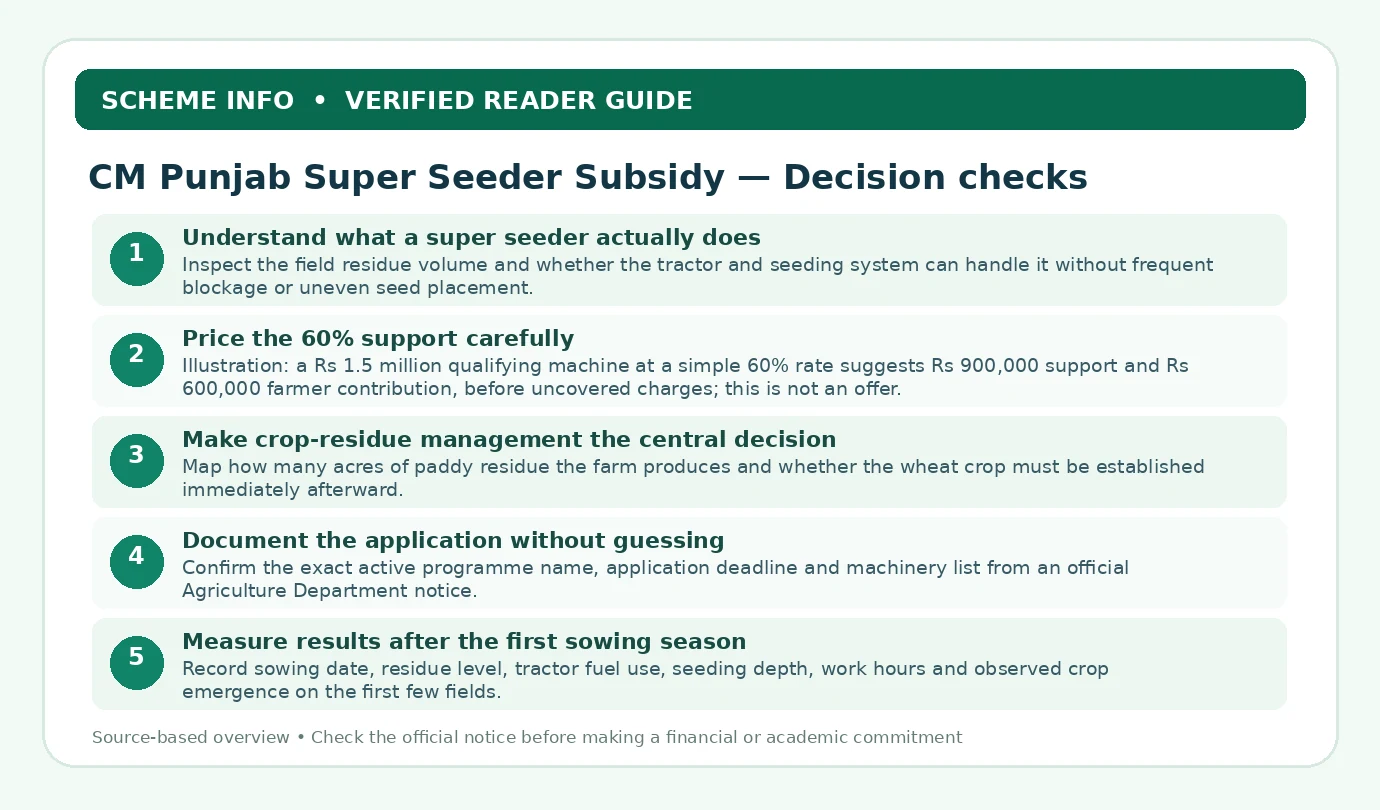
- Inspect the field residue volume and whether the tractor and seeding system can handle it without frequent blockage or uneven seed placement.
- Compare chopping, mixing and drilling components across eligible specifications; a photo of a machine is not enough to prove it is an approved super seeder.
- Consider timing after paddy harvest. Wet soil, standing water or a delayed combine can reduce the benefit of the machine even when the farmer owns it.
- Assess tractor horsepower, hydraulic system, fuel demand and operator training before requesting a quotation.
- Plan an initial supervised test strip to check seed depth, residue cover and germination before using the machine across the entire acreage.
What this means for a real applicant
A strong application starts with the decision the family or operator actually faces. Record the facts that apply to your own land, qualifications, machine or programme category and mark any missing evidence. A helpful scheme guide should enable you to decide whether to proceed, change the plan or investigate a different option.
Price the 60% support carefully
A percentage is a planning input; final grant rules may limit approved models or price components. Farmers need a written invoice and cost breakdown rather than a dealer’s advertised discount.
- Illustration: a Rs 1.5 million qualifying machine at a simple 60% rate suggests Rs 900,000 support and Rs 600,000 farmer contribution, before uncovered charges; this is not an offer.
- Ask whether the amount is applied at purchase, reimbursed later or routed through an approved supplier, because timing changes how much cash is needed.
- Budget transport to the village, service tools, replacement blades, insurance where applicable and operator training separately.
- Compare the farmer’s total cost to hiring a service provider for three seasons, using realistic rates and field availability.
- Do not pay advance amounts to a person claiming to sell a guaranteed allotment or to reopen an expired application round.
How to turn these points into evidence
Where a number is published, keep the source and its date beside the calculation. Use actual fees, quotations, marks and family records—not a rounded social-media figure. The correct decision may be to revise the proposed amount, wait for a verified intake or ask the implementing office for written clarification.
Make crop-residue management the central decision
Rice-stubble management can influence air quality, soil preparation and planting dates. A machine purchase should be evaluated against both agronomic outcomes and financial ability.
- Map how many acres of paddy residue the farm produces and whether the wheat crop must be established immediately afterward.
- Check whether the preceding combine leaves residue distributed evenly; large piles can defeat even a correctly configured seeder.
- Consult agriculture extension staff about residue load, soil moisture and seed rate rather than assuming one set of machine settings works everywhere.
- Calculate fuel and maintenance costs in comparison with existing tillage passes, not just the costs of straw burning.
- Consider custom-hiring to neighbours only if availability, transport and any project conditions make that feasible.
The hidden cost or condition
Compare the best-case headline with the less attractive possibilities: an applicant share above the cap, a delayed payment, a year of low demand, or a scholarship expense beyond the award. That comparison is what makes planning more reliable than relying on an eligibility headline alone.
Document the application without guessing
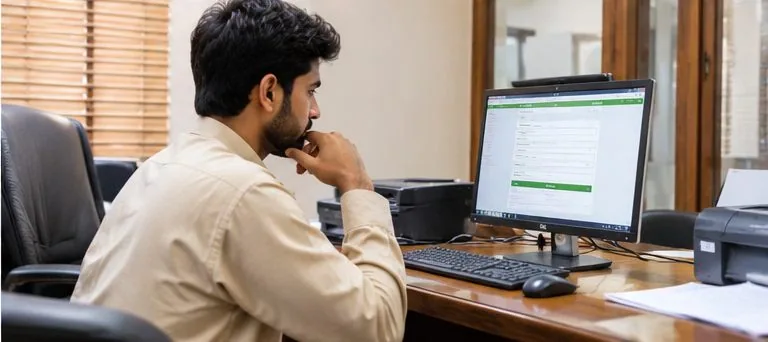
Punjab may announce eligibility through district advertisements, online portals or agriculture offices. A useful guide must tell farmers what to verify, not invent current form fields.
- Confirm the exact active programme name, application deadline and machinery list from an official Agriculture Department notice.
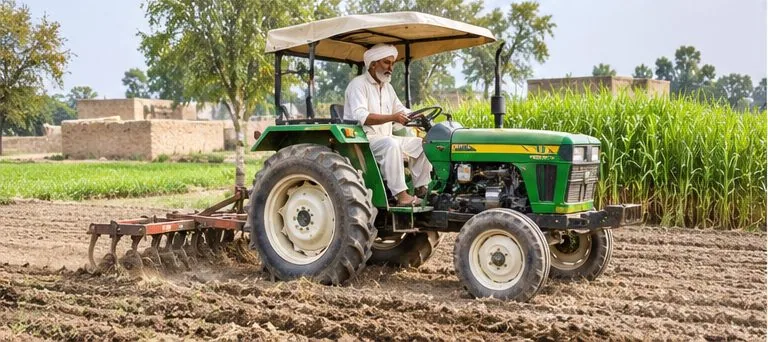
- Prepare the applicant’s CNIC, verified land records, contact details and tractor details if the current form requires them.
- Keep a clear quotation of the eligible model and the dealer’s tax, warranty and servicing terms.
- Ask how beneficiaries will be selected and notified, and what signed documents are needed before delivery.
- Retain acknowledgement numbers and copies while refusing unofficial fees or requests for one-time passwords.
How to check a claim before committing
Treat the active government advertisement, a university focal person or the responsible department as the decision-maker. An intermediary may help explain a process, but cannot change the formal conditions. Keep a dated screenshot or PDF of the notice when a portal opens.
Measure results after the first sowing season
The value of residue-management machinery depends on whether it works on real local fields without disrupting wheat establishment.
- Record sowing date, residue level, tractor fuel use, seeding depth, work hours and observed crop emergence on the first few fields.
- Compare yields cautiously because soil, fertiliser and weather may differ even when sowing technology improves.
- Inspect the machine after every peak operation for blades, shafts, seed tubes and bearings worn by heavy residue.
- Keep separate accounting for hired operations and the owner’s farm instead of relying on memory at season end.
- Review whether timely custom-hiring would have produced the same outcome more cheaply for a smaller farm.
A practical next decision
Finish with a decision you can defend: the relevant scheme, the matching condition, the exact evidence, the cost or expected benefit, and the one unanswered question. This keeps the research focused rather than collecting forms before establishing a realistic path.
Programme details that often change the decision
These details address questions that often appear only after the headline scheme conditions are understood. Read the relevant point alongside the current official notice, particularly where a programme phase or regional rule matters.
Why Super Seeders are subsidised
The Punjab Clean Air Program aims to reduce residue burning by improving rice-straw management. A Super Seeder can place wheat seed while dealing with residue under suitable field conditions. Imagine a rice grower scheduling wheat sowing immediately after the paddy harvest.
The published subsidy
Punjab’s 2025–26 to 2027–28 programme targets 5,000 Super Seeders with 60% subsidy. It is a contribution to approved equipment cost, not an unrestricted cash award. A reader weighing CM Punjab Super Seeder Subsidy should record that detail before comparing advertised amounts. Imagine a seeder operator working through fields with different straw thickness.
The last public application round
A government news report described applications for Super and Pak Seeders at 60% subsidy, with a June 30, 2026 submission deadline. Do not claim that this completed window is currently accepting forms. This specific condition matters more for CM Punjab Super Seeder Subsidy than a headline about possible benefits. Imagine two villages sharing one machine during a short planting window.
Who may benefit most
Rice-wheat farmers and credible machinery service providers need to compare planted hectares, straw conditions and the availability of a suitable tractor or power source. It is a useful way to distinguish CM Punjab Super Seeder Subsidy from superficially similar programmes. Imagine a contractor pricing blades and fuel against the income from each acre.
Benefits beyond crop burning
Residue handling may save labour and improve timely wheat sowing, but results depend on soil moisture, machine adjustment, surface residue and operator skill. The real value of CM Punjab Super Seeder Subsidy depends on how that rule works on the ground. Imagine a rice grower scheduling wheat sowing immediately after the paddy harvest.
Machine specifications and field fit
Examine working width, required tractor horsepower, seed and fertiliser calibration, depth control and spare-part access before choosing an approved machine. This condition is often overlooked in casual descriptions of CM Punjab Super Seeder Subsidy. Imagine a seeder operator working through fields with different straw thickness.
The equipment cost calculation
The farmer’s balance depends on purchase value, subsidy ceilings and round-specific documentation. Budget fuel, transport, training and blades as operating costs separate from purchase assistance. For anyone assessing CM Punjab Super Seeder Subsidy, it defines an important boundary of eligibility or use. In the context of CM Punjab Super Seeder Subsidy, A feasible applicant contribution can be difficult to assemble at the deadline. Imagine two villages sharing one machine during a short planting window.
Application offices and documents
The earlier round directed farmers to Agriculture Extension offices and service centres, with district-specific submission channels. Verify your district and any new notification with the official department. Those requirements should inform a decision about CM Punjab Super Seeder Subsidy before any payment is made. Before committing to CM Punjab Super Seeder Subsidy, A quotation should be evaluated for fit, warranty, eligibility and the ability to obtain repairs or academic services after approval. Imagine a contractor pricing blades and fuel against the income from each acre.
How selection should be documented
A registration receipt does not mean a subsidy has been sanctioned. Keep the submission number, farmer records and any prescribed machine-selection or post-selection inspection papers. A credible plan for CM Punjab Super Seeder Subsidy starts with a realistic understanding of this obligation. When planning around CM Punjab Super Seeder Subsidy, A reasonable scenario includes both a normal outcome and a credible problem: an absent technician, unsuitable weather, additional travel, delayed payments or an academic admission result. Imagine a rice grower scheduling wheat sowing immediately after the paddy harvest.
Custom hiring as a farm business
One machine may serve multiple small plots, but a service operator must evaluate seasonal booking volume, travel between farms, route efficiency and payment collection. When assessing current access to CM Punjab Super Seeder Subsidy, treat announcements and open windows separately. Imagine a seeder operator working through fields with different straw thickness.
Avoid misleading advertisements
Private vendors may market ordinary seeders as government-approved machines. Check the exact scheme list and avoid paying an intermediary for an alleged guaranteed allotment. This is one reason that CM Punjab Super Seeder Subsidy should not be compared only on its advertised maximum. Imagine two villages sharing one machine during a short planting window.
A sensible planning sequence
Confirm the live scheme round, check eligible models, calculate contribution, examine tractor compatibility and ask for written technical support before ordering. The next step for CM Punjab Super Seeder Subsidy is to check the actual official process applicable to your case. Imagine a contractor pricing blades and fuel against the income from each acre.
Cost and affordability worksheet
Machinery programmes should be evaluated against the total cost to the owner, not a single subsidy percentage. Record the approved invoice, published cap, amount you must contribute, any bank loan and the equipment’s likely service life.
Before you rely on the result
- I have the correct dated official notice, not only a blog or forwarded message.
- I understand which eligibility rule or project area applies to my own situation.
- My cost, award, or benefit calculation includes the non-covered items.
- I know who will verify the application and which document supports each claim.
- I have a practical alternative if I am not selected, if finance is refused or if funding is delayed.
Replace all hypothetical figures with your own dated records and the institution’s formal decision. A conservative plan is more useful than an optimistic estimate that has no margin for delays or setbacks.
Six mistakes that can undermine this application
These mistakes are particular to the CM Punjab Super Seeder Subsidy described here. Check them against your actual circumstances before making commitments that may be hard to reverse.
- The programme’s target of 5,000 super seeders describes planned units, not an automatic entitlement for any farmer who registers interest.
- Confirm tractor compatibility and soil moisture; forcing a large seeder through unsuitable fields can damage equipment and compromise wheat establishment.
- Shredded rice residue must be distributed sufficiently evenly to reduce seeding blockages; a poorly operated combine can create a second mechanical problem.
- Compare the full unsubsidised contribution with the cost of hiring a super-seeder service for two or three rice–wheat rotations.
- Test seed depth and germination on a small area before assuming a new machine will improve yields across an entire farm.
- An old seasonal application deadline cannot be reused as proof of a currently live registration portal.
Taking an extra day to verify a condition can be less costly than discovering after purchase, enrolment or submission that the central requirement was misunderstood.
Real-life situations and the better decision
These are realistic examples intended to clarify decisions—not real applicants, official promises or predictions of selection. Use the questions each situation raises to check your own evidence.
A wheat grower after paddy
The farmer harvests rice late and often burns straw to sow wheat quickly. The correct analysis compares super-seeder performance in their wet soils, suitable tractor power and actual sowing window. The next step is to identify the formal requirement involved and obtain the specific supporting record, rather than making a payment on the strength of a verbal promise.
A small farmer without a strong tractor
The subsidy is not useful if a new machine cannot run safely with the existing tractor. Hiring a trained operator may be the more affordable choice. An applicant should compare the actual cost and timing with a less risky alternative, then use the official office or bank to confirm what remains uncertain.
A contractor with several village clients
The contractor has an operating route and enough work, but must test spare-parts support and the number of workable days before financing a new machine. The applicant should keep the relevant advertisement or award letter and avoid interpreting a planned project, a maximum grant or an old deadline as a guaranteed benefit.
How to apply for CM Punjab Super Seeder Subsidy: six verified steps
There is no single universal application form for every programme. The steps below explain the right order of preparation while leaving each authority’s current instructions in control.
- Confirm the latest intake: Check the named authority’s current advertisement and date. An older phase, archived form or project allocation does not establish an open application window.
- Screen eligibility first: Compare your true academic record, household status, landholding or approved machine requirement with the exact published criteria.
- Collect and check records: Prepare legible identity, education, land, category or financial documents as appropriate. Confirm names and numbers match before submission.
- Calculate the real commitment: For machinery, obtain a dated quote and own-share estimate; for study, calculate all fees and living expenses; for community works, establish feasibility and rights.
- Submit through the authorised route: Use the official portal, university scholarship office or designated agriculture office. Do not pay a person who promises selection.
- Save references and read the outcome: Keep the acknowledgment, follow official updates, verify any selection and review the actual award, contract or acceptance conditions.
Official sources and editorial independence
Read the current notice alongside this independently edited guide. SchemeInfo is an information website—not the department, university, government, lender or scholarship provider. No application or selection can be guaranteed here.
Editorial verification completed 12 November 2026; later changes should be checked directly with the listed authorities.
Frequently asked questions
These answers reflect the published sources as checked in November 2026. A fresh government advertisement, university notice or award letter can change the procedure for the next intake.
Is the CM Punjab super seeder grant 60%?
The Punjab 2026–27 programme plan lists 60% subsidy under the Clean Air Programme.
Is there a verified open 2026 form?
The official programme listing does not itself establish an active public application window.
What is the project target?
The published plan targets 5,000 super seeders.
Can a small tractor run the machine?
Only if it meets the chosen equipment’s technical requirements.
Does it eliminate every field operation?
No. Performance depends on stubble, moisture, tractor capacity and proper settings.
Can I buy from any dealer?
Verify approved specifications, suppliers and selection requirements in the current notice.
Will I receive cash directly?
The disbursement mechanism must be checked in the actual programme instructions.
Does the subsidy apply to tractors?
No. The project’s named focus is super seeders.
What if an earlier deadline has expired?
Do not apply through an old link; look for an official new-round announcement.
Where can I get technical advice?
Ask Punjab Agriculture Department field staff or a qualified machinery technician.