A larger SME loan can make sense for an established business, but it also needs documented cash flow and careful review of fees. This guide separates the published Punjab rules from questions that only a lender can resolve.
Before you apply
Programme published; confirm application intake and exact tier boundary with official authority
Last source review: 1 November 2026. The original authority may update conditions without notice.
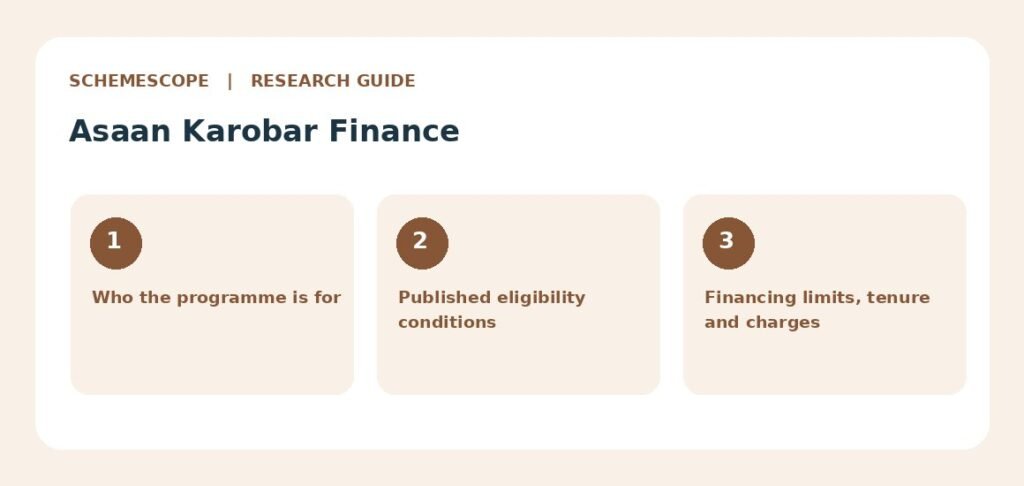
Who the programme is for
Asaan Karobar Finance targets small and medium businesses located in Punjab. It is intended for ventures that need capital for establishment, expansion, modernisation, operating finance, commercial logistics or approved climate-friendly improvements. It is a different programme from the lower-limit Asaan Karobar Card.
An applicant should first decide which business expense is being financed. A specific requirement, supplier quote or credible expansion plan is easier to assess than an unexplained request for the maximum financing available.
Published eligibility conditions
- The provincial overview lists an applicant age range of 25 to 55.
- The applicant needs a valid CNIC and National Tax Number.
- Active FBR tax-filer status and a clean credit record are listed conditions.
- The business and residence must be in Punjab.
- For relevant existing-business uses, documentation of owned or rented business premises is required.
SME classifications and business-size tests may affect which tier is suitable. Review the official requirements rather than assuming every registered business qualifies.
Financing limits, tenure and charges
The Government of Punjab describes Tier 1 financing of approximately PKR 1 million to 5 million on personal-guarantee terms and Tier 2 secured financing of higher amounts up to PKR 30 million. The published customer markup rate is 0%, with repayment periods of up to five years.
The provincial overview lists processing fees of PKR 5,000 for Tier 1 and PKR 10,000 for Tier 2, alongside possible handling charges, insurance, legal and registration expenses. It also explains equity contributions for some cases. Do not rely on the zero-markup label alone when calculating the total cost.
Steps to prepare an application
- Determine whether your planned use falls within the current finance categories.
- Check your FBR filer and NTN details before starting the official application.
- Prepare a concise business plan and a realistic instalment forecast.
- Collect the business-premises evidence and any collateral documentation needed for your tier.
- Use the provincial portal’s link to the authorised application website and check its current availability.
For programme support, the Punjab overview lists helpline 1786. Confirm this contact number against the official website before calling.
Comparing the card with finance
The Asaan Karobar Card has a smaller maximum limit and structured day-to-day digital business spending. Asaan Karobar Finance is aimed at larger SME needs and places greater emphasis on tax status, documented premises, project viability and tier-specific security. A business should compare both the permitted purpose and all applicable costs before choosing a path.
Common questions
Is it available outside Punjab?
The official conditions specify Punjab residence and a business located within Punjab.
Do I need to be an active tax filer?
Yes, active filer status is among the Punjab portal’s published criteria.
Is 0% markup the same as no fees?
No. Processing, handling and other permitted charges may still apply.
Who the Punjab SME financing programme is designed to serve
Asaan Karobar Finance aims to support new and existing small and medium enterprises operating in Punjab. The government's programme description includes startup funding, expansion, modernisation, working capital and certain logistics or cleaner-production activities. These are distinct purposes with different timelines. A manufacturer replacing inefficient equipment should document the expected production gain or energy saving, whereas a retailer funding inventory should explain stock turnover. Both may fall under the broad programme purpose, but approval depends on the current scheme rules, individual business records and institutional checks. It is not a general-purpose personal loan or a scheme for buying assets unrelated to a genuine enterprise.
A useful plan identifies the business and location, products or services, current or expected customers, existing expenses and the specific amount required. For an established firm, trading records can help show past performance; for a startup, owners must explain assumptions and their capacity to begin operations. The programme's overall objectives do not remove the need for a responsible repayment plan. Public financing support can reduce certain charges to a borrower, yet a loan still needs to be repaid under an agreed schedule. The right question is not simply “How much can I receive?” but “What amount could this enterprise use productively and afford to repay?”
Published eligibility requirements and practical interpretation
Punjab's official programme page describes a borrower age range of 25 to 55, a valid CNIC and NTN, active FBR tax-filer status, a clean credit history and residence and business presence in Punjab. It also discusses the premises requirement for relevant cases. These are published conditions and should be interpreted according to the current application rules, not a universal promise of eligibility. A person with an NTN but no genuine business project may not satisfy the purpose of enterprise finance. Likewise, operating a business in Punjab while using an unrelated address may require clarification from the programme administrator.
Borrowers should check that personal data, business location and tax records are accurate before submitting. If the enterprise is a partnership or company, identify the authorised applicant and supporting records. An existing borrower should review credit reports and outstanding commitments honestly; hiding them can undermine the assessment. Avoid making claims about the exact minimum operating history unless an official current document says so. In cases where the provincial programme page and a separate agency description use different wording, seek direct clarification from the implementing authority rather than selecting the version that looks more favourable to the applicant.
Tier one and tier two are not interchangeable
The Punjab programme describes financing tiers and different security requirements. Its overview gives the first tier from PKR 1 million to PKR 5 million and a larger secured tier reaching PKR 30 million, with a published zero-percent borrower markup. Other official provincial documents describe a boundary in slightly different terms, which is a reason to confirm the latest approved schedule before presenting a precise tier transition as undisputed fact. The important practical difference is that a larger facility can require security and a more detailed understanding of the business's cash flow and asset base.
Do not request a larger amount merely because the programme provides a high maximum. A trading business might need funds to purchase seasonal stock, while a processing plant requires machinery, installation and training. Both should prepare itemised estimates and demonstrate a clear link between spending and revenue. When comparing tiers, consider collateral exposure, fees, borrower equity and actual repayment capacity. Approval of a lower amount than requested may change the proposed project; the borrower should reassess whether the remaining budget still allows the venture to succeed rather than automatically proceeding with an underfunded plan.
What zero-percent markup does and does not mean
The published Punjab offer states a zero-percent end-user markup, but it also lists processing fees and notes costs that may arise for particular categories or transactions. The word “interest-free” should not be converted into the statement that borrowers face no upfront or ongoing charges. A careful reader distinguishes a customer markup subsidy from an administration fee, an insurance expense, a legal cost or a contribution toward the financed asset. Asking a lender to show each item separately is more useful than comparing only promotional advertisements.
The programme overview lists different processing charges by tier and discusses handling expenses for some existing-business cases, along with actual legal, insurance or registration costs. These numbers and categories are subject to current official terms. Do not transfer a fee to a personal wallet merely because someone claims to be a programme representative. If the implementing institution requires a legitimate charge, it should provide an authorised payment channel, explain the reason and issue appropriate documentation. Applicants should check whether a fee is payable at application, approval or disbursement and whether any portion is refundable.
Cash contribution and the special circumstances mentioned in published rules
Some subsidised finance products require the borrower to contribute part of the total project cost. Punjab's published Asaan Karobar description discusses different equity shares depending on the tier, lease type and applicant group, including specific treatment for women, transgender people and persons with disabilities. These provisions should be checked against the official current scheme conditions; the percentages should never be applied to every applicant without considering the precise category. A borrower needs to know whether the required contribution must be provided before disbursement and how it will be documented.
An example illustrates the distinction without creating a fictional scheme offer. If a project costs more than the approved financing amount, the applicant must identify how the remaining legitimate costs will be funded. The difference could include an equity contribution, taxes, installation, insurance or expenses the programme does not cover. Before accepting a loan, calculate the entire project budget and leave room for day-to-day business operations. A project that uses all available cash to acquire equipment may then lack the operating funds needed to produce, market and sell goods. These planning questions are independent of whether the programme charges markup.
Preparing a new business application
A startup should begin by checking that the proposed activity is lawful, commercially plausible and supported by the owner's skills or plans to employ qualified staff. List suppliers, equipment, premises, labour, working capital and the time required before meaningful sales start. If projected revenue depends on a contract, distinguish an actual signed purchase commitment from an informal conversation. Avoid inserting made-up turnover numbers simply to satisfy a form. A loan can support a venture only when the owner understands the market and the cost of operating within it.
The official programme page mentions a grace period for some new businesses. That does not mean all obligations vanish during the early months, nor that every startup gets the maximum period. Obtain the actual due dates and treatment of any applicable costs in the financing agreement. A sensible forecast should show when the venture needs equipment, when it can start sales and when customers are expected to pay. Include a slower-than-expected launch scenario so the instalment obligation is not based entirely on optimistic assumptions. If the proposed startup needs licences or premises approvals, address them before drawing down funds that might sit unused.
Preparing an expansion or working-capital application
An established business can use actual operating records to demonstrate why financing is needed. For inventory, identify products, purchase costs, historic sales and the expected cycle between paying a supplier and receiving customer money. For expansion, explain the present production capacity, the proposed change and the cost of new staff, space or machinery. For replacement or resource-efficient technology, explain expected savings and how they will be measured. The objective is to distinguish a productive investment from borrowing that only covers persistent operating losses without solving their cause.
The government's published conditions refer to a shorter grace period for some existing-business financing than for startups. However, exact terms must be confirmed in the lender's written offer. Owners should not assume that every form of working capital permits delayed repayments. They should review current borrowings and account for obligations such as supplier invoices, wages, rent and taxes. A cash-flow forecast based on recent actual receipts is more credible than a plan that assumes immediate growth without new orders. If the enterprise already has repayment difficulties, seek transparent advice before increasing debt.
Online application, official contacts and avoiding agents
Start with the Government of Punjab's official programme description and use the link it identifies to reach the responsible application system. Confirm any current announced phase, bank involvement, deadline and document list. Do not interpret an old news article about the original launch as evidence that a new round is open without checking the current portal. Government pages and financing agencies sometimes update application routes; follow the latest authorised instructions rather than a screenshot from a blog post. An application acknowledgement is useful evidence but should not be confused with approval.
Take care with phone calls and messaging groups. Public programmes attract false agents who copy names and colours from government websites. Check the full web address before submitting a CNIC or bank record. Never share account passwords or one-time verification codes with a supposed broker. The Punjab programme page lists a helpline and links for more details; retrieve contact information afresh from the government site rather than relying on a number supplied in an unsolicited message. If fees are mentioned, confirm them on the official application or bank channel and preserve receipts.
Repayment schedule, late charges and difficult scenarios
The published programme describes repayment through instalments and sets out possible grace periods, as well as late charges. The precise schedule for any borrower appears in the authorised approval and loan agreement. Before borrowing, calculate a conservative monthly amount available after operating costs and existing finance obligations. Consider a scenario in which sales decline unexpectedly or a key customer pays late. If the business could not meet the instalment under a moderate setback, ask whether a smaller facility or different timing is appropriate. The aim is sustainable enterprise growth, not maximum leverage.
Even when borrower markup is subsidised, missing payments can have consequences. Read the lender's default provisions, security commitments and collection policy carefully. A personally guaranteed or secured loan exposes individuals or assets to risks that should be understood in advance. Keep transaction statements and pay through recognised bank channels. If the schedule or a charge seems inconsistent with the agreement, request written clarification promptly. A website that explains the scheme cannot reduce outstanding balances or make binding decisions on behalf of the financing institution. For complex personal liabilities, consider qualified legal or financial advice.
How to keep the scheme guide updated responsibly
The programme has appeared in multiple official provincial sources, and some wording about the tier boundary, equity shares or administrative costs differs between summaries. An honest guide must point out such uncertainty rather than create a single unqualified figure. Readers should rely on the current application notice, official programme description and final finance documents together. When an authority publishes a new phase or revision, a website should update the relevant facts, log the verification date and avoid presenting the earlier intake as currently open. The same principle applies to claimed approval times and total budgets, which can change as funding is allocated.
Asaan Karobar Finance should also be distinguished from Asaan Karobar Card. They serve related business-support objectives but have different loan structures and conditions. Anyone comparing them should examine the purpose, limits, eligibility, documentation and total cost for each rather than assume the names are interchangeable. The safest next step is to define a realistic business financing need, check Punjab's current official portal and request the programme terms in writing before submitting personal records. This site is not an authorised lender or application processor and cannot promise eligibility, approval or the opening of a new funding round.
Official source and application guidance
For the most reliable current position, read the following original source before sharing documents, paying fees or submitting an application:
Government of Punjab — Asaan Karobar Finance — official information ↗
This article is an independent explanation, not financial advice or an application service. Only the administrator or participating financial institution can confirm current availability, final eligibility, approved amount and repayment terms.